Showing posts with label Rav Moshe Feinstein zt"l. Show all posts

Wednesday, July 06, 2011

Rav Moshe Feinstein Zt”l: A New Discovery, Part 2

After having read part 1 of this post, the significance of my discovery can be more readily understood. Lately 
I happened across Rav Yecheskel Grubner’s Kenesses Yecheskel (vol. 1, 2009) where he documents the proceedings of the Detroit eruv. His account validates my understanding of Rav Moshe’s shita regarding distinguishing a neighborhood that contains a population of less than shishim ribo with a tzuras hapesach.
From the above, we see that Rav Moshe was apprised of the fact that the city of Detroit proper is built up and contiguous with these two neighborhoods, and they were not delineated from Detroit proper in any way. Additionally, while Rav Moshe knew that the whole area including the two neighborhoods are part of Metropolitan Detroit, nevertheless, he allowed the establishment of these eruvin.

Furthermore, Rav Grubner included an unpublished teshuvah of Rav Moshe Stern, the Debrecener rav author of Be’er Moshe regarding the Detroit eruv.

From this teshuvah we see that the Debrecener rav clearly agreed and understood that Rav Moshe’s shita was that one can demarcate a neighborhood from a large contiguous built up city even though it’s under the rubric of a metropolis. Furthermore, the Debrecener rav maintained that not only was it permissible to establish an eruv in these cities, it was even a mitzvah. [This teshuvah confirms the well known fact that the Debrecener rav’s objection to the Brooklyn eruvin was for hashkafic and not halachic reasons. Since there is no difference halachically between Brooklyn and Detroit, the only reason why the Debrecener rav would have objected to a Brooklyn eruv was because of a matter of hashkafah. It is a known fact that those who fought the establishment of the Brooklyn eruvin used all means to negate them. Because the Debrecener rav and the Pupa rav (and others) did not believe that there were any halachic issues, they were told that there were problematic hashkafic issues in these communities which an eruv could exacerbate. There is a corroborating letter from Rav Yaakov Yitzchak Neiman zt”l from Montreal (Agurah B’Ohalecha, vol. 2 siman 56) stating that his rebbe, the Pupa Rav zt”l, only objected to the Brooklyn eruvin on hashkafic grounds which do not pertain to us today. Moreover, the Debrecener rav clearly maintained that Brooklyn is a karmelis (Be’er Moshe, 1:40), which proves that the matter was not halachic.]

In summation, there is no doubt that had Rav Moshe known that the populations of both Boro Park and Flatbush was much less than shishim ribo, he would have allowed a tzuras hapesach to distinguish them from their respective neighborhoods because no one would have mistaken them as a reshus harabbim. Furthermore, those who claim that Rav Moshe’s shitos would negate eruvin in other cities such as London are simply incorrect. If Detroit can establish an eruv because a tzuras hapesach can demarcate a neighborhood therein no doubt Rav Moshe would allow the same for London.

A few more points that need to be expounded on:
1) There are people who attempt to rationalize why Rav Moshe allowed an eruv to be erected in Queens. For example, some claim that Queens is not conceptualized from a halachic perspective as one city while others allege that Queens was not incorporated into the city as a whole unit, but rather as a set of disparate neighborhoods. Therefore, they argue, the population of Queens is considered divided and each neighborhood is independent of the other, which is why Rav Moshe allowed an eruv to be erected there.

These assumptions are an excuse after the fact. Rav Moshe never said that Queens is not conceptualized as one, only that Kew Garden Hills is a small neighborhood in Queens (ibid., 4:86 and Addendum to O.C. 4:89). Rav Moshe never said that Brooklyn is conceptualized as one, only that Boro Park and Flatbush individually contain shishim ribo, and therefore, an eruv can’t be erected (ibid., 5:28:5 and Addendum to O.C. 4:89). Additionally, Kew Gardens Hills is part of Queens just as Boro Park and Flatbush are part of Brooklyn, as can be seen on any map of the area. Every neighborhood in Queens is built up to the adjoining neighborhood and forms one contiguous borough just as all neighborhoods do in Brooklyn.

Moreover, as mentioned above, according to Rav Moshe, it makes no difference whether or not Queens is considered as one city since Rav Moshe’s main thesis is that we look at an area of twelve mil by twelve mil and not how the boroughs are conceptualized. If the twelve mil by twelve mil area contains a population of three million, an eruv cannot be erected in any part it (ibid., 1:139:5, 4:87-88). Kew Garden Hills is part of the twelve mil by twelve mil area of Queens just as Boro Park and Flatbush are part of the twelve mil by twelve mil area of Brooklyn. If the population of Queens doesn’t meet the requirement of Rav Moshe’s chiddush to be classified as a reshus harabbim, neither does the population of Brooklyn.

In any case, this discussion is beside the point. Rav Moshe declared that both the Boro Park and Flatbush neighborhoods independently contain shishim ribo without including the population of Brooklyn. Evidently, Rav Moshe did consider the neighborhoods in Brooklyn as distinct entities, and nevertheless, he objected to an eruv therein because their populations were greater than shishim ribo (ibid., 5:28:5 and Addendum to O.C. 4:89).

2) Some argue that the above rationalizations (see number 1) of why Rav Moshe allowed an eruv for Kew Garden Hills comes from reputable sources, so why shouldn’t we accept their oral explanations? Furthermore, they claim that those who disagree with these oral explanations of why Rav Moshe allowed an eruv in a neighborhood in Queens are undermining his teshuvos because this is the only reason why he could have allowed an eruv there as opposed to Brooklyn. Consequently, they are denigrating Rav Moshe’s kavod by undermining his position.

I reiterate, these arguments are excuses post facto. Rav Moshe clearly set forth his chiddushim in eruvin in his teshuvos. To argue that we should accept what someone claims Rav Moshe verbally expressed when it contradicts what he had clearly written is dangerous to advocate. If so, maybe Rav Moshe verbally discounted all of his teshuvos and none of them are reliable, chas v’shalom (see also Noda B’Yehudah, Tinyana, Y.D. 29-30).

Moreover, all these purported, “oral explanations,” differentiating between Brooklyn and Queens were clearly fabricated in order to justify why Rav Moshe allowed an eruv in Queens but not in Brooklyn. However, those people generating these fictitious accounts did not fully study all the pertinent teshuvos in Igros Moshe and didn’t realize that their excuses contradict his written words. In essence, these people are arguing that we should believe that Rav Moshe did not know his own shitos in eruvin. I would rather believe that these claims were created after the fact by people who do not know Rav Moshe’s shitos. In any case, there is no need to rely on hearsay since Rav Moshe indicated in his teshuvos why he allowed an eruv in a neighborhood in Queens — because he allowed the neighborhood to be delineated with a tzuras hapesach.

It’s fascinating that those promoting these contradictory statements as an excuse for an eruv in Queens have the temerity to claim that those promoting an eruv in Brooklyn are denigrating Rav Moshe’s kovod. In fact, they are making Rav Moshe look as if he did not know his own teshuvos. Clearly, they are the ones who are denigrating Rav Moshe’s kavod. Don’t they see the irony in the situation? In their campaign to argue against Brooklyn eruvin, they are quick to make claims in Rav Moshe’s name even if they contradict his teshuvos. Contrast that with the rabbanim supporting the eruv who spent a considerable amount of time studying Rav Moshe’s teshuvos and investigating the mechitzos in order to satisfy Rav Moshe’s shitos in eruvin. So who is more respectful of Rav Moshe’s kavod — the proponents of eruvin who study every word he wrote or those objecting to eruvin whose arguments contradict his teshuvos?

3) There are those who tried to argue that Rav Moshe mentioned in this teshuvah the highways in Queens because he was making use of the mechitzos that bounded them.

This is a total fabrication, as Rav Moshe never refers to mechitzos in any teshuvah concerning Kew Gardens Hills (ibid., 4:86 and Addendum to O.C. 4:89). Nor does anyone else mention mechitzos regarding Kew Gardens Hills (see Minchas Chein, siman 24 and Minchas Asher, 1:51-52, 2:56-57, 2:59). More so, since Brooklyn is encircled with mechitzos as well, why should it be any different than Kew Gardens Hills? If mechitzos are adequate for a Kew Gardens Hills eruv, so too would they be sufficient for Boro Park and Flatbush.

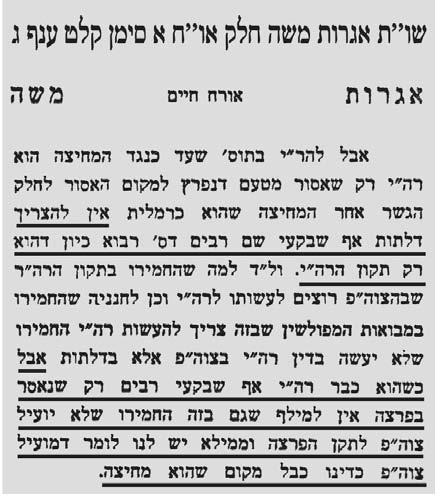
4) Some try to debase my above clarification of Rav Moshe’s shitos claiming that it’s not possible that Rav Moshe allowed a tzuras hapesach to demarcate an area containing less than shishim ribo in Kew Garden Hills because a reshus harabbim cannot be delineated with a tzuras hapesach.

They are mistaken. Rav Moshe is not the only one to maintain as such. There are Rishonim and Achronim who posit that a tzuras hapesach can demarcate an area containing less than shishim ribo (see Tosfos Rid, Eruvin 22a; Or Zarua, Eruvin 22a; Rav Yonasan Stief zt”l in Mahari Stief, siman 68; Rav Chaim Michoel Dov Weissmandel zt”l in Toras Chemed, p. 93, and Rav Elya Meir Bloch zt”l in Kol Tzvi number 7).

5) It’s important to note that, in the end, Rav Moshe objected to a Brooklyn eruv not because of his gezeirah but because he was led to believe that while Brooklyn’s population is actually somewhat less than three million there were over a million people who came into Brooklyn to work and visit (see the teshuvah below). Thus, the total population of Brooklyn would be much greater than three million, and the prohibition to establish one is no longer a matter of a gezeirah, but of a d’Oraysa.
שו"ת אגרות משה אורח חיים חלק ד סימן פח
אבל עתה נודענו במפה שניתן מהעיריה (הסיטי) ונמצא שכל ברוקלין הוא רק י"ב מיל על י"ב וקצת יותר ודרים שם בקביעות קרוב לשלשה מיליאן ועוברים ושבים ממקומות אחרים למסחר ולהתראות עם קרובים ולעבודה קבועה קרוב למליאן שא"כ יש ממש יותר הרבה מס' ריבוא ברחובות שודאי בהי"ב מיל על י"ב מיל יש ג"כ יותר מס' ריבוא, ולהשוות בריבוע הוא בהכנסת מקצת מנהעטן שנכנס שם האיסט סייד שהוא גם וואל סטריט וסיטי האל והסביבה שהוא עוד איזה מיליאנים, אבל כיון שמופסק בהנהר אין לצרף זה לברוקלין ולכן נחשב כמעט כל ברוקלין שג"כ איכא הרבה יותר מס' ריבוא וא"כ הוא רה"ר דאורייתא דודאי אין לתקן עירובין מדינא
However, this is obviously incorrect. The number of people who actually commute into the borough to work is approximately 235,000 people (NYC Department of City Planning, Table CTPP P-6, 2003); thus, the total falls far short of the required three million. Had Rav Moshe known these facts, he would concur that Brooklyn does not have the status of a reshus harabbim of shishim ribo.

6) Finally, it’s important to note that Rav Moshe’s gezeirah was not thought of as a reason in and of itself to negate eruvin. Both Brooklyn and Chicago have a population of approximately 2.5 million people over a twelve mil by twelve mil area. Despite this number of people, Rav Dovid Feinstein shlita agreed that, according to his father, an eruv could be established in Chicago (West Rogers Park Eruv, 1993 p. 23). This gezeirah was not considered a serious enough issue to impede the construction of an eruv in Chicago and should not interfere with an eruv in Brooklyn either.

Rav Moshe Feinstein Zt”l: A New Discovery, Part 1

The following background information is necessary reading before I discuss my new discovery in part two.

Those who read my blog know I have consistently argued that there are three reasons according to Rav Moshe Feinstein zt”l why the current Brooklyn eruvin would be allowed:
1) The population of a twelve mil by twelve mil area in Brooklyn, including the people who commute into the borough to work, is less than the three million inhabitants required by Rav Moshe.
2) Even if the total population of Brooklyn would be more than three million, since the tzuras hapesachim erected in our neighborhoods encircle a population of less than shishim ribo, Rav Moshe would have allowed an eruv to be erected in our neighborhoods in Brooklyn.
3) Even if Brooklyn would have a population of three million and the eruv would encircle more than shishim ribo, since there are mechitzos encompassing Brooklyn, Rav Moshe would definitely have allowed an eruv to be erected in any neighborhood in Brooklyn, without the need for delasos at the pirtzos.

While I have discussed and expounded on all three of the above premises, people always argue that reason number two is the weakest of all my rationales, being that Rav Moshe did not elucidate that a tzuras hapesach can demarcate an area of less than shishim ribo. I strongly disagree because this underlying principle is the only rationale that neatly sums up Rav Moshe’s shitos in eruivn, and there is no other coherent explanation why Rav Moshe allowed the eruvin in Queens and Detroit and why it mattered to him that both Boro Park and Flatbush independently contain a population greater than shishim ribo.

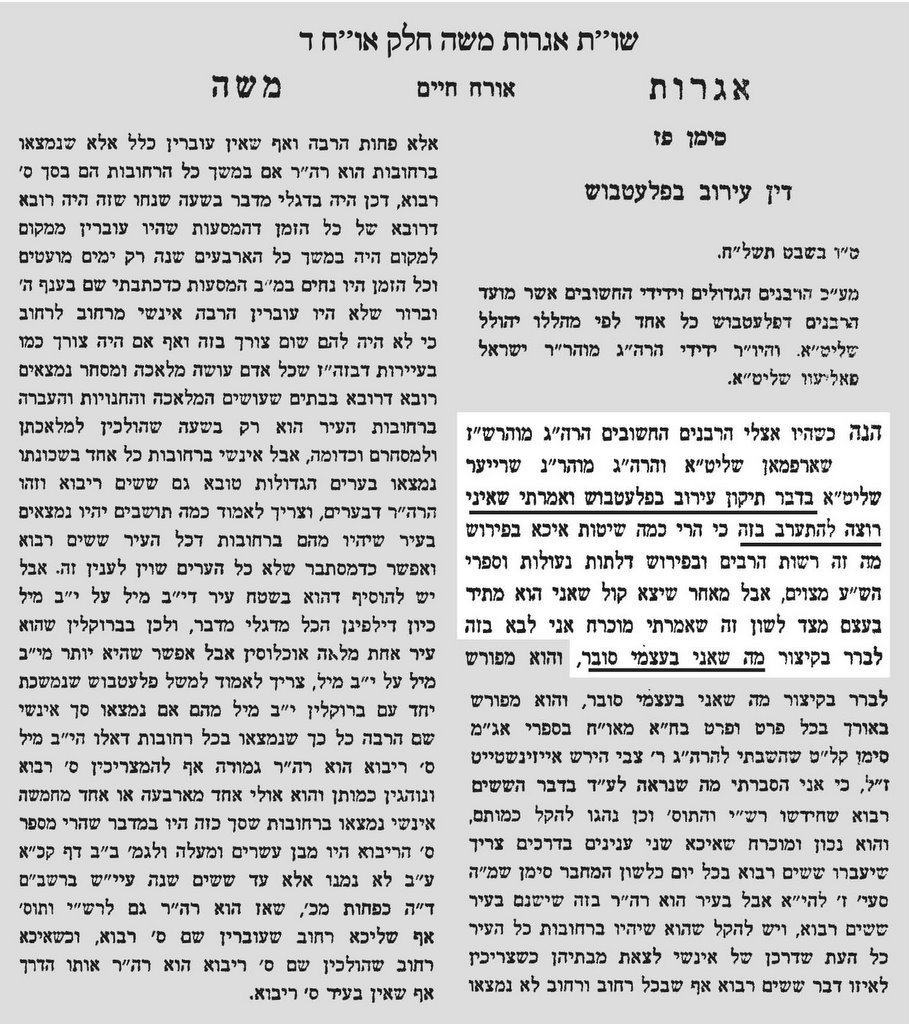
Regarding Kew Garden Hills, Queens, Rav Moshe wrote:
שו"ת אגרות משה אורח חיים חלק ד סימן פו

הכשר העירוב בקיו גארדענס הילס, ט' ניסן תשל"ד, מע"כ ידידי הרה"ג מוהר"ר פרץ שטיינבערג שליט"א

הנה בדבר העירוב אשר תיקן כתר"ה סביבות קיו גארדענס הילס והיה זה בהסכם כל הרבנים אשר בקיו גארדענס הילס ונעשה זה באופן שלא נכנס הדרך הכבושה לרבים הנקרא היי וויי וגם נעשה באופן שהחששות ליפסל ע"י איזה קלקול הם רחוקים מאד וגם העמידו משגיח שיראה בכל ערב שבת קדש, הנני רואה בזה תועלת גדולה והצלה ממכשול בשוגג ובמזיד, ואין דומה כלל לנוא יארק שלא היה זה ברצוננו ורצון הגאון ר' אהרן זצ"ל ועוד גדולי תורה מאגוד"ר כי נוא יארק עיר גדולה מאד וכדבארתי בתשובה בספרי א"מ אבל קיו גארדענס הילס היא קטנה לענינים אלו וליכא הטעמים שכתבתי שם דלכן הוא טובה גדולה ותועלת לשמירת שבת ואני אומר שיפה עשיתם
In the same vein Rav Moshe wrote:
שו"ת אגרות משה יורה דעה חלק ג השמטה לאו"ח ח"ד סי' פ"ט

וכן לא שייך לקיו גארדענס הילס שהסכמתי להעירוב שתיקנו (לעיל או"ח סי' פ"ו) שהיא עיר קטנה ודרך הכבושה לרבים הנקרא היי וועי לא הכניסו בתוך העירוב, שהוא פשוט וברור שבערים כאלו עושין צוה"פ ועירובין ולא שייך לטעות כלל
Rav Moshe wrote likewise regarding Detroit:
שו"ת אגרות משה אורח חיים חלק ה סימן כט

תיקון עירוב ליד דעטראיט, בע"ה ח' אלול תש"מ, מע"כ ידידי הנכבד מאד הרב הגאון כש"ת מוהר"ר יחזקאל הלוי גרובנער שליט"א

נתאחרתי במכתבי מחמת שנדמה לנו שכתר"ה עוד יכתוב לנו מביתו בזה, אבל כיוון שלא נתקבל יותר, אראה לכתוב רק במה שחתמו כל חברי ועד הרבנים, שהוא אם לעשות תיקון עירובין במקום שדרים רוב היהודים, שאין זה בדעטראיט שהיא העיר הגדולה שנחשבת בין הערים הגדולות, אלא בשני מקומות קטנים. ואף שבמכתב מיום ד' מנ"א שחתמו כולם לא הוזכר זה, אבל כתר"ה אמר לי זה אשר כמעט כל היהודים ובפרט שומרי תורה דרים כולם בשני מקומות הקטנים, שכל הציבור הוא פחות ממאה אלף …אבל עתה שהנידון הוא על שני מקומות שביחד יש שם פחות ממאה אלף תושבים, וגם עוברים ושבים ממקומות אחרים אין שם אלא מעט
For those who believe that Rav Moshe would never allow an eruv in Brooklyn, the Kew Gardens Hills teshuvah is the most disquieting of all of Rav Moshe’s eruvin teshuvos.

Rav Moshe argues that Kew Gardens Hills is a small town in comparison to Manhattan, thus he allowed an eruv there. However, Rav Moshe’s main thesis in eruvin was that we examine an area of twelve mil by twelve mil, and if the area contains a population of three million (see Part 2: Shishim Ribo According to Hagaon Rav Moshe Feinstein zt”l ), an eruv cannot be erected in any part of it (Igros Moshe, O.C. 1:139:5, 4:87-88). Kew Garden Hills is part of the twelve mil by twelve mil area of Queens just as Boro Park and Flatbush are part of the twelve mil by twelve mil area of Brooklyn. Consequentially, it follows that if an eruv can be established in Kew Gardens Hills, since the population in a twelve mil by twelve mil section of Queens is less than three million, so too can an eruv be established in a neighborhood of Brooklyn since its population is also less than three million. [Regarding not including the highways in the parameters of the eruv, there is no difference between Kew Gardens Hills and Brooklyn since highways are not included in Brooklyn’s eruvin either. Additionally, there are those who claim that the reason Rav Moshe permitted an eruv in Kew Gardens Hills was because, as he mentioned, there was a rabbinical consensus supporting an eruv. This excuse was created after the fact, because this issue did not play a major role in Rav Moshe’s thinking. Had the position of all the other rabbanim been a vital consideration, Rav Moshe would not have allowed the Manhattan rabbanim to do as they saw fit and establish an eruv (ibid., 4:89 and HaPardes, 33rd year, vol. 9). Moreover, even regarding the Flatbush eruv, we see from Rav Moshe’s teshuvah (Igros Moshe, O.C. 4:87) that he did not argue with the rabbanim who erected an eruv that this issue would negate the eruv there.]

The same can be asked regarding the eruvin Rav Moshe allowed in the two Detroit neighborhoods, Oak Park and Southfield. Rav Moshe established that Detroit would be classified as a large city, but argued an eruv would be allowed since it was only encompassing two small neighborhoods. Certainly, if an eruv can be established in these Detroit neighborhoods, since the population in a twelve mil by twelve mil section of Detroit is less than three million, so too can an eruv be established in a neighborhood of Brooklyn since its population is also less than three million.

However, Rav Moshe added a caveat regarding large city eruvin:
שו"ת אגרות משה אורח חיים חלק ד סימן פח

הנה כבר בארתי בעל פה הטעם שאני סובר דאין לעשות תיקון עירובין בברוקלין אפילו בחלק אחד כהא דפלעטבוש, אף אם נימא שמשך י"ב מיל על י"ב מיל כשיתחילו למדוד מאיזה צד דתחלת העיר דברוקלין אין שם סך גדול כמספר בני ישראל שהיו במדבר על משך כזה, דהאומדנא היתה שנמצאים ברחובות בחוץ ס' ריבוא, משום דכיון דעיר גדולה כברוקלין צריך לברר מי שאומר שאין שם סך ס' ריבוא כשרוצה להתיר, דהא הרבה אינשי הם באומדנא שיש בברוקלין בכל חלק כזה די"ב מיל על י"ב מיל ס' ריבוא ויותר מאחר דכמובן הבתים גדולים שיש בתים דהרבה קומות בעלי ארבע וחמש ושש שהם כמעט רוב הבתים ואף הנמוכים הם בעלי שתים ושלש ונמצאים גם בתים גבוהים ביותר ומגיעין גם לבעלי עשרים קומות, נגד מחנה ישראל במדבר שהיו באהלים שהוא רק אהל בקומה אחת על הקרקע, שלכן אף שהרחובות הם רחבים ערך פי שנים מרחובות דבמדבר שהיו רק ט"ז אמה מ"מ הוא לפי אומדנא דסתם אינשי שהם יותר מכפי שהיו במדבר במשך שטח זה, שלכן אם הוא פחות לענין המציאות צריך לברר זה, ומכיון שצריך לברר זה אף שהאמת הוא שאין שם ס' ריבוא וגם אפשר לברר זה, הרי ודאי רובא דרובא מאינשי לא ידעו מברור זה לא רק מעלמא אלא אף הדרים כאן לא ידעו זה ויאמרו דמותר לעשות תיקוני עירובין דצורת הפתח ברה"ר גמור דיש שם ס' ריבוא ויותר ויבא לקלקולא

וזה אמרתי אף כשאמרו לי שלפי ידיעה הברורה אין במשך י"ב על י"ב מיל ס' ריבוא בברוקלין, והוא טעם לאסור על כל כרכים ששייך לאמוד לסתם אינשי שיש שם ס' ריבוא ברחובות מחוץ להבתים, דאפילו אם האמת שלאחר הברור נתברר שאין שם ס' ריבוא אין לתקן עירובין דרובא דאינשי אין יודעין הברור
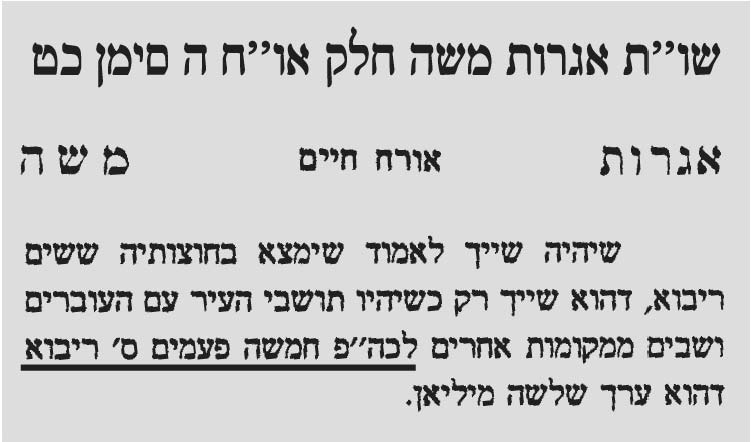
Rav Moshe reiterates the above in his Detroit teshuvah:
שו"ת אגרות משה אורח חיים חלק ה סימן כט

אם לעשות תיקון עירובין במקום שדרים רוב היהודים, שאין זה בדעטראיט שהיא העיר הגדולה שנחשבת בין הערים הגדולות, אלא בשני מקומות קטנים. ואף שבמכתב מיום ד' מנ"א שחתמו כולם לא הוזכר זה, אבל כתר"ה אמר לי זה אשר כמעט כל היהודים ובפרט שומרי תורה דרים כולם בשני מקומות הקטנים, שכל הציבור הוא פחות ממאה אלף. ותמוה שעיקר כזה לא הוזכר בהמכתב, אבל זהו עכ"פ המציאות … והנה בשנה העברה כתבתי לפלעטבוש (ונדפס באג"מ אורח חיים חלק ד' סוף סימן פ"ח) אשר פשוט שבערים גדולות ששייך לאינשי לחשוב שיש שם שישים ריבוא בחוצותיה, אף שלפי האמת נודענו משלטונות (אפיס) העיר ומהמשטרה (פאליס) דהעיר שאין שם מספר כזה, אין לתקן שם עירובין, דהא אתי לתקלה, דהא רובא דאינשי אין יודעין הבירור. ומהאי טעמא לא היה אפשר בדעטראיט לתקן שם עירובין, כי היא נחשבת בין ערים הגדולות שיושביה עולה למיליאנים. אף שלפי האמת שמעתי שאינה כל כך גדולה, שיהיה שייך לאמוד שימצא בחוצותיה ששים ריבוא, דהוא שייך רק כשיהיו תושבי העיר עם העוברים ושבים ממקומות אחרים לכה"פ חמשה פעמים ס' ריבוא דהוא ערך שלשה מיליאן. מ"מ אין לתקן שם עירוב מאחר דיש הרבה שיאמרו באומדנא שלהם שהיא גדולה עד שוודאי איכא ששים ריבוא. וכן הוא בכל ערים הגדולות ששייך לאינשי לאמוד שאיכא ס' ריבוא … אבל עתה שהנידון הוא על שני מקומות שביחד יש שם פחות ממאה אלף תושבים, וגם עוברים ושבים ממקומות אחרים אין שם אלא מעט, ולא שייך לשום אדם לטעות כלל על יותר מכ"ה או שלשים אלף, שא"כ הוא ידוע ומפורסם שאין שם רה"ר, ואין לחוש לשום תקלה כשיתקנו שם עירובין שיבואו לתקן גם בערים גדולות
In these teshuvos, Rav Moshe added to his chiddushim in eruvin that even if a large city’s population is less than three million, an eruv should not be constructed since one may think that there is shishim ribo over a twelve mil by twelve mil area [clearly, this prohibition is no longer a matter of a d’Oraysa, but only of a gezeirah]. Consequentially, even after Rav Moshe was told that the total population of Brooklyn was somewhat less than three million, he argued that an eruv should not be established because of this gezeirah. Rav Moshe declared the same regarding Detroit, a city with a population of approximately 1.2 million (in 1980, at the time this teshuvah was written). Despite the fact that the population was only 1.2 million, Rav Moshe maintained that an eruv should not be established for the city of Detroit proper because of this gezeirah (as opposed to the two small neighborhoods where he did allow, see further).

Why then did Rav Moshe allow eruvin in Kew Garden Hills, Queens; Oak Park and Southfield, Detroit? A careful reading of the above teshuvos illuminates the basis for why Rav Moshe allowed these eruvin. Rav Moshe argued that these neighborhoods were only small sections of their respective cities and so they would not be mistaken as a reshus harabbim of shishim ribo.

This concept is reiterated in the following teshuvah:
שו"ת אגרות משה אורח חיים חלק ה סימן כח

ומווארשא שעשו שם עירובין, אף שהיה כרך גדול ידוע לפי חשיבות כרכים גדולים שברוסלאנד ופולין, לא היו בה ס' ריבוא ברחובות שהוא רק בעיר שדרים בה ערך קרוב לשלשת מיליאן נפשות. ובווארשא לא היו שם כל כך אינשי ואף המחצה מזה לא היו שם. ועוברים ושבים ג"כ לא היו כל כך שישלימו המספר. ובשאר הכרכים לא היו עירובין, אלא בחלק קטן בהעיר מקום שדרו שם רוב היהודים ושם לא היו ס' ריבוא
Rav Moshe states here that the reason why eruvin could be allowed in Europe (according to his chiddushim) was because the eruvin were only established in the Jewish quarters which were only a small section of the city and did not contain shishim ribo. Apparently, Rav Moshe considered the eruv, in and of itself, a separation of the shishim ribo. Consequentially, Rav Moshe was not concerned about the possibility that a twelve mil by twelve mil section of Queens, which includes Kew Gardens Hills, might be classified as a reshus harabbim, even though Queens ― like Brooklyn ― had a population of well over 2 million. The important issue was that in Kew Gardens Hills, a neighborhood in Queens, they were dividing only a part of Queens, which contained less than shishim ribo with a tzuras hapesach. This is clearly confirmed by Rav Moshe regarding the Detroit neighborhoods. Rav Moshe explicitly stated that his reason to allow an eruv there was because the two neighborhoods that were demarcated contained a population of much less than shishim ribo so no one would mistake them as a reshus harabbim. [Lately, some claim that Rav Moshe only allowed the delineation of these neighborhoods when the cities in question were not a matter of a d’Oraysa but only a gezeirah. Since Brooklyn’s population would classify it as a reshus harabbim, they argued that a neighborhood therein could not be delineated. This explanation was fabricated post facto and is false. In fact, when Rav Moshe allowed the eruvin in Queens and in Europe to be demarcated with a tzuras hapesach, he did not argue that since these cities are not an issue of a d’Oraysa (but only of a gezeirah) an eruv can be established. No doubt, even if these cities would have been a matter of a d’Oraysa, Rav Moshe would also have allowed them to be delineated with a tzuras hapeasch, and Brooklyn should be no different. Besides for which, Brooklyn is not a reshus harabbim to begin with since its population does not meet Rav Moshe’s requirement for shishim ribo, and an eruv could only be proscribed because of his gezeirah. Consequentially, since these neighborhoods in Brooklyn contain a population fewer than shishim ribo, they would be able to be delineated with an eruv, as well.]

This leaves us with the obvious question, why then didn’t Rav Moshe allow an eruv to demarcate Boro Park or Flatbush?

The following two Brooklyn eruvin teshuvos clarify this conundrum:
שו"ת אגרות משה יורה דעה חלק ג השמטה לאו"ח ח"ד סי' פ"ט

אבל על ברוקלין שתלוי בדין הס' ריבוא אם נמצאו בשטח דלא יותר מי"ב מיל על י"ב מיל וכיון שנתברר שפלעטבוש יש שם הרבה יותר אף שהוא עוד על שטח הפחות מי"ב על י"ב מיל וכן בארא פארק הוא אסור מדינא בלא דלתות.

שו"ת אגרות משה אורח חיים חלק ה סימן כח

אבל ברוקלין, הא כל חלק חשוב כמו פלעטבוש ובארא פרק וכדומה הם רה"ר בפ"ע, דיש בכל אחד על משך שעוד פחות מי"ב על י"ב מיל ס' ריבוא. שאף אם שייך לחלקם לשני מקומות חלוקין, הוי כל אחד בפני עצמו רה"ר דס' ריבוא
From these two teshuvos we see that the difference between Boro Park and Flatbush as opposed to the other neighborhoods where Rav Moshe allowed eruvin — Kew Garden Hills, Queens; Oak Park and Southfield, Detroit; and the Jewish quarters in Europe — was because Rav Moshe was led to believe that independently Boro Park and Flatbush have populations greater than shishim ribo; therefore, an eruv could not demarcate these Brooklyn neighborhoods. On the other hand, in those neighborhoods where Rav Moshe allowed an eruv, the population was less than shishim ribo. [Rav Moshe states that while each one of these Brooklyn neighborhoods encompasses an area less than twelve mil by twelve mil, nevertheless, they contain a population greater than shishim ribo. Conversely, Rav Moshe affirmed that Brooklyn includes an area of more than twelve mil by twelve mil (ibid., 4:87-88). Consequently, these teshuvos must indicate that each neighborhood independently has shishim ribo and not just the whole of Brooklyn.]

However, Rav Moshe was obviously misled since the area included in the Boro Park and Flatbush eruvin contains a population considerably less then shishim ribo (approximately 100,000 and 200,000 respectively − NYC Department of City Planning, Community District Profiles, 2002). Consequentially, no one would mistake that these neighborhoods are a reshus harabbim. Had Rav Moshe known these figures, he certainly would have agreed to an eruv of tzuras hapesachim for these Brooklyn communities, just as he allowed that an eruv in Kew Gardens Hills, Queens; Oak Park and Southfield, Detroit; and the eruvin for European communities set them off from their respective cities.

Wednesday, July 08, 2009

In Light of New Evidence: Revisiting Brooklyn’s Kol Koreis

The following letter that Rav Moshe Feinstein zt”l wrote to Rav Shalom Yehuda Berman of the Lincoln Square Synagogue should put to rest the claim that kol koreis (especially those regarding eruvin) carry any weight at all. The fact that in this correspondence Rav Moshe declared that even in Manhattan ― where he signed the kol korei opposing the eruv[*] ― Rav Shimon Eider zt”l does not need to follow his opinion and can establish an eruv is proof that Rav Moshe never subscribed to the rhetoric of these kol koreis. How much more so regarding Brooklyn where Rav Moshe did not sign the kol koreis at all (see The 1979 Flatbush Kol Korei Exposed and The 1981 Boro Park Kol Korei Exposed) would Rav Moshe have allowed an eruv to be established. [I would add that if Rav Moshe would have known the facts on the ground, he would have even agreed to the eruvin in Brooklyn in their present construction.]

My apologies for the quality of the scan. As of yet, I have not been able to obtain a better copy of this letter.
_____________________________
[*] The only support that Rav Moshe signed this kol korei is the addendum to Igros Moshe, (vol. 6) O.C. 4:89. The fact that this is the only addendum in any volume of Igros Moshe makes it somewhat questionable.

Friday, July 03, 2009

Kol Koreis Versus Rav Moshe Feinstein Zt”l’s Teshuvos

I frequently hear Rav Moshe Feinstein zt”l’s opinion regarding Brooklyn eruvin being cited by those who have, unfortunately, gleaned their information from the Boro Park (1981) and Flatbush (1979) kol koreis and not from Rav Moshe’s copious teshuvos. Therefore, I feel that there is a need for the following reposting of Rav Moshe’s opinion as articulated in his teshuvos. I hope that the public will concur that the teshuvos supersede any kol korei.

Interestingly, of all the instances where Rav Moshe was asked for a p’sak, eruvin is probably the only issue where he did not want to prohibit something solely on the basis of his own chiddush. The only actual p’sak regarding eruvin issued by Rav Moshe were those in favor of erecting an eruv, in communities such as Sea Gate, Kew Gardens Hills and Detroit (Igros Moshe, O.C. 2:89-90, 4:86, 5:29). Yet in instances when he personally was against the establishment of an eruv and he was asked for a p’sak on the matter such as in Flatbush, Rav Moshe not only avoided giving a p’sak he even declined to state his personal conviction (ibid., 4:87; see the teshuvah below). Rav Moshe declared, “I do not want to join you in this matter [of eruvin], because there are many opinions on this topic, as we see in the Shulchan Aruch.” It is along this same line of reasoning that Rav Moshe zt”l told Hagaon Rav Tuvia Goldstein zt”l ― even after the 1979 Flatbush kol korei was published ― that, not withstanding his opinion of the matter, if the rabbanim of Flatbush wanted to erect an eruv they could do as they saw fit.

However, at the time, there was a misunderstanding concerning Rav Moshe’s personal conviction, and some people mistakenly supposed that he was even in support of an eruv (see the teshuvah below); hence, Rav Moshe stated that he needed to clarify his opinion (ibid., 4:87-88). Even when illuminating his position, which he considered to be “l’dinah,” Rav Moshe did not want to issue a p’sak since, as he wrote, his chiddush was not mentioned in the Achronim, and moreover the Aruch HaShulchan would not agree with him. It is important to note that both these teshuvos (ibid.) were written to the same people, and the second one was just a clarification of the first and was not written as a p’sak to prohibit the eruv. In the first teshuvah (ibid., 4:87) Rav Moshe explained his chiddush that in order for there to be shishim ribo traversing the streets over a twelve mil by twelve mil area there would need to be approximately three million people living in the area (see Three Million: More or Less?). However, after Rav Moshe was told that there were fewer than three million people living in Brooklyn, he expounded on his chiddush in a second teshuvah adding that he would still not be in favor of an eruv in a large city since some might think that there was shishim ribo traversing its streets (ibid., 4:88). At the conclusion of this teshuvah, Rav Moshe declared that since he was now told that Brooklyn’s population was nearly three million and that there was almost a million people who come into Brooklyn to work daily, “me’dinah” an eruv cannot be established. In both teshuvos, “me'dinah” only refers to Rav Moshe’s personal opinion.

Regarding the Boro Park eruv, a similar sequence of events occurred when Rav Menashe Klein shlita asked Rav Moshe to issue a p’sak whether he could erect an eruv. Rav Moshe answered that he could do as he saw fit (Oim Ani Chomah, p. 266). Just as in Flatbush, this was misunderstood to mean that Rav Moshe would support an eruv. Therefore, Rav Moshe felt a need to clarify his personal opinion regarding this matter (Igros Moshe, O.C. 5:28:20). In both Boro Park and Flatbush, Rav Moshe’s teshuvos were written in reaction to the public’s misunderstanding of his personal opinion regarding eruvin and not as a p’sak. [Regarding Rav Moshe’s signature on the kol koreis which prohibited the Boro Park and Flatbush eruvin, see The 1979 Flatbush Kol Korei Exposed and The 1981 Boro Park Kol Korei Exposed.]

On the other hand, when Rav Tzvi Eisenstadt zt”l asked the rabbanim of Manhattan for their opinions ― as opposed to their p’sak ― regarding erecting an eruv, Rav Moshe answered that in his personal opinion they should not establish an eruv (see the beginning of Igros Moshe, O.C. 1:138 which is the introduction to the Manhattan teshuvah 1:139). When Rav Moshe was asked if the rabbanim of Manhattan have a right to erect an eruv, he answered that they could do as they saw fit (ibid., 4:89 and HaPardes, 33rd year, vol. 9). This follows what Rav Moshe told Rav Menachem M. Kasher zt”l, “even though I will not join you, you should finish what you started [and establish the eruv]” (Divrei Menachem, O.C. vol. 2, introduction). Only when Rav Aharon Kotler zt”l and other Roshei Yeshivos made a takanah not to erect an eruv in Manhattan did Rav Moshe join them and prohibit the eruv as well (Igros Moshe, O.C. 4:86 and Addendum to O.C. 4:89) ― this takanah was only about Manhattan and not Brooklyn; see The 1979 Flatbush Kol Korei Exposed. Even when Rav Moshe signed on the 1962 takanah with Rav Aharon Kotler, we see that he was not at ease with the language which stated that, “those who rely on the eruv in Manhattan are considered a mechalel Shabbos,” since after he quoted this takanah in his teshuvah, he omitted this last line (ibid., Addendum to O.C. 4:89).

Given that Rav Moshe, despite his personal convictions, never issued a p’sak for others against erecting eruvin, we can possibly understand why Rav Moshe stated (ibid., 3:94, 5:19, 5:24:10) that we rely on the heter of shishim ribo in all cities ― including Brooklyn and Manhattan ― since he did not want to employ his chiddush as a p’sak din barur (see also Rav Moshe zt"l and the Walking Stick).

Following the above, besides for the speciousness of the kol koreis, those who nonetheless want to follow the kol koreis have no right to impose their misguided personal opinions on others. [If there is a need for eruvin today according to Rav Moshe, see Rav Moshe Feinstein zt”l: The Need For Eruvin]

i
i

The teshuvah above confirms that Rav Moshe never issued a p’sak opposing an eruv in Flatbush but only stated his personal opinion since he recognized that his chiddush was not mentioned in the Achronim and that the Aruch HaShulchan did not agree with him.

Wednesday, June 13, 2007

Rav Moshe Feinstein zt”l: The Need For Eruvin

Theories abound as to what Rav Moshe Feinstein zt”l’s shitos were regarding eruvin. There are many arguments set forth by people that purport to explain exactly what Rav Moshe proposed. Invariably, they fail in their attempt because they contradict Rav Moshe’s teshuvos. In truth, these interpretations are unnecessary since Rav Moshe expressed his views very clearly in his teshuvos.

For example, some argue that not only did Rav Moshe not consider the establishment of a contemporary eruv a mitzvah, but they continue that even when Rav Moshe did allow the construction of an eruv, he believed that one should not carry. Therefore, I have set out to clarify what Rav Moshe’s true beliefs are.

שיטת האג"מ בענין המצוה והשתדלות לעשות עירוב

לשון השו"ת אגרות משה חלק או"ח ה סימן כח אות כא-כב:

יש צורך לתקן עירובין, אף שוודאי אינו צורך כל כך כמו שהיה ביוראפ. אבל לעומת זה איכא צורך להיפוך, דהרי בשביל זה לא ידעו כלל שאיכא איסור הוצאה וכו', שא"כ כשע"י זה שיתקנו בעירובין כל הערים הרי ישכחו שאיכא איסור הוצאה בעולם, דהא בכרכים גדולים אין עושין צוה"פ ממש שיכירו כל אדם וכו', ואף אם באיזה מקום יצטרכו לצורת הפתח מיוחדת, לא יזדמן לראות זה אלא איזה יחידים וכו', ואף שאנן לא גזרינן יותר ממה שאיתא בגמ' ובדברי הגאונים, מ"מ אין לומר שהוא מעלה ומצוה כשאיכא חסרון זה וכו'.

והתיקון שיש בעירוב למחללי שבת במזיד בפרהסיא וכו', אולי בשביל אלו שאין יודעין כלום, דרשעותן ואף הכפירה שלהן בא להם מצד שחנכום כן אבותיהם הרשעים, יש איזה מעלה ואולי גם מצווה לתקן עירובין, שלא יעברו גם על איסור הוצאה שבידינו למנוע אותו בתיקון העירובין, מאחר שיש לדונו כשוגג. אף שאינו שוגג ממש, דאף שאביו חנכו לרשעותו ולכפירתו, הא עכ"פ רואה ויודע משומרי תורה ומצוות, ויודע שאיכא גדולים ובעלי דעת וחכמה יותר מאביו, שלכן נוטה יותר לומר שליכא חיוב למונעו מעבירה.


לשון שו"ת אגרות משה חלק או"ח ה סימן כט:

והנה הא דמצינו בגמ' עירובין דף ס"ח ע"א (א"ל רבה בר רב חנן וכו') דאיכא חיוב על חכמי העיר לתקן שיוכלו לטלטל בעיר, וכן היו בכל עיירות שהיו נמצאים יהודים היו מתקנין עירובין, אמרתי שהיה זה במקומותינו שלא היה אפשר בלא זה וכו', וגם בערים גדולות היה זה דבר קשה, שלכן היו גם ערים גדלות שהיו מתקנים עירובין. אבל כאן בזמנינו שאין שום צורך וכו', שלכן אין תיקון עירובין דבר נחוץ, אלא רק לאטפויי הנאה בעלמא, אין זה ענין הצריך להשתדל בזה.

ואף שהוא דבר טוב בעוה"ר שאיכא הרבה עוברי עבירה, שתיקון העירובין ימעט האיסורין, ליכא חיוב להפריש בשביל מומרים במזיד וכו', ושוגגים שאין יודעין האיסור אין מצויין ואולי גם ליכא.

ולעומת זה איכא חסרון בתיקון עירובין שירגילו להוציא, ולפעמים שיתקלקל בשבת ולא יוכלו להודיע ויכשלו שומרי תורה.

אבל בשנים האחרונות התחילו לתבוע שיתקנו עירובין, מחמת שהנשים מצטערות הרבה בזה מפני שמניעת הנאה הוא צער גדול להם, מפני הרגילות להיות מפונקות. ואלו שיש להם תינוקות אין יכולין לצאת מהבית כל השבת וכדומה. ויש גם שאין יכולות להבליג על דעתן ורצונם, ועוברות. והתחילו בשביל זה בכמה מקומות לתקן עירובין. ושייך להחשיב כשאיכא הרבה תובעין, לצורך, ויש אולי מקומות ששייך להחשיב גם צורך גדול, ושייך להרב המקומי לידע זה. וא"כ וודאי לא שייך למחות, ואולי יש גם להשתדל בזה וכו'.

שלכן אם רוב הרבנים יודעים מקהילותיהם שרוצים ותובעין שיתקנו עירובין, שנמצא שהוא צורך גדול, יש גם להשתדל לתקן עירובין.


לשון האגרות משה חלק או"ח ד סימן פו :

הכשר העירוב בקיו גארדענס הילס וכו', הנני רואה בזה תועלת גדולה והצלה ממכשול בשוגג ובמזיד וכו', דלכן הוא טובה גדולה ותועלת לשמירת שבת,ואני אומר שיפה עשיתם.


סיכום:

א) בכל תשובותיו מיירי רק לענין אם יש מצוה להשתדל לעשות עירוב.

ב) בסימן כ"ח לא ברירא ליה שלא לעשות עירוב, דהא יש תיקון למחללי שבת "בשביל אלו שאין יודעין כלום", רק ד"נוטה יותר לומר שליכא חיוב למונעו מעבירה".

ג) בסימן פ"ו כותב בברירות: "הנני רואה בזה תועלת גדולה והצלה ממכשול בשוגג ובמזיד וכו', דלכן הוא טובה גדולה ותועלת לשמירת שבת, ואני אומר שיפה עשיתם".

ד) גם בסימן כ"ט כתב דכשאיכא הרבה תובעין נחשב לצורך, "ויש אולי מקומות ששייך להחשיב גם צורך גדול, ושייך להרב המקומי לידע זה, וא"כ וודאי לא שייך למחות, ואולי יש גם להשתדל בזה", וסיים: "שלכן אם רוב הרבנים יודעים מקהילותיהם שרוצים ותובעין שיתקנו עירובין, שנמצא שהוא צורך גדול, יש גם להשתדל לתקן עירובין". וידוע דרוב מורי ההוראה בשכונות בארא פארק חשבו זה לצורך גדול מחמת כמה וכמה טעמים.

ה) וכל השקו"ט בתשובותיו הנ"ל הם רק לענין לכתחלה, אבל עירוב שכבר נעשה וכשר להלכה, לא כתב בשום מקום שלא יטלטלו בו משום ספיקותיו. ואדרבה לגבי דעטראיט וסיגעיט וקיו גארדענס כתב מפורש לעשות עירוב, ולא כתב בשום מקום שבעל נפש יחמיר שלא יטלטל בעירוב כשר.


In Summation:

From the above, it appears that Rav Moshe would agree that if the rabbanim uphold that there is a great need for an eruv, they should strive to establish one. More so, there is no doubt that Rav Moshe would concur that if an kosher eruv is established, one can carry therein, and nowhere do we see that Rav Moshe states that a baal nefesh should be stringent.

Monday, May 08, 2006

Part 4c: The Permissibility of a Brooklyn Eruv According to Rav Moshe Feinstein zt”l

Continued from part IVb

The only issue Rav Moshe zt”l had with the Brooklyn mechitzos was that he required delasos (Igros Moshe, O.C. 5:28:5) and as stated above, since we are erecting the tzuras hapesachim in a reshus hayachid, Rav Moshe would not have required delasos. However, regarding Manhattan, Rav Moshe stated that, based on additional shitos yechidaos (shitas haRashbah and Rabeinu Ephraim), even with mechitzos and delasos at the pirtzos, Manhattan would not be classified as a reshus hayachid (ibid., 1:39:5-6).

Even these shitos yachidaos would not affect an eruv in a Brooklyn neighborhood for the following reasons:

  • Rav Moshe only utilized these shitos in conjunction with his chiddushim regarding delasos and the similarities he noted between Manhattan and Yerushalayim (see Yerushalayim of Old and Brooklyn: A Common Thread?) to nullify the benefit the mechitzos surrounding Manhattan would have provided (ibid., 1:39:6). However, since Rav Moshe would concur that delasos are not necessary when a tzuras hapesach is established in a reshus hayachid and the issue of Yerushalayim does not concern us in Brooklyn as well (see Yerushalayim of Old and Brooklyn: A Common Thread?), there is no question that Rav Moshe would have allowed an eruv in Brooklyn in its current construction. Therefore, in regards to Brooklyn’s mechitzos, Rav Moshe only refers to his requirement of delasos and not to these shitos yachidaos (ibid., 5:28:5).
  • Rav Moshe at first stated in a teshuvah regarding Manhattan (ibid., 1:140) that he was unclear whether mefulash is considered a criterion of a reshus harabbim. On the other hand, according to those who do regard mefulash as a criterion of a reshus harabbim, since the streets of Manhattan were not mefulash the mechitzos would classify Manhattan as a reshus hayachid ― or me’d’rabbanan as a karmelis. In which case, notwithstanding these shitos yachidaos, Rav Moshe allowed that delasos at the pirtzos would be the only requirement. However, in a later teshuvah regarding Brooklyn (ibid., 5:28:7) Rav Moshe does accept that for a walled city to be classified as a reshus harabbim there is a requirement that its streets ― to be analogous to the diglei hamidbar ― would need to be mefulash u’mechuvanim m’shaar l’shaar, a criterion of a reshus harabbim (see Part 1: Why Brooklyn Is Not a Reshus HaRabbim). [This is contrary to Rav Aharon Kotler’s zt”l’s understanding of the criterion mefulash u’mechuvanim m’shaar l’shaar as being dependent solely on mechitzos and not a criterion of a reshus harabbim (see Mishnas Rav Aharon, 6:2).] Therefore, given the fact that Brooklyn is enclosed by mechitzos and its streets are not mefulash u’mechuvanim m’shaar l’shaar, Brooklyn would not be classified as a reshus harabbim at all, and Rav Moshe would agree, that these mechitzos would classify Brooklyn as a reshus hayachid, notwithstanding these shitos yachidaos. Consequently, in regards to Brooklyn, Rav Moshe only mentions that there is a requirement of delasos if Brooklyn is enclosed by mechitzos (Igros Moshe, O.C. 5:28:5). However, as explained previously, since we are erecting a tzuras hapesach only around a section of Brooklyn, delasos would not be required as well.

Thursday, April 27, 2006

Part 4b: The Permissibility of a Brooklyn Eruv According to Rav Moshe Feinstein zt”l

Continued from part IVa


Does Brooklyn Require Delasos at Its Pirtzos


At first Rav Moshe zt”l questioned if Brooklyn had mechitzos at all, adding that even if Brooklyn was surrounded by mechitzos, delasos would be required at the pirtzos (Igros Moshe, O.C. 5:28:5).

Rav Moshe maintained (ibid., 1:139:3) that even if an area such as a walled city ― which is classified me’d’Oraysa as a reshus hayachid ― has pirtzos which are open to an unenclosed area containing shishim ribo, these pirtzos would nevertheless require delasos, me’d’rabbanan. This requirement is Rav Moshe’s own chiddush. [On the contrary, the Shulchan Aruch HaRav (364:4); Bais Ephraim (O.C. 26); Bais Meir (O.C. 364:2); Mishnah Berurah (364:5), and the Achiezer (4:8) maintain that only when the area meets all the classifications of a reshus harabbim is there a requirement of delasos.]

Rav Moshe mentioned this originally about Manhattan which had shishim ribo and nevertheless was classified, me’d’Oraysa, as a reshus hayachid because it was enclosed by mechitzos ― sea walls that encompassed the island. Since Rav Moshe had seen Rav Tzvi Eisenstadt zt"l's teshuvah he knew that there were some pirtzos in the Manhattan mechitzos (Kuntres Tikkun Eruvin Manhattan, pp. 68, 168-69; Divrei Menachem, O.C. vol. 2, p. 76; Rav Tzvi Eisenstadt in his Hatzaah L’Tikkun Eruvin B’Manhattan, and in his recently published sefer Minchas Tzvi, siman 4). Nevertheless, because Manhattan is an island, the pirtzos opened to the water, which obviously did not contain shishim ribo, and therefore posed no problem to Rav Moshe since a tzuras hapesach would then be adequate. However according to Rav Moshe’s chiddush, the bridges leading from Manhattan ― which were open along their sides ― possibly would have needed to be rectified with delasos. Rav Moshe questioned (Igros Moshe, O.C. 1:139:5) whether the bridges were considered part of Manhattan, in which case the city’s population would in effect cause the bridges to be classified as a reshus harabbim and they would require delasos. Alternatively, if the bridges were not considered part of the city, but an intercity road (sratya), they would require shishim ribo crossing them in order to be classified as a reshus harabbim. As this was not the case, a tzuras hapesach would then be sufficient.

According to Rav Moshe, in a Brooklyn neighborhood, a tzuras hapesach would suffice for the following reason:
Since the tzuras hapesachim we erected in our neighborhoods are established in an area encompassed by mechitzos, the area is classified as a reshus hayachid, and the tzuras hapesachim are sufficient and delasos are not required (ibid., 1:139 see the end of anaf 3 where Rav Moshe states clearly that if the tzuras hapesach is erected in a reshus hayachid, it is sufficient; see Is There a Requirement of Delasos According to Rav Moshe Feinstein zt”l).

Monday, April 24, 2006

Is There a Requirement of Delasos According to Rav Moshe Feinstein zt”l

This teshuvah demonstrates that if a tzuras hapesach is erected in a reshus hayachid, Rav Moshe zt"l would agree that there is no requirement of delasos. Since Brooklyn is circumscribed by mechitzos and is classified as a reshus hayachid, a tzuras hapesach in any section of Brooklyn would be sufficient.

Tuesday, April 04, 2006

Part 4a: The Permissibility of a Brooklyn Eruv According to Rav Moshe Feinstein zt”l

Continued from part III


Is Brooklyn Enclosed by Mechitzos?


Rav Moshe zt”l stated (Igros Moshe, O.C. 5:28:5) regarding Brooklyn’s mechitzos, “Until now they [the mechitzos] did not exist but that one can investigate” (see also ibid., Addendum to O.C. 4:89).

These are the facts:
That there are three mechitzos nowadays enclosing more than 95 percent of the Brooklyn waterfront, is obvious even to the most casual of observers (see Part 3: Why Brooklyn Is Not a Reshus HaRabbim). Therefore, according to Rav Moshe, Brooklyn is classified as a reshus hayachid and an eruv of tzuras hapesachim can be erected.

These mechitzos were evaluated by the following rabbanim to see whether they fulfilled Rav Moshe requirements:
Members of Rav Yechezkel Roth shlita’s Bais Din; see Emek HaTeshuvah (5:19) and Appendix 8.
Rav Shlomo Gross shlita, Belzer Dayan of Boro Park.
Rav Tuvia Goldstein zt”l sent a select group from his kollel Emek Halacha.

All were in agreement that these mechitzos exist and that they are valid mechitzos according to Rav Moshe zt"l.

Tuesday, March 28, 2006

Part 3: The Permissibility of a Brooklyn Eruv According to Rav Moshe Feinstein zt”l

Continued from part II


Does the Eruv Encompass Shishim Ribo?


Rav Moshe zt”l maintained (Igros Moshe, O.C. 5:28:5 and Addendum to O.C. 4:89) that an eruv of tzuras hapesachim was not permissible in Boro Park and Flatbush since he was led to believe that each neighborhood individually contained a population in excess of shishim ribo (see Does the Eruv Encompass Shishim Ribo?).

These are the facts:
Census figures reveal that in Boro Park the eruv includes a population of less than 100,000 people and in Flatbush a population under 200,000 people (NYC Department of City Planning, Community District Profiles, 2006). Had Rav Moshe known these figures, he certainly would have agreed to an eruv of tzuras hapesachim in these Brooklyn communities, which would set them off from their borough, just as he allowed that an eruv in Kew Gardens Hills, Queens and the eruvin in European communities set them off from their respective cities (Igros Moshe, O.C. 4:86, 5:28:5; see also Brooklyn and Queens: Same or Different?).

Monday, March 20, 2006

Part 2: The Permissibility of a Brooklyn Eruv According to Rav Moshe Feinstein zt”l

Continued from part I

Are There Three Million People in Brooklyn?

Rav Moshe zt”l maintained that the area Brooklyn encompasses is a little more than twelve mil by twelve mil and he was told that the population of Brooklyn is somewhat less than 3,000,000 (Igros Moshe, O.C. 4:87-88; see Part 1: Shishim Ribo According to Hagaon Rav Moshe Feinstein zt”l). He nevertheless maintained that Brooklyn has the status of a reshus harabbim d’Oraysa because he was led to believe that nearly a million people come into the borough to work (ibid., 4:88).

These are the facts:
The US Census Bureau (Census 2000 Summary File 1) reported the population of Brooklyn in the year 2000 as being 2,465,326 people, which is much fewer than the population required by Rav Moshe. How much more so if we were to focus only on a twelve mil by twelve mil area and not the entire Brooklyn, the population would be significantly less than the number required by Rav Moshe. Additionally, even if one were to factor into the population the number of people who actually commute into the borough to work [235,918 people], the total never comes close to the required 3,000,000 people. Even more so, at the same time there are more people who commute out of Brooklyn to work [424,107 people]; thus, the total falls far short of the required 3,000,000 (NYC Department of City Planning, Table CTPP P-6, P-7, 2003). Had Rav Moshe known these facts he would concur that Brooklyn does not have the status of a reshus harabbim of shishim ribo.

Thursday, March 16, 2006

Does Rav Moshe Feinstein zt”l Require a Daily Shishim Ribo?

Rav Moshe zt”l maintains that according to the Shulchan Aruch (O.C. 345:7), the requirement of shishim ribo is daily (Igros Moshe, O.C. 1:139:5, 4:87, 5:28:16). Rav Moshe maintained that the Shulchan Aruch is referring to a sratya which requires that the shishim ribo traverse it daily in order that it be classified as a reshus harabbim. [This is as opposed to a city (a twelve mil by twelve mil area) where he posits that if there is a population of 3,000,000 it would support shishim ribo in its streets and then the city would be classified as a reshus harabbim (see Part 1: Shishim Ribo According to Hagaon Rav Moshe Feinstein zt”l).] Additionally, Rav Moshe states (ibid., 4:88) that although at times Brooklyn’s beaches might be host to a million people, this in itself is not reason enough to prohibit an eruv of tzuras hapesachim because he concludes that according to the Shulchan Aruch the requirement is that the shishim ribo has to traverse the streets on a daily basis (see also the end of Part 3: A Critical Analysis of Rav Yisroel Hirsch’s Critique of Eruvin in Brooklyn).

Tuesday, March 07, 2006

Part 1: The Permissibility of a Brooklyn Eruv According to Rav Moshe Feinstein zt”l

Like most poskim, Rav Moshe originally maintained (Igros Moshe, O.C. 1:109) that the criterion of shishim ribo was conditional on 600,000 people traversing the street and a tzuras hapesach would therefore be sufficient anywhere in Brooklyn. However, later (ibid., 1:139:5) he formulated his chiddush in which shishim ribo was not dependent on a street but on a twelve mil by twelve mil area [approximately 8.1 by 8.1 miles]. Rav Moshe concluded (ibid., 5:28:5, 5:29) that in order for an area this size to have 600,000 people collectively traversing its streets at the same time there would have to be five times that number, 3,000,000 people (see Part 1: Shishim Ribo According to Hagaon Rav Moshe Feinstein zt”l), living and/or commuting into the area for work. Only then would the area be classified as a reshus harabbim d’Oraysa. [The rationale underlying Rav Moshe’s zt”l’s rulings is based on the diglei hamidbar from which the halachos of domains are derived. Since the twelve mil by twelve mil encampment in the midbar included shishim ribo (600,000 men 20-60 years of age) plus women, children and elders, Rav Moshe calculated the population to be 3,000,000. As a result, Rav Moshe maintained there was shishim ribo traversing the streets of the encampment. To utilize the size of the encampment and to require a population of 3,000,000 as the basis for a reshus harabbim of shishim ribo is uniquely Rav Moshe’s own interpretation in the laws of reshus harabbim (ibid., 1:139:5, 4:87).] Therefore, if Brooklyn encompassed 3,000,000 people, a tzuras hapesach would not be adequate; dalsos would be needed.

However, if the tzuras hapesach encircled only a neighborhood in Brooklyn, it would be permissible according to Rav Moshe as long as the eruv encompassed fewer than shishim ribo, (ibid., 4:86, 5:28:5, 5:29) [see Does the Eruv Encompass Shishim Ribo] or if Brooklyn was surrounded by mechitzos (ibid., 1:139 the end of anaf 3). [According to Rav Moshe, mechitzos would classify an area as a reshus hayachid d’Oraysa. Therefore, a tzuras hapesach would be sufficient anywhere in an area included by mechitzos; a future post in this series will elaborate on this topic.]

Only when all three criteria have been realized ― that is, Brooklyn has a population of 3,000,000 and the tzuras hapesach encompasses more than shishim ribo and Brooklyn is not enclosed by mechitzos ― would it not be permissible to erect an eruv of tzuras hapesachim even around a section of Brooklyn; dalsos would be needed.

It is important to note that Rav Moshe did not set forth his chiddush as a p’sak for others since his chiddush was not stated in the Achronim and the Aruch HaShulchan did not agree with him. Only when people mistakenly supposed that he was personally supportive of the eruv did Rav Moshe feel a need to clarify that he was not in favor of one, hence his teshuvah clarifying the matter (ibid., 4:87; see Hagaon Rav Moshe Feinstein zt”l’s Reluctance to Pasken Against the Establishment of an Eruv).

Rav Moshe’s personal approach to eruvin prohibited an eruv in Boro Park and Flatbush, because it was based on information that was provided to him at the time.

That is:
Brooklyn’s population, including those who commute into the borough to work, is over 3,000,000.
Boro Park and Flatbush independently contain more than shishim ribo.
Brooklyn is not encompassed by mechitzos.

Part 2 of this series will present current Brooklyn facts and statistics that would make the eruv permissible in its present construction even according to Rav Moshe’s personal approach to eruvin.

Wednesday, December 28, 2005

Does the Eruv Encompass Shishim Ribo?

From Rav Moshe zt”l’s first teshuvah listed here [Fig. a] we see he maintained that if the tzuras hapesach encircled fewer than shishim ribo it is considered as if the tzuras hapesach separates the neighborhood from the whole city and an eruv is permissible. Additionally, both these teshuvos [Figs. a and b] demonstrate that Rav Moshe was led to believe that independently Boro Park and Flatbush have populations of shishim ribo and therefore an eruv of tzuras hapesachim was not permissible. Rav Moshe states that each one of these neighborhoods encompasses less than twelve mil by twelve mil and nevertheless they have more than shishim ribo. On the other hand Rav Moshe states that Brooklyn includes an area of more than twelve mil by twelve mil (Igros Moshe, O.C. 4:87-88). Consequently, these teshuvos must indicate that each neighborhood independently has shishim ribo and not just the whole of Brooklyn. Therefore, since the Boro Park and Flatbush eruv contain considerably less then shishim ribo inhabitants (approximately 100,000 and 200,000 respectively − NYC Department of City Planning, Community District Profiles, 2002) there is no reason according to Rav Moshe not to allow an eruv to be established (see also Brooklyn and Queens: Same or Different?).
l

Monday, December 19, 2005

Yerushalayim of Old and Brooklyn: A Common Thread?

Rav Moshe Feinstein zt”l, using Yerushalayim in the times of the Bais HaMikdash as his precedent (Igros Moshe, O.C. 1:139:5, 4:89, 5:28:15), maintained that an eruv should not be erected in Manhattan even if there is no halachic basis against establishing an eruv there. Rav Moshe maintained that an eruv was not erected in Yerushalayim in the times of the Bais HaMikdash because of the fear that people who traveled to Yerushalayim from all over the world would, upon returning home, erect eruvin improperly. [The Noda B’Yehudah, Mahadura Tinyana Kuntres Achron (siman 21) and the Tiferes Yisroel (Eruvin, 10:57) maintain that an eruv was allowed in Yerushalayim, however it was not possible to establish an eruv at the time.] Since Manhattan like Yerushalayim has many visitors from all over the world, Rav Moshe maintained an eruv should not be established in Manhattan as well. However, Rav Moshe agreed (HaPardes, 33rd year, vol. 9; Kuntres Tikkun Eruvin Manhattan p. 161, and Divrei Menachem, O.C. vol. 2, siman 4) that if the rabbanim in Manhattan would erect an eruv, the precedent of Yerushalayim would not pose an obstacle. How much more so would Rav Moshe have allowed an eruv that had been erected in Brooklyn, as he was not sure if Brooklyn was even comparable to Yerushalayim at all (Igros Moshe, O.C. 1:139:6, 5:28:15).

Thursday, December 08, 2005

Part 2: Shishim Ribo According to Hagaon Rav Moshe Feinstein zt”l

In Hagaon Harav Moshe Feinstein zt”l’s final two teshuvos about eruvin we see that he codified his chiddush; in order for a city to be classified as a reshus harabbim of shishim ribo, the requirement is at least five times shishim ribo which could amount to 3,000,000 or more people. Consequently, in the Chicago eruv pamphlet (West Rogers Park Eruv, 1993 p. 23) it is stated that Rav Dovid Feinstein shlita was in agreement that according to his father’s shitah there must be a minimum of 3,000,000 people in order for the city to be defined as a reshus harabbim. Since the population of Brooklyn is less than 3,000,000, an eruv of tzuras hapesachim would be allowed even according to Rav Moshe zt”l (see also Part 1: Shishim Ribo According to Hagaon Rav Moshe Feinstein zt”l).
l
l

Friday, November 25, 2005

Brooklyn and Queens: Same or Different?

As there are many similarities between Brooklyn and Queens, all the arguments why an eruv cannot be erected in Brooklyn can be said of Queens as well. [For example, the claim that there are many illegal immigrants who are not included in the Brooklyn census can be said of Queens as well and nevertheless we do not see that this issue concerned Rav Moshe Feinstein zt”l regarding Brooklyn or Queens.]

There are people who attempt to rationalize why Rav Moshe allowed an eruv to be erected in Queens. For example, some claim that Kew Gardens Hills is considered a suburb of Queens while others allege that Queens was not incorporated into the city as a whole unit, but rather as a set of disparate neighborhoods. Therefore, they argue, the population of Queens is considered divided and each neighborhood is independent of the other, which is why Rav Moshe allowed an eruv to be erected there. This assumption is incorrect; Rav Moshe never claimed that Kew Gardens was a separate entity, only that it was a small neighborhood in Queens (Igros Moshe, O.C. 4:86 and Addendum to O.C. 4:89). Additionally, Kew Gardens Hills is part of Queens just as Boro Park and Flatbush are part of Brooklyn, as can be seen on any map of the area. Every neighborhood in Queens is built up to the adjoining neighborhood and forms one contiguous borough just as all neighborhoods do in Brooklyn. Why then did Rav Moshe allow an eruv in Queens and oppose one in Brooklyn? Even more so, since both Brooklyn and Queens have similar populations of over 2,000,000, why did Rav Moshe not apply the same gezeirah that he implemented regarding Brooklyn and Detriot to negate an eruv in Kew Gardens Hills, Queens as well (see previous post Three Million: More or Less?)?

Additionally, in a speech given a while ago about the eruv in Flatbush, there was a claim made that the reason Rav Moshe allowed an eruv in Kew Gardens Hills, Queens was that the area is encircled with mechitzos. This is a fabrication, as Rav Moshe never refers to mechitzos in any teshuvah concerning Kew Gardens Hills (ibid., 4:86 and Addendum to O.C. 4:89). Nor does anyone else mention mechitzos regarding Kew Gardens Hills (See Minchas Chein, siman 24 and Minchas Asher, 1:51-52, 2:56-57, 2:59). More so, since Brooklyn is encircled with mechitzos as well, why should it be any different than Kew Gardens Hills? If Brooklyn would require dalsos at it’s pirtzos, Kew Gardens Hills would require dalsos as well (Igros Moshe, O.C. 1:139:3).

The underlying principle must be that Rav Moshe allowed an eruv in Kew Gardens Hills because the tzuras hapesach there separated the neighborhood just as he stated the eruvin in Europe demarcated the Jewish quarters from their cities (ibid., 5:28:5). Rav Moshe considered the eruv, in and of itself, a separation of the shishim ribo and allowed the eruv there. Consequentially, Rav Moshe was not concerned about the possibility that a twelve mil by twelve mil section of Queens which includes Kew Gardens Hills might be classified as a reshus harabbim, even though Queens ― like Brooklyn ― had a population well over 2,000,000. The important issue was that in Kew Gardens Hills, a neighborhood in Queens, they were dividing only a part of Queens, which contained less than shishim ribo with a tzuras hapesach in contrast to Brooklyn where Rav Moshe was under the impression that the tzuras hapesach encircled more than shishim ribo (Igros Moshe, O.C. 5:28:5 and Addendum to O.C. 4:89).

These are the facts:
Census figures reveal that in Boro Park the eruv includes a population of less than 100,000 people and in Flatbush a population under 200,000 people (NYC Department of City Planning, Community District Profiles, 2002). Had Rav Moshe known these figures, he certainly would have agreed to an eruv of tzuras hapesachim in these Brooklyn communities, which would set them off from their borough, just as he allowed that an eruv in Kew Gardens Hills, Queens and the eruvin in European communities set them off from their respective cities.

Three Million: More or Less?

In one of his teshuvos regarding eruvin in Brooklyn (Igros Moshe, O.C. 4:88), we see that Rav Moshe Feinstein zt”l realized that the total population of Brooklyn was perhaps less than 3,000,000. Nevertheless, he maintained that despite this an eruv should not be constructed since in a large city one may think that there is shishim ribo over a twelve mil by twelve mil area. [See also ibid., 5:29 regarding Detriot, a city with a population of approximately 1.2 million (in 1980, at the time this teshuvah was written). Despite the fact that the population was 1.2 million, Rav Moshe maintained that an eruv should not be established in the city of Detroit proper because of this gezeirah.] Since Brooklyn’s population is less than 3,000,000 an eruv according to Rav Moshe is not a matter of a d’Oraysa only a gezeirah.

This gezeirah does not pertain to us as well for the following reasons:
1. Rav Moshe only stated this gezeirah because he was led to believe that Brooklyn did not have mechitzos. Once we have established that Brooklyn is circumscribed by mechitzos, Rav Moshe would certainly not have objected because of a gezeirah since in any case with mechitzos Brooklyn is considered, me’d’Oraysa, a reshus hayachid.

2. Since we have erected a tzuras hapesach in each neighborhood, the area enclosed contains a population of much fewer than shishim ribo, which would definitely not be mistaken as a reshus harabbim. In fact, Rav Moshe allowed the separation of a neighborhood with a tzuras hapesach (see ibid., 5:28:5).

It is interesting to note the similarities between the Brooklyn and Chicago eruvin. Both Brooklyn and Chicago have a population of approximately 2,500,000 people over a twelve mil by twelve mil area. Despite this number of people Rav Dovid Feinstein shlita was cited in the Chicago eruv pamphlet (West Rogers Park Eruv, 1993 p. 23) as being in agreement that, according to his father, an eruv could be established in Chicago. This gezeirah was not considered a serious enough issue to impede the construction of eruvin in Chicago and should not interfere with an eruv in Brooklyn as well.

Thursday, October 06, 2005

Part 1: Shishim Ribo According to Hagaon Rav Moshe Feinstein zt”l

Like most poskim, Rav Moshe originally maintained (Igros Moshe, O.C. 1:109) that the criterion of shishim ribo was dependent on the street having shishim ribo traversing it. However, later (ibid., 1:139:5) he formulated his chiddush in which shishim ribo when applied to a city was not dependent on a street but over a twelve mil by twelve mil area. Rav Moshe added that the criterion of shishim ribo ovrim bo would require a sizable population living and commuting into the twelve mil by twelve mil area so that it could physically satisfy the condition of 600,000 people collectively traversing its streets. When these criteria are met, the area would be classified as a reshus harabbim and a tzuras hapesach would not be adequate; dalsos at the pirtzos would be needed. However, at this time Rav Moshe did not quantifying how many people would be required to live in this twelve mil by twelve mil area.

In the first teshuvah quantifying how many people would be required to live in this twelve mil by twelve mil area, Rav Moshe stated (ibid., 4:87) that since in the past eruvin had been erected in cities with populations exceeding shishim ribo, one could not classify a city as a reshus harabbim solely on the basis of the existence of a population of 600,000. He then added that although the actual number of inhabitants could possibly vary according to the city, in Brooklyn it would most likely require four to five times shishim ribo. In the final two teshuvos which followed regarding Brooklyn we see that Rav Moshe codified his chiddush that the requirement is, "just about 3,000,000 people," (ibid., 5:28:5) or, "at least five times shishim ribo," (ibid., 5:29) which could amount to even more than 3,000,000 people. Consequently, in the Chicago eruv pamphlet (West Rogers Park Eruv, 1993 p. 23) it is stated that Rav Dovid Feinstein shlita was in agreement that according to his father's shitah there must be a minimum of 3,000,000 people in order for the city to be defined as a reshus harabbim.

It’s important to note that Rav Moshe maintained the above only regarding shsihim ribo as it applied to a city. However, with regard to a sratya [intercity road] Rav Moshe stated (ibid., 1:139:5, 4:87, 5:28:16) that the shishim ribo would have to traverse the road itself every day.

2 - The Brooklyn Eruv and the Sidewalk Eruvin: A Necessary Clarification

לעורר לב הטועים לויט די וואָס זענען מתנגד צו יעדן עירוב אין ברוקלין, זענען פאַראַן צוויי הויפּט טענות קעגן דעם עירוב: אַן הלכה׳דיגע טענה און...