Tuesday, November 24, 2009

Part 2: Meoz U’Mekedem – Exploring the Historical Roots of the Machlokas Regarding Eruvin

הערעור על מנהגן של ישראל


העירעור הראשון והתקיף בדורות האחרונים[13] נגד מנהג עתיק זה של ישראל המטלטלים בעירוב, יצא מאת תלמיד תלמידו(הגר"ח מוואלוז'ין זצוק"ל), ה"ה הגאון הגדול רבי יעקב ברוכין אב"ד קארלין בעמח"ס "משכנות יעקב", בעת היותו עדיין אב"ד האראדק, שכתב ד"לא ישר בעיני מאד המנהג הלזה... דלאו שפיר עבדי וחוששני להם מחטאת".[14]

בקונטרס תשובתו הרמה ששלח כ"שאלה" לבראד,[15] ערך המשכנות יעקב מערכה גדולה נגד נו"כ השו"ע רבותינו הט"ז והמג"א,[16] בו הלך ומנה מנין הראשונים המחמירים, שלדעתו הגדולה הם רוב מנין ובנין,[17] הסוברים דרחובות הרחבים ט"ז אמה, אף אם אין ס' רבוא עוברים בהן, הוי "רשות הרבים" שאינם ניתרים בצורת-הפתח אלא רק בדלתות.[18]

למולו נעמד כחומה בצורה הגאון הגדול רשכבה"ג רבי אפרים זלמן מרגליות זצוק"ל מבראד (בעמח"ס "מטה אפרים" ו"שערי אפרים"), לחזק ולקיים פסק השו"ע ונו"כ, ולהגן על מנהגן של ישראל קדושים, והשיב בארוכה[19] להגאון משכנות יעקב: ש"אין כח ביד שום אדם לערער על המנהג אשר נתייסד עפ"י גדולי עולם חכמי צרפת ואשכנז אשר אנו מבני בניהם וממיהם אנו שותים, וכל מה שטרחתי, לא טרחתי אלא בשביל ידידי החכם השלם החריף ובקי בחדרי תורה מו' יעקב נ"י מק"ק האראדק, הנה זה בא קונטרסו והאריך למעניתו וקרא ערעור על מה שכתב הט"ז והמג"א שיש לסמוך וכו'. ולבבו לא כן ידמה, וערך מערכת הפוסקים החולקים. ולזאת הוכרחתי להיות מונה והולך גדולי עולם הסוברים כן. וגם אשר חשב ידידי החריף הנ"ל לחזי לאצטרופי איזה גדולים לדעת האוסרים, טעי במנינא, ולכבודו אמרתי לבוא קצת על סדר קונטרס וכו'. - בהמשך דבריו מעיר שמלבד זאת - עי' באורים ותומים בקונטרס התפיסות, שאין להעמיד יסוד על מה שנראה לעינינו כי אלו הפוסקים הם רבים וכו', כי מי יודע כמה חולקים וכמה מהפוסקים אשר המה עודם בכתובים[20] כו', וקיימו וקבלו עליהם חכמי הדור לשמור ולעשות כהכרעת המחבר והרמ"א".[21]

____________________________

[13] כי בדורות הקודמים כבר הקדימוהו הלמדנים דעיה"ק צפת בפקפוקם על היתר הטלטול דלא סגי בצורת-הפתח, כי בשכונת הגוים מקום קיבוציהם לתיפלה היתה רחבה גדולה יותר מט"ו אמה, ומבואות העיר פתוחים אליה, ודחה המהרי"ט צהלון את ערעורם (ראה להלן הערה 39). וכבר רמז בשערי תשובה סימן שמ"ה על ערעור קודם זה.

[14] הנה לאחרונה נודע, דרבו הגר"ח מוואלוז'ין פקפק על דבריו אלו ולא הסכים דיש בזה גררא דחיוב חטאת, וז"ל רבו הגר"ח אליו: "ואשר כתב שהמטלטלים במבואות שבהם דרך הרבים עוברת ע"י צוה"פ עוברים על איסור דאורייתא, אזיל לשיטתי' שתופס לעיקר דעת המלחמות כו', אבל לשיטת התוס' שם ובכמה דוכתי קי"ל כרבנן דסגי בשם ד' מחיצות, ואפילו להעומדים באמצע הפילוש דליכא מכל הצדדים אלא צוה"פ, לא הוי רה"ר לרבנן, מכל שכן היכא דאיכא שני מחיצות גמורות ומשני הצדדים צוה"פ, ודאי נפיק לי' מאיסור דאורייתא". (מתוך תשובת הגאון החסיד אור העולם מרנא רבינו חיים מוואלוז'ין זיע"א הנדפס אשתקד [תשס"ח] בריש ספר אוצר רבי חיים ברלין - שו"ת נשמת חיים). וראה עוד להלן הערה 44 דעת שאר הפוסקים דצוה"פ ודאי מפיק מחשש חטאת.

[15] שהדפיסו אח"כ (בסימן ק"כ-קכ"ב) וכתב שם בריש תשובתו: "שאלה זו ותשובתי שלחתי לק"ק בראדי, ליד כבוד הרב הגאון המפורסם נר ישראל וכו' מוהר"ר אפרים זלמן נר"ו".

[16] או"ח סימן שמ"ה וז"ל הטו"ז (ס"ק ו' וי"א שכל שאין ס' רבוא כו'): כתב ב"י הדיעה האחרונה היא דעת רש"י והתוס' והרא"ש והטור וסמ"ג וסמ"ק וסה"ת (והמרדכי פ' כל כתבי) והרוקח והאחרון מהרי"ו בתשו', ודיעה ראשונה הוא דעת הרמב"ם ורמב"ן ורשב"ם והמ"מ והר"ן והריב"ש וכו'. ורמ"א כתב בסי' שמ"ו שכל רשויות שלנו כרמלית הם, משמע כדיעה אחרונה, ובפי העולם מורגל עכשיו שאין לנו ר"ה הוא כדעת הי"א והם רבים...". וכן כתב המג"א (שם ס"ק ז' ד"ה ויש אומרים) וז"ל: ומשאת בנימין סי' צ"ב ורש"ל בביצה סי' פ' פסקו לחומרא, אך דעת רוב הפוסקים להקל, וכן פסק בש"ע סי' ש"ג סי"ח ובכמה דוכתי וכ"כ מהרא"י בפסקים סי' נ"ה, ע"כ לשונם.

[17] כי בדורו של המשכנות יעקב נתגלו מספר ראשונים שלא ראו אור הדפוס בימי המג"א והטו"ז, כמבואר ב"ערוך השלחן" (סימן שמ"ה סעי' י"ז) וז"ל: "והנה מפרשי השו"ע (ט"ז ומג"א) כתבו דרוב הפוסקים סוברים כשיטה זו (דבעינן ס' רבוא), האמנם אחד מהגדולים בדור שלפנינו הרעיש העולם על העירובין שלנו והראה בעליל שהאוסרים הם הרבה יותר מהמקילים, אך מפרשי השו"ע לא ראום, כי לא נדפסו בימיהם".

[18] שו"ע או"ח סימן שס"ד סעיף ב.

[19] שו"ת "בית אפרים" או"ח סימן כ"ו.

[20] ראה להלן שרוה"ק הופיע בבית מדרשם, שאכן נתגלו בתקופתנו עוד הרבה ראשונים שעודם היו בכתובים בזמנו של המשכנות יעקב ואף בדורו של המשנה ברורה, ועד בכלל, כמפורט להלן בהערות 188-147.

[21] באו"ח סימן שנ"ז סעי' ג דבזמן הזה לית לן רשות הרבים, וכן בעוד כמה דוכתי. ובדרכי משה סימן שס"ד ס"ק א בשם מהר"ם מרוטנבורג.

Part 1: Meoz U’Mekedem – Exploring the Historical Roots of the Machlokas Regarding Eruvin

מסורת דרכי ההוראה

מאז ומקדם

בעד ונגד תיקון עירובין

המצוה לחזור אחר תיקון עירובין,[1] היתה מנהג ותיקין בישראל מאז ומקדם, בעיירות [2] גדולות[3] כקטנות,[4] בהם תיקנו רבותינו הקדמונים עירובין ע"י צורת-הפתח[5] המתיר טלטול מביתם חוצה לרחובה של עיר.

מטרתה ההלכתי: שמירה ממכשול האיסור החמור של הוצאה בשבת,[6] שכמעט ואי-אפשר להנצל ממנה.[7] יש בה גם משום מצות עונג שבת.[8] ואף יש בה מטרה עליונה נשגבה.[9] והאר"י הק' הקפיד לטלטל טליתו וחומשו בצפרא דשבתא עד המקוה הידועה בצפת.[10]

מאידך, החמיר הגר"א ז"ל על עצמו מאד שלא לטלטל בעירוב. ואפילו בחצרו ובתוך ביתו לא נשא כלום בכיסי מלבושיו, ואף החמיר על נשיאת תכשיטי נשים אפילו בתוך ביתם וחצרם.[11] ואכן גאוני ישראל לבית בריסק החמירו על עצמם כדעת הרמב"ם שרחוב ברוחב ט"ז אמה הוא רשות-הרבים-דאורייתא לכל דבר, ולכן החמירו גם שלא לישא תכשיטין ואפילו לא לצאת עם טלית-קטן ברחוב.[12]

____________________________

[1] עי' טור ושו"ע או"ח סימן שס"ו סעי' י"ג לענין עירובי חצרות, וסימן שצ"ה סעי' א לענין שיתופי מבואות, "שלא יבוא לידי איסור טלטול" (טו"ז).

[2] כידוע בימים הקדמונים ובמשך רוב הדורות, לא התגוררו היהודים ברוב חלקי העיר, אלא במבואות שהיו ברחוב היהודים, וע"כ הזכירו הראשונים והפוסקים המצוה לערב מבואות. ורק בדורות האחרונים, לאחר שהותר ליהודים להתפשט במבואותיהם לשאר חלקי העיר, נהגו לערב יחד את כל המבואות שבעיר, וכדכתב החתם סופר בתשובתו (או"ח סימן צ"ט) וז"ל: "וברוך ה' אלקי ישראל אשר נתן בלב מלכים וסגנים ושרים אשר עם ה' חוסים בצילם, שנותנים רשות לשמור דתינו בכלל, ובפרט לקבוע עירובין במבואותיהם, אפילו במבואות שגדולי מלכות דרים בהם... ומי לנו גדול מעירנו פרעשבורג מטרופלין דמדינתא". ועל עיירות כיו"ב פסק מרן החתם סופר (שם) ד"הדבר מוטל על הרב הת"ח שבעיר לתקן המבואות, ואם לאו, מכשול וקולר העם על צוארו, כדאמרינן בעירובין (סח ע"א) אמר לי' רבב"ח לאביי, מבואה דאית ביה גברי רברבי כרבנן, לא להוי בה לא עירוב ולא שיתוף?, והוצרך אביי להתנצל על המכשלה שתחת ידו", עכ"ל. וראה עוד להלן הערות 104,100,98.

[3] "נהגו לערב בכרכים גדולים מאוד, ולא חששו למה שיש שם ס' ריבוא" (שו"ת דברי מלכיאל ח"ד סוף סימן ג). ועי' שו"ת בית אפרים (או"ח סימן כ"ו דף מ"ה עמו' ב) דהראשונים כתבו שאין לנו רשות-הרבים בזמן הזה אף "שהיו מצוי כמה עיירות גדולים במדינות אשכנז וצרפת ואינגלטירא, שהיו בו ס' ריבוא, כגון עיר גדולה פאריז, לונדון, ווינא, פפד"מ, ועוד רבים כהנה כרכים גדולים אשר המה רוכלי העמים ומרובה באוכלסין מאוד". וכידוע שהמנהג לתקן עירובין הי' גם בערים הגדולים כמו ווארשא, אודעסא ולאדז', שבכל אחת מהם היו בתקופות שונות ס' רבוא תושבים (ראה להלן הערה 192). הרי שלא חששו על ס' רבוא בעיר, אלא על ס' רבוא ברחוב, וכדעת רוב הפוסקים (המנויים להלן בהערה 108) שנקטו כן בפשיטות.

[4] ראה להלן בהערה 53 דיש אומרים שלדעת הגאון בעל המשכנות יעקב יותר מצוי רשות-הרבים-דאורייתא בעיירות הקטנות מאשר בערים הגדולות.

[5] הגם שהשם "עירוב" נקרא בעיקר על שיתוף הפת שעל ידו מתערבין כולם יחד, הרי דעניני מחיצות וצורת-הפתח גם הם נקראים בראשונים בשם 'עירוב', כדחזינן בגמרא (עירובין ו ע"א) 'כיצד מערבין' דאף תיקון מחיצות נקרא 'עירוב' (וע"כ סוברים הרבה פוסקים דהלכה כדברי המיקל 'בעירוב' קאי גם על עניני מחיצות). וכן מפורש בהלכות גדולות לר"י גאון הלכות עירובין (פרק הדר) וז"ל: "וצריכא מתא למיעבד לה עירוב הדר הדרנא (-סביב סביב) בחבלים או בצורות הפתח". וכן מפורש בפסקי רי"ד (שבת ו ע"א ד"ה חצירות) וז"ל: האי 'עירבו' משמע שיתופי מבואות, ומשמע נמי תיקונו בלחי או קורה, שגם הוא יקרא עירוב, כדתנן 'אין מערבין רשות הרבים בכך'.

[6] בין לשוגגים ובין להמון עם המזלזלים והמתפרצים, כמבואר בפוסקים וז"ל: "נתתי אל לבי לתקן עירוב מחדש ולהעלות על ספר סימני הגבולים של היתר העירוב, ואגב אורחין נוסיף אומץ בכחא דהיתרא להרחיב מקום ההיתר, להסיר מכשלה מהמון עם המזלזלין בדבר" (שו"ת גינת ורדים או"ח כלל ג סימן כב). "על דבר שאלתו אם כדאי לתקן עירוב בעיר שלא הורגלה בזה, לא אדע מה זו שאלה, כי לא רשות וכדאי הדבר, אלא חובה גמורה היא בדור פרוץ כזה שבודאי מטלטלים גם בלא עירוב, שכל מה דאפשר לתקוני ולהציל מחלול שבת מתקינן, וחוב בזה להשתדל ככל האפשר לתקן עירובין" (שו"ת זקן אהרן ח"א סימן כו). וראה עוד להלן בהערות 64,57,43 עד כמה זירזו גדולי הדורות להשתמש בכוחא דהיתרא לתיקוני, כמבואר בש"ס (ביצה טז ע"ב) על ההוא מרבנן שהיה אוסר לערב ביו"ט שחל בע"ש, ואמרו עליו שהוראותו לקלקולא, ופריך בגמ' מאי קלקולא, הרי החמיר? ומתרץ, "כיון דמקלקלי ביה רבים היינו קלקול". פרש"י: "ששוכחים ומטלטלים בלא עירוב, היינו קלקול אם היה מותר לערב אתמול והוא אוסרו". הובא בתשב"ץ ראה להלן הערה 185.

[7] "דהאי ברכה על מצות עירוב, היא על מצות התיקון הגדול הלז, להשמר מאיסור הוצאה אשר ממש אי-אפשר להיזהר ממנו" (שו"ת חתם סופר או"ח סימן צ"ט). "שלא לטלטל בשבת בעיר, אי-אפשר להיות נשמרין, כידוע" (הגאון רבי שלמה קלוגער בשו"ת האלף לך שלמה או"ח סימן קפ"ה).

[8] עי' רב נסים גאון (ריש ברכות), שמצות עונג היא הלכה למשה מסיני. "למען ינוח, דאין מנוחה רק ממלאכה, אלא גם להיות לו נוח ולא צער" (תוס' שבת קכ"ב ד"ה מעמיד בשם המכילתא). ועי' יראים סימן תכ"ט. ועי' פרישה או"ח סימן שצ"ה ס"ק א וז"ל: "לצורך הנאתו כדי לטייל או להביא צרכי אכילתו, וזה מצוה כמ"ש וקראת לשבת עונג". ועי' בפמ"ג או"ח סימן ר"ס (בא"א ס"ק ג) וז"ל: "דודאי עירובי חצירות שבות הוא, ומשום מצות כבוד שבת 'שלא יהיו ידיו אסורות' מלהוציא ולהכניס, התירו בין השמשות".

[9] עי' לקמן הערות 65- 69.

[10] שער הכוונות למוהרח"ו (למורנו הרב חיים ויטאל תלמיד האריז"ל) ענין רחיצה בד"ה ענין העירוב, וז"ל: "הנה ראיתי למורי ז"ל שבשחרית יום שבת הי' מוליך עמו הטלית והחומש מביתו לביהכ"נ, וגם הי' מוליכו לבית הטבילה אשר מחוץ לעיר צפת ת"ו אותה הנודעת, ולא הי' מקפיד וחושש לחקור בענין העירוב שנעשה בשיתוף כל מבואות צפת ת"ו". ועי' להלן בהערה 39 דהוראה גדולה משמיענו מוהרח"ו ב"מעשה רב" זה מרבו האריז"ל שהיה מוליך בידו את הטלית והחומש. וזאת כדי שלא נשוב אחור, אף לחומרא, ממנהג אבותינו ורבותינו, כי זהו יסוד וכלל גדול באמונתנו בתקנות חז"ל וקיום התורה שבע"פ. וראה עוד להלן הערה 71.

[11] "שערי רחמים" (מנהגי הגר"א) הל' שבת אות צ"ג, וז"ל: "שלא לישא בשבת כלל אפילו במקום שיש עירוב. אפילו בחצר ובבית לא ישא כי אם בידו. וכן אשה אם יודעין בה שתקבל הדברים, מצוה לומר לה שכל התכשיטין אסורים אפילו בחצר ובבית".

[12] דלגבי יציאה בטלית קטן לרשות-הרבים דאורייתא אינם סומכים על מה שסומכים העולם דתכלת אינו מעכב לגבי ברכת ציצית.

Thursday, November 19, 2009

Eruvin in the News: Mill Hill, London

New Eruv Would Join Up Others in North West London

By Susannah Palk

Plans to erect a new Eruv which will serve around 2,000 members of the Jewish community have been drawn up in Mill Hill.

If approved by Barnet Council, the Eruv would allow observant Jews to push or carry objects such as buggies and wheelchairs on the Sabbath outside their homes. Read on...

Sunday, November 15, 2009

Eruvin in the News: Borehamwood, London 7

Hertsmere Council Approves Borehamwood Eruv

By Robyn Rosen

An eruv will be built in Borehamwood in a “matter of weeks” after Hertsmere’s planning committee unanimously backed an amended application.

Although the original application was approved in 2007, changes have been made to 21 of the 34 pole locations and one new pole site has been added. Read on...

Wednesday, November 04, 2009

Rashi and the Criterion of Shishim Ribo: Conditional on a Street or a City?

I am sure that most of my readers are familiar with the machlokas whether to apply the criterion of shishim ribo, to a city or to a street. The main argument cited by those who claim that shishim ribo is conditional on a city is that Rashi, the main supporter of this fundament, employs the word ir [city] when mentioning shishim ribo (Eruvin 6a):

ר"ה: משמע רחב שש עשרה אמה ועיר שמצויין בה ששים רבוא

However, the source for Rashi, the Behag (Berlin edition, p. 131; see the following post The Reprinting of the Berlin Edition of the Behag), refers to a place/road:

רשות הרבים דוכתא דדשין בה שית מאה אלפי גוברין בכל יומא

Therefore, it is unlikely that Rashi or any of the other Rishonim maintains that shishim ribo applies to a city.

Why then does Rashi make use of the word city in reference to the criterion of shishim ribo? Rashi clarifies his shita in Eruvin 59b:

דרך עיירות להיות פתחי פילושיהן לאורכם ורה"ר עוברת מפתח לפתח וחלוקה לאורכה ... והני דרסי בהך רה"ר ... ורה"ר זו מחברתם שכולם מעורבין בה

Likewise, we find in Tosfos Rid, Eruvin 59b:

דדמי מבוי האמצעי לכל מבואות העיר הפתוחין לעיר, כמו המבוי לחצרות ... כך כל מבואות העיר דורסין על המבוי האמצעי כשרוצין לצאת מן העיר ולהיכנס

Rashi and Tosfos Rid are informing us as to how cities were designed. Cities in the past had a main road that all residents used to enter and exit the city (because most cities were walled), and this thoroughfare was the reshus harabbim of the city. Consequentially, when Rashi and the Rishonim who follow him use the word city in reference to shishim ribo, they are not signifying that the criterion is conditional on a city but only that the main thoroughfare in a city containing shishim ribo would be classified as a reshus harabbim since it is traversed by its entire population.

This follows why Tosfos,[1] Rosh,[2] Ritva,[3] Ran[4] and Meiri,[5] when citing Rashi’s shita regarding shishim ribo, omit the word city because, as defined by Rashi, a city that includes a population of shishim ribo would also contain a central corridor traversed by the entire population of the city. A city containing shishim ribo is only an example as to how a thoroughfare can support such a population. Additionally, this clarifies why the Ritva, who omits the word city when citing Rashi (Shabbos, 6a), at times does mention city when discussing the criterion of shishim ribo (Eruvin, 59a). A city and street, as defined by Rashi, are dependent on each other. In a city containing shishim ribo, only its main thoroughfare would be classified as a reshus harabbim since the entire populace would need to traverse it when exiting and entering the city.

On the other hand, since the populace of today’s cities utilizes many thoroughfares, none of the streets are traversed by its entire population, and therefore, none of the streets would be classified as a reshus harabbim.[6]
_____________________________
[1] פרק קמא דעירובין דף ו ע"א ד"ה כיצד מערבין וז"ל: "פירוש הקונטרס רה"ר רחב י"ו אמות ומפולש משני צדדים משער לשער ומצויין בה ששים רבוא.
[2] שם סימן ח וז"ל: "ורה"ר פי' רש"י צריך שיהא רחב ט"ז אמה ומצויין בה ששים רבוא.
[3] שבת דף ו ע"א ד"ה ואיזהו ר"ה סרטיא ופלטיא גדולה ומבואות המפולשות וז"ל: "ופלטיא השוקים והרחובות שנושאים ונותנים רבים תדיר, ומבואות המפולשים כשהם רחבים י"ו אמה ויש בהם דרך לששים רבוא וכפרשי"י בפ"ק דעירובין.
[4] פרק קמא דעירובין דף ו ע"א ד"ה כיצד מערבין רשות הרבים וז"ל: "פרש"י ז"ל דרשות הרבים בעינן שיהא רחב שש עשרה אמה ועוד שמצויין בה ששים רבוא.
[5] שם דף ו ע"ב וז"ל: "ורה"ר הוא לדעת רש"י שהוא רחב י"ו אמה ושתהא דריסת ששים רבוא מצויה לשם.
[6] This is similar to the Aruch HaShulchan’s chiddush (345:19-22).

Wednesday, September 30, 2009

Carrying a Lulav or a Shofar for a Woman or a Child on Yom Tov

I hope you enjoy the following timely repeat of an earlier post. Best wishes for a gut yom tov.

The Shaarei Teshuvah (589:3) cites the Shagas Aryeh (siman 106) who maintains that one is not allowed to carry a shofar or a lulav into a reshus harabbim (where there is no eruv) for a woman or a child since they are not required to partake in this mitzvah. The Shagas Aryeh (siman 108) adds that once one has fulfilled his obligation min haTorah of shofar or lulav he cannot carry them into a reshus harabbim to fulfill a mitzvah d’rabbanan (e.g. once one has fulfilled tekiyos d’meyushav he would not be permitted to carry the shofer for tekiyos d’mussaf or, as some have a minhag to shake the lulav in the sukkah in the morning, they would not be allowed to carry it to shul afterwards for the na’anuim during Hallel).

However, most poskim disagree and allow the carrying of a shofar or a lulav for a woman or a child as well as to fulfill a mitzvah d’rabbanan (Shiurei Bracha, 589:2; Yosef Omets, siman 82; Shulchan Aruch HaRav, 589:2; Orchos Chaim, 589:3; Daas Torah, 589; Kaf HaChaim, 589:28, regarding a woman; Ketzeh HaMateh, 389:5; Igros Moshe, O.C. 3:94, see also Part 2a: Why Brooklyn Is Not a Reshus HaRabbim; Oz Nidberu, 13:38).

The Elef HaMagen (660:1; see also Ketzeh HaMateh, 389:5, and Kuntres Achron) cites the Ostrovtzer rav that the Shagas Aryeh is referring only to a situation of a reshus harabbim d’Oraysa. However, since we do not have a reshus harabbim d’Oraysa today (because we rely on the criterion of shishim ribo) the Shagas Aryeh’s issues do not concern us.

[The Teshuvos V’Hanhagos (1:348) states that after one has fulfilled all his d’Oraysa and d’rabbanan obligations of shaking the lulav (in an area without an eruv), and there is no concern of shmira, the lulav cannot be carried anymore (there can also be an issue of hachanah, preparation for another day). However, the Sheraga HaMe’ir (5:72) maintains that if one preserves the lulav in water, he may carry it home because the lulav has to be returned to the same water it was in originally (see Shulchan Aruch, O.C. 654).]

Wednesday, September 16, 2009

K’siva V’Chasima Tova

As we enter 5770, תהא שנת עירוב, I would like to wish my readers and all of Klal Yisroel a k’siva v’chasima tova and a gut gebentchte yahr. Hashem yemaleh kol mishalos lebecha l’tova.

May the lines we have drawn serve not to divide us but rather to unite us as one, so that together we may be zocheh to greet Moshiach speedily in our days.

Wednesday, September 02, 2009

Part 2: The 1979 Flatbush Kol Korei Exposed

I believe that in Part 1 I have conclusively established that the text of the 1979 Flatbush kol korei is specious, and I will now present evidence that Rav Moshe Feinstein zt”l did not sign the kol korei either (before continuing further, I implore you to read Part 1).

There are two copies of the 1979 Flatbush kol korei that include handwritten signatures, the prevalent one that has been widely disseminated [heretofore referred to as the second kol korei], and a copy that I have obtained from a rav who, when asked to sign the kol korei, made a photocopy of it for himself [heretofore referred to as the first kol korei].

To begin, with I would like to establish that both kol koreis are actually the same document; in both kol koreis the signatures on the top half of the documents are the same and are identically lined up with the text and each other. However, the second kol korei was considerably modified when most of the bottom half was lopped off and many signatures were added, moved around, or otherwise altered.

While there are glaring signs of tampering in the second kol korei, including obvious cutting and pasting (with some of the paste marks even still visible), the changing of the order of some signatures and different signatures for the same person, I would like to focus for now on the most important signature of them all, Rav Moshe’s.

To begin with I find it puzzling that Rav Moshe’s signature is missing from the first kol korei. As Rav Moshe’s signature would have been the main draw to petition other rabbanim to join in the cause, I would think that the askanim would have solicited him from the get-go and not at some later point in time. I realize that there are those who will suggest that maybe someone just removed Rav Moshe’s signature from the first kol korei, and Rav Moshe was actually the first to sign onto the kol korei since his signature was the first one below the text.[1] However, the first kol korei was published in Der Yid (November 12, 1999, section 2 p. 21) so obviously the anti-eruv group maintained that this kol korei was authentic even though it was lacking Rav Moshe’s signature.[2]

Others have also argued that Rav Moshe was the first to sign the second kol korei, and then the askanim copied and pasted all the other signatures from the first kol korei onto the second one (which, in itself, raises the question of the veracity of these askanim and the kol korei). However, this cannot have been the sequence of events. As I established above, besides for the bottom halves, these kol koreis are exactly the same, the only striking difference being Rav Moshe’s signature at the top of the second kol korei.[3] Therefore, if the first kol korei did not include Rav Moshe’s signature, there is no doubt that his signature on the second kol korei was a later addition. Moreover, if Rav Moshe had been the first to sign the second kol korei, he would not have needed to place his signature so close to the text that it would appear forced into place. In any case, this argument is illogical. If this was actually the case — that there existed a kol korei with Rav Moshe’s signature on it — why wouldn’t they have shown this kol korei to all the rabbanim since Rav Moshe signature was the strongest draw to solicit others to sign? Why didn’t they have the rabbanim sign this kol korei directly? It follows then that Rav Moshe’s signature was, at the most, a later addition.

An additional argument that I have heard is that the first kol korei was copied prior to Rav Moshe signing it, and the second kol korei was simply a later edition that Rav Moshe had signed. However, this argument does not follow logically. If Rav Moshe’s signature was solicited for this kol korei, faced with the scarcity of space below the text, he would not have forced his signature between the text and the Bluzver rebbe’s signature. He would have simply signed at the conclusion of all the signatures.[4] Consequentially, it is obvious that Rav Moshe did not sign this document or at least not in that spot. Moreover, as mentioned above, I would think that Rav Moshe’s signature would have been the first one that they would have solicited. [Actually, I have been told by someone who was involved that the askanim were very concerned because Rav Moshe did not want to sign onto this kol korei.]

The most probable sequence of events regarding how and when Rav Moshe’s signature was placed on this kol korei is as follows: After collecting all the signatures for the kol korei, those doing the paste job were faced with a dilemma, namely where to place Rav Moshe’s signature. They could not place it at the conclusion of all the signatures because to them Rav Moshe’s stature and importance merited a position at the head of the signatories. However, they could not insert it right under the text as there was no space. Therefore, they reduced Rav Moshe’s signature and forced it into the space right below the text of the kol korei and above the Bluzver rebbe’s signature.

As there is no doubt that these askanim collected many of the signatures on the final kol korei by copying and pasting and even resigning signatures, why should we take them at their word that Rav Moshe signed this kol korei at all? Maybe Rav Moshe’s signature was filched from a different document that did not pertain to the matter of eruvin? Alternatively, maybe someone just signed Rav Moshe’s signature as they did with many others on this kol korei?

Furthermore, there is a deceitful claim in this kol korei regarding Rav Moshe. In this kol korei, which was issued in 1979, they write that Rav Moshe had already prohibited in his Igros Moshe an eruv in New York and Brooklyn. There is no chronological basis for this reference. They cannot be referring to Igros Moshe, Orach Chaim vol. 4, containing the Flatbush teshuvos since it was first published in 1982. If they are referring to Orach Chaim vol. 1 (1959), where Rav Moshe did write that he was personally opposed to an eruv in Manhattan, he did not write there that he maintained that an eruv cannot be established in Brooklyn. Rav Moshe only took issue with Rav Weissmandal’s use of the elevated train line as a mechitzah in Brooklyn (see here). It is incomprehensible that Rav Moshe would have signed a kol korei that claimed things in his name that were simply untrue.[5]

In light of the aforementioned inconsistencies in this kol korei, it follows that one can only be confident in what Rav Moshe actually stated in his teshuvos (see Kol Koreis Versus Rav Moshe Feinstein Zt”l’s Teshuvos) and not in what is merely written on a flyer. The most unabashed chutzpah that these askanim have is that they disseminate an obviously specious document containing many inaccuracies and then argue that the world is compelled to follow it.

One last thought: When examining these kol koreis, why not try your hand at playing a game of “How many differences can you spot between the two pictures?”


First Kol Korei: This kol korei was the original document that was shown to the rabbanim and does not include Rav Moshe Feinstein zt”l’s signature.


Second Kol Korei: This kol korei demonstrates obvious signs of tampering and includes some paste marks. Notice as well, in comparison to the first kol korei above, the shuffling of the signatures and that some of the signatures were resigned by different hands.
_____________________________
[1] If Rav Moshe’s signature was actually the first one on the kol korei, he would probably have signed on the far left, as is conventional. As the signature on the far left of this kol korei was that of Rav Moshe Bick zt”l, his was probably the first signature. I will add that the fact that Rav Bick is the only one to have written נאום (signed by) before his name suggests, as well, that he was the first to have signed this kol korei. This follows what is widely believed to be the fact that the main rav opposing New York eruvin was Rav Bick.
[2] However, the text has been newly typeset, and for some reason, they omitted the last two signatures. It is possible that the Yid purposefully made use of this copy of the kol korei because Rav Moshe’s signature is lacking and served no purpose for the Satmar community, ve’hamavin yavin.
[3] The Mattersdorfer rav’s signature and the resigning of Rav Simcha Elberg’s name are later additions, as well. The Mattersdofer rav’s signature does seem to be legitimate. However, I believe that the Mattersdofer rav was probably asked to sign right below the text in order to fill up that space so that Rav Moshe’s signature should not look out of place.
[4] Moreover, even if there was some room, Rav Moshe would not have signed right under the text; he would have simply signed below all the signatures or in the larger gap between the Bluzver rebbe and the Tenka rav. It is hard to imagine Rav Moshe, who was known for his modesty, seeking to be the first signature on a document when other rabbanim had already filled most of the available space.
[5] It is also strange that Rav Moshe would sign a kol korei in which the text refers to his Igros Moshe which states that he had issued a p’sak din that it was prohibited to establish eruvin in New York and Brooklyn. I think that Rav Moshe would have told these askanim that he had already made his opinion heard in his teshuvos and that it was more than sufficient.

Friday, August 28, 2009

Eruvin in the News: New Haven, CT 6

Whalley Widening Disrupts An Eruv

By Leonard J. Honeyman

Every Thursday, a man in a red Oldsmobile drives around New Haven, keeping one eye on the road and the other on a barely visible set of overhead wires and dowels attached to poles. He’s looking for a break — and hoping he doesn’t find one.

His name is Rabbi Tzvi Thaler. He’s checking the boundary of the New Haven eruv. Read on...

Sunday, August 02, 2009

A Startling Discovery

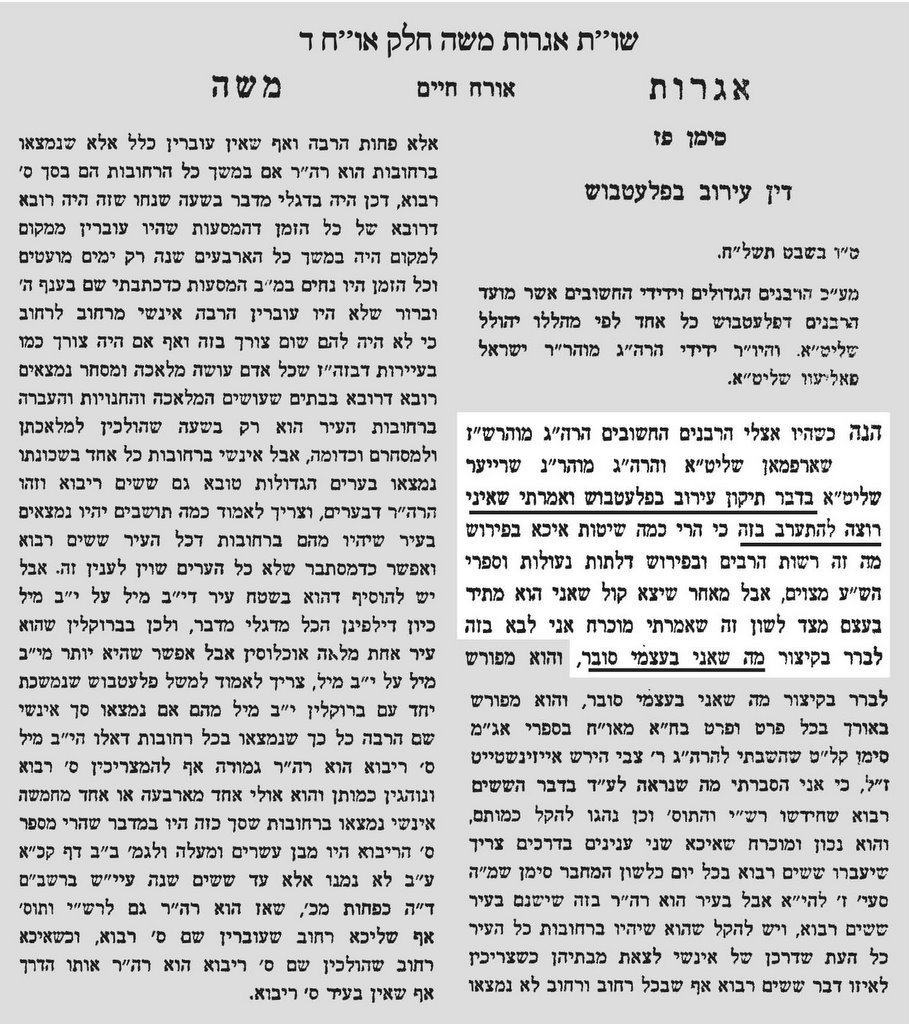
As can be witnessed by the fact that almost all cities large and small have established eruvin, the debate regarding the criterion of shishim ribo between the Bais Ephraim and the Mishkenos Yaakov has just about been abandoned as a lost cause by those who oppose it. However, one of the fundamental arguments between the Bais Ephraim and the Mishkenos Yaakov, whether or not we psaken asu rabbim umevatlei mechitzta, has not been settled at all. The Bais Ephraim argued that we pasken lo asu rabbim and that most Rishonim maintain as such while the Mishkenos Yaakov disagreed. Whereas the overwhelming majority of poskim clearly sided with the Bais Ephraim (see here) the preponderance of Roshei Yeshivos and yeshivaleit maintain that the Mishkenos Yaakov was in the right that most Rishonim maintain asu rabbim umevatlei mechitzta.[1]

Entering the fray is a startling discovery — a teshuvah by one of the most major of Roshei haYeshivos that has just now surfaced. In the newly published Otzar Reb Chaim Berlin, Shu"t Nishmas Chaim (p. 1) there is a teshuvah from Rav Chaim of Volozhin to an unidentified recipient. After studying the contents of this teshuvah, there is no doubt that this letter was written by Rav Chaim Volozhiner to his talmid the Mishkenos Yaakov regarding his debate with the Bais Ephraim on the subject of eruvin.[2] What is startling is the fact that Rav Chaim argued with the Mishkenos Yaakov stating:

ואשר כתב [המשכנ"י] שהמטלטלים במבואות שבהם דרך הרבים עוברת ע"י צורת הפתח עוברים על איסור דאורייתא, אזיל לשיטתי' שתופס לעיקר, דעת המלחמות בסוגי' דדרך הרבים מפסקתן. אבל לשיטת התוס' שם ובכמה דוכתי קיי"ל כרבנן דסגי בשם ד' מחיצות, ואפילו להעומדים באמצע הפילוש דליכא מכל הצדדים אלא צוה"פ, לא הוי רה"ר לרבנן, מכל שכן היכא דאיכא שני מחיצות גמורות ומשני צדדים צורת הפתח ודאי נפיק ליה מאיסור דאורייתא לשיטת התוס'.

Rav Chaim declared that because the Mishkenos Yaakov accepted the opinion of the Ramban, who maintained that we pasken asu rabbim umevatlei mechitzta like Rav Yehudah, carrying in an area encompassed by a tzuras hapesach was a matter of a d’Oraysa. However, Rav Chaim argued that Tosfos, who paskens lo asu rabbim umevatlei mechitzta like the Rabbanan, maintains that the matter is not more than that of a d’rabbanan. This teshuvah basically places Rav Chaim in the Bais Ephraim’s camp regarding the issue of asu rabbim.[3]

[Moreover, Rav Chaim, just like the Shulchan Aruch HaRav and numerous other poskim (see here), understood (that according to Tosfos) if a tzuras hapesach is being used to encompass a reshus harabbim the requirement of delasos is only d’rabbanan.[4] It is important to note that, since the requirement of delasos is me’d’rabbanan, we can be lenient (safek d’rabbanan l’kulla) and apply any additional heter to remove the requirement of delasos (Kanah V’Kanamon, 5:56; Livush Mordechai, 4:4, and Bais Av, 2:9:3.]

Following the above, I would suggest that those who disagree with the Bais Ephraim regarding his argument that we pasken lo asu rabbim umevatlei mechitzta reassess their position as one of the most important Roshei haYeshivos and the rebbe of the posek whom they are basing their opinion on, the Mishkenos Yaakov, did not agree with them either.
_____________________________
[1] However, see my post here where I demonstrate that the Bais Ephraim and the poskim are supported by the overwhelming majority of Rishonim. Moreover, most people do not realize that even those Rishonim who follow Rav Yehudah (besides for the Ritva) maintain that if we have mechitzos that are omed merubeh al ha’parutz (as opposed to shem daled mechitzos), even Rav Yehudah would agree that we pasken lo asu rabbim (see here).
[2] There is additional proof that this teshuvah was penned to the Mishkenos Yaakov. On the very same page in the Shu"t Nishmas Chaim, they included a second teshuvah in which Rav Chaim Volozhiner referred to a debate regarding the kashrus of an animal. This happens to be another major debate between the Mishkenos Yaakov and the Bais Ephraim, but in this case, Rav Chaim sided totally with his talmid (see Bais Ephraim, Y.D. siman 6; Mishkenos Yaakov, Y.D. siman 15; Pischei Teshuvah, Y.D. 31:1, and Darkei Teshuvah, siman 31:5).
[3] Additionally, it seems from this teshuvah that Rav Chaim accepted l’halalchah the criterion of shishim ribo. He argued that Rashi only applied his shita to a platya, but a sratya would be classified as a reshus harabbim even without shishim ribo traversing therein. With this distinction, Rav Chaim argued all of the Mishkenos Yaakov’s proofs to negate shitas Rashi fall to the wayside.
Following all of the above, I do not know what to make of the following anecdotes (that I mentioned here):

סיפר הגרי"ד סאלאווייטשיק ז"ל מבאסטאן (בשיעורו בהל' שבת אייר תשכ"ג, "שיעורי הרב" עמוד רפ"ז): "בעת חילופי המכתבים שבין המשכנ"י והר"ר אפרים זלמן מרגליות, שבעה"ב היה, ולא תפס משרת רבנות, אך הי' נודע כפוסק דכולא גאליציא בזמן ההוא, וכן הג"ר יענקעלע קרלינער הי' נודע ומפורסם כפוסק הליטאי אפילו בחיי רבו הגר"ח מוואלאז'ין, הי' כל יהודי ב' העיירות מתעוררים ומעוניינים לדעת, מי ינצח את מי, במלחמתה של תורה. וכל תלמידי ישיבת וואלאז'ין היו מצפים לבוא הדואר עם המכתב החדש, בכדי לעיין בו מי מנצח. וביקשה אשתו של הגר"ח נ"ע, שיצאתה מהמטבח במיוחד בפרט לשואלו על כן, שיודיענה בעלה, כשיבוא הדואר מי נצח את מי... ולאחר שקרא המכתב (תשובת הבי"א) חזר ואמר לאשתו: ...דער גאליציאנער האט פארלוירן !!!". ויותר מסופר ב"תולדות רבנו חיים מוואלוז'ין" (ווילנא תר"ע, ונדפס כעת פעם ג' מחדש) פרק י"א בהערה 6 וז"ל: "הגאון רבי מאיר מסלוצק סיפר לי בשם אביו הגאון זצ"ל, כי הגאון בעל משכנות יעקב הי' בתור תלמיד חבר להגר"ח... ובעת שבאה לפניו התשובה הידועה של בעל המשכנ"י (באו"ח סימן ק"ט) בנידון רשות-הרבים שלנו אשר מערבין אותן בצורת-הפתח, אמר אז כי דברי הגאון מהר"ז מבראדי בנוגע לתשובה הנ"ל לעומת דברי הגאון בעל משכנ"י, המה כדברי אברך מפולפל מול גאון זקן ומיושב... "

Even though from this recently published teshuvah we see that Rav Chaim did not entirely concur with the Bais Ephraim, it is even more apparent that he did not totally agree with the Mishkenos Yaakov either. Consequentially, I believe that the ikar is missing from these tales. Moreover, these stories are more a form of cultural posturing and cannot entirely be relied on as fact. I will just add what I mentioned previously:

הנה פשוט דחלילה לנו להתעסק בהשוואות מעמדם של גדולי ישראל זה מול זה, ואין לנו אלא להעיר את תשומת לב הקורא שהגר"ח מוואלוז'ין עצמו פנה להגאון בי"א וביקש ממנו חוו"ד על תשובתו (ראה שו"ת בי"א אבה"ע סימן מ"ז). מה עוד, דבאותו דור דעה חיו הגאונים הגדולים הרעק"א, הקצות, הנתיבות והחת"ס, ומדוע בחר לו המשכנ"י לערוך מערכתו זו דוקא לפני הגאון הבי"א, אם לא שהבי"א נחשב בדורו לגדול הדור.


[4] Furthermore, since Rav Chaim accepts that we pasken lo asu rabbim umevatlei mechitzta, in a situation of three mechitzos omed merubeh al haparutz there is no reason to believe that he would even require delasos me’d’rabbanan. This is an essential argument of the Bais Ephraim which is in turn supported by the Rishonim, as well (see Tosfas Ysheinim, Eruvin 32b and Tosfos Rosh, Eruvin 32b). No posek who maintains lo asu rabbim necessitates, in a situation of three mechitzos, delasos me’d’rabbanan since the area is classified me’d’Oraysa as a reshus hayachid (see here regarding the Avnei Nezer). However, the Mishkenos Yaakov and Rav Aharon Kotler who follows him pasken asu rabbim umevatlei mechitzta and maintain that a rabbim can be less than shishim ribo. Nevertheless, even according to the Mishkenos Yaakov and Rav Aharon, a tzuras hapesach to bridge the gaps of the mechitzos at the Brooklyn waterfront would be sufficient since there is no rabbim at all traversing them. [That there may be a pirtzos esser in the Brooklyn mechitzos would not concern the Mishkenos Yaakov — who paskens pirtzos esser negates a mechitzah on a d’Oraysa level — since he admits that, halachically, a tzuras hapesach bridges the gap; see Mishkenos Yaakov, O.C. 122 p. 144.]
It is noteworthy, as well, that Rav Chaim did not concur with the Mishkenos Yaakov regarding the need for delasos to bridge the gaps of a karmelis. Rav Chaim argued that there was no consensus of the poskim regarding the obligation of delasos for the pirtzos of a karmelis. Moreover, since the matter [the domain — a karmelis] is only a d’rabbanan, we can be mekil.

Eruvin in the News: Boynton Beach, FL 3

Boynton-Area Eeruv Gives Orthodox Jews Options on the Sabbath

By Lois K. Solomon

WEST BOYNTON - For the past six Saturdays, Ari Sonneberg has held the hands of his two preschoolers as they walked a mile to their synagogue west of Boynton Beach.

His wife, Erin, stayed home with their 1-year-old, since the little one can't walk and Jewish law prevents her from carrying him on the Sabbath.

But today, the Sonnebergs feel a freedom they had almost forgotten: They can push all three kids in their strollers as they walk to temple because the Jewish community's new, expanded eruv, or symbolic wall, is up and running. Read on...

Wednesday, July 08, 2009

In Light of New Evidence: Revisiting Brooklyn’s Kol Koreis

The following letter that Rav Moshe Feinstein zt”l wrote to Rav Shalom Yehuda Berman of the Lincoln Square Synagogue should put to rest the claim that kol koreis (especially those regarding eruvin) carry any weight at all. The fact that in this correspondence Rav Moshe declared that even in Manhattan ― where he signed the kol korei opposing the eruv[*] ― Rav Shimon Eider zt”l does not need to follow his opinion and can establish an eruv is proof that Rav Moshe never subscribed to the rhetoric of these kol koreis. How much more so regarding Brooklyn where Rav Moshe did not sign the kol koreis at all (see The 1979 Flatbush Kol Korei Exposed and The 1981 Boro Park Kol Korei Exposed) would Rav Moshe have allowed an eruv to be established. [I would add that if Rav Moshe would have known the facts on the ground, he would have even agreed to the eruvin in Brooklyn in their present construction.]

My apologies for the quality of the scan. As of yet, I have not been able to obtain a better copy of this letter.
_____________________________
[*] The only support that Rav Moshe signed this kol korei is the addendum to Igros Moshe, (vol. 6) O.C. 4:89. The fact that this is the only addendum in any volume of Igros Moshe makes it somewhat questionable.

Friday, July 03, 2009

Kol Koreis Versus Rav Moshe Feinstein Zt”l’s Teshuvos

I frequently hear Rav Moshe Feinstein zt”l’s opinion regarding Brooklyn eruvin being cited by those who have, unfortunately, gleaned their information from the Boro Park (1981) and Flatbush (1979) kol koreis and not from Rav Moshe’s copious teshuvos. Therefore, I feel that there is a need for the following reposting of Rav Moshe’s opinion as articulated in his teshuvos. I hope that the public will concur that the teshuvos supersede any kol korei.

Interestingly, of all the instances where Rav Moshe was asked for a p’sak, eruvin is probably the only issue where he did not want to prohibit something solely on the basis of his own chiddush. The only actual p’sak regarding eruvin issued by Rav Moshe were those in favor of erecting an eruv, in communities such as Sea Gate, Kew Gardens Hills and Detroit (Igros Moshe, O.C. 2:89-90, 4:86, 5:29). Yet in instances when he personally was against the establishment of an eruv and he was asked for a p’sak on the matter such as in Flatbush, Rav Moshe not only avoided giving a p’sak he even declined to state his personal conviction (ibid., 4:87; see the teshuvah below). Rav Moshe declared, “I do not want to join you in this matter [of eruvin], because there are many opinions on this topic, as we see in the Shulchan Aruch.” It is along this same line of reasoning that Rav Moshe zt”l told Hagaon Rav Tuvia Goldstein zt”l ― even after the 1979 Flatbush kol korei was published ― that, not withstanding his opinion of the matter, if the rabbanim of Flatbush wanted to erect an eruv they could do as they saw fit.

However, at the time, there was a misunderstanding concerning Rav Moshe’s personal conviction, and some people mistakenly supposed that he was even in support of an eruv (see the teshuvah below); hence, Rav Moshe stated that he needed to clarify his opinion (ibid., 4:87-88). Even when illuminating his position, which he considered to be “l’dinah,” Rav Moshe did not want to issue a p’sak since, as he wrote, his chiddush was not mentioned in the Achronim, and moreover the Aruch HaShulchan would not agree with him. It is important to note that both these teshuvos (ibid.) were written to the same people, and the second one was just a clarification of the first and was not written as a p’sak to prohibit the eruv. In the first teshuvah (ibid., 4:87) Rav Moshe explained his chiddush that in order for there to be shishim ribo traversing the streets over a twelve mil by twelve mil area there would need to be approximately three million people living in the area (see Three Million: More or Less?). However, after Rav Moshe was told that there were fewer than three million people living in Brooklyn, he expounded on his chiddush in a second teshuvah adding that he would still not be in favor of an eruv in a large city since some might think that there was shishim ribo traversing its streets (ibid., 4:88). At the conclusion of this teshuvah, Rav Moshe declared that since he was now told that Brooklyn’s population was nearly three million and that there was almost a million people who come into Brooklyn to work daily, “me’dinah” an eruv cannot be established. In both teshuvos, “me'dinah” only refers to Rav Moshe’s personal opinion.

Regarding the Boro Park eruv, a similar sequence of events occurred when Rav Menashe Klein shlita asked Rav Moshe to issue a p’sak whether he could erect an eruv. Rav Moshe answered that he could do as he saw fit (Oim Ani Chomah, p. 266). Just as in Flatbush, this was misunderstood to mean that Rav Moshe would support an eruv. Therefore, Rav Moshe felt a need to clarify his personal opinion regarding this matter (Igros Moshe, O.C. 5:28:20). In both Boro Park and Flatbush, Rav Moshe’s teshuvos were written in reaction to the public’s misunderstanding of his personal opinion regarding eruvin and not as a p’sak. [Regarding Rav Moshe’s signature on the kol koreis which prohibited the Boro Park and Flatbush eruvin, see The 1979 Flatbush Kol Korei Exposed and The 1981 Boro Park Kol Korei Exposed.]

On the other hand, when Rav Tzvi Eisenstadt zt”l asked the rabbanim of Manhattan for their opinions ― as opposed to their p’sak ― regarding erecting an eruv, Rav Moshe answered that in his personal opinion they should not establish an eruv (see the beginning of Igros Moshe, O.C. 1:138 which is the introduction to the Manhattan teshuvah 1:139). When Rav Moshe was asked if the rabbanim of Manhattan have a right to erect an eruv, he answered that they could do as they saw fit (ibid., 4:89 and HaPardes, 33rd year, vol. 9). This follows what Rav Moshe told Rav Menachem M. Kasher zt”l, “even though I will not join you, you should finish what you started [and establish the eruv]” (Divrei Menachem, O.C. vol. 2, introduction). Only when Rav Aharon Kotler zt”l and other Roshei Yeshivos made a takanah not to erect an eruv in Manhattan did Rav Moshe join them and prohibit the eruv as well (Igros Moshe, O.C. 4:86 and Addendum to O.C. 4:89) ― this takanah was only about Manhattan and not Brooklyn; see The 1979 Flatbush Kol Korei Exposed. Even when Rav Moshe signed on the 1962 takanah with Rav Aharon Kotler, we see that he was not at ease with the language which stated that, “those who rely on the eruv in Manhattan are considered a mechalel Shabbos,” since after he quoted this takanah in his teshuvah, he omitted this last line (ibid., Addendum to O.C. 4:89).

Given that Rav Moshe, despite his personal convictions, never issued a p’sak for others against erecting eruvin, we can possibly understand why Rav Moshe stated (ibid., 3:94, 5:19, 5:24:10) that we rely on the heter of shishim ribo in all cities ― including Brooklyn and Manhattan ― since he did not want to employ his chiddush as a p’sak din barur (see also Rav Moshe zt"l and the Walking Stick).

Following the above, besides for the speciousness of the kol koreis, those who nonetheless want to follow the kol koreis have no right to impose their misguided personal opinions on others. [If there is a need for eruvin today according to Rav Moshe, see Rav Moshe Feinstein zt”l: The Need For Eruvin]

i
i

The teshuvah above confirms that Rav Moshe never issued a p’sak opposing an eruv in Flatbush but only stated his personal opinion since he recognized that his chiddush was not mentioned in the Achronim and that the Aruch HaShulchan did not agree with him.

Monday, June 29, 2009

Eruvin in the News: Stanmore, London

Go-Ahead for Eruv in Stanmore

By Keren David

Orthodox Jews in Stanmore are celebrating Harrow Council's approval of an eruv for the area at its planning committee meeting last night.

An eruv defines the boundary of a single area of land or domain surrounding the community. Much of the boundary is formed by existing walls and structures but where there are gaps a symbolic ‘fence’ – typically made of tall vertical poles linked together at the top by a single horizontal wire – needs to be erected. This then enables certain restrictions that are in force on Shabbat – such as carrying and pushing wheelchairs, prams and baby buggies – to be alleviated within the Eruv area. There are over 200 eruvim in place in Jewish communities throughout the world, including in neighbouring Edgware. Read on...

Monday, June 22, 2009

The Reprinting of the Berlin Edition of the Behag

The following is in honor of the reprinting of the Berlin edition of the Halachos Gedolos [Behag] published by Rav Ezriel Hildesheimer between the years 1888-1892. This reprint of the important Gaonic work, which is a recension of the Vatican MS (Biblioteca Apostolica ebr. 142), differs from the more common published editions which are based on the first printing of the Behag in Venice, 1548. There is an additional edition published between 1972-1987 in Yerushalayim by Rav Ezriel Hildesheimer (a grandson of the Rav Ezriel Hildesheimer who published the Berlin edition). This Behag is a recension of the Milano MS (Biblioteca Ambrosiana C 116 Sup) and has many similarities to the Berlin edition.

Tosfos (Eruvin 6a) reveals that the criterion of shishim ribo cited by Rashi was already mentioned in the Behag. Additionally, the following Rishonim also mention that the source for shishim ribo is the Behag: Ramban (Eruvin 59a), Shitas Hamyuchos LaRan (Shabbos 6b), Tosfas Rosh (Eruvin 6a), and Maharam MeRotenberg (Piskei Eruvin, ois 9). However, the Mishkenos Yaakov (O.C. siman 121) stated that our Behag does not mention the criterion of shishim ribo at all (see also the Bi’ur Halachah, 345:7 who follows the Mishkenos Yaakov in this regards). Moreover, he continues, since there are Rishonim such as the Ritva and the Rivash who oppose the criterion of shishim ribo and they only cite Rashi as the source of the criterion and not the Behag ― whom they would not have easily rejected l’halachah[1] ― these Rishonim must not have found the criterion mentioned in the Behag, as well.

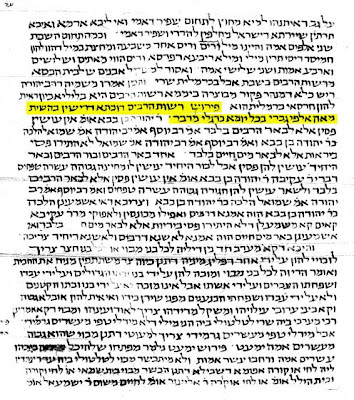
Rav Menachem Mendel Kasher in his Torah Shelemah (vol. 15, 1953, p. 164) was the first to note that today we actually know of an edition of the Behag that mentions the criterion of shishim ribo. The Berlin edition of the Behag (p. 131; see below for a facsimile of this passage)[2] states והכין אמרו משמיה דרב יהודה ריש כלא דמנהר פקוד מבוצרה ... פירוש רשות הרבים דוכתא דדשין בה שית מאה אלפי גברי בכל יומא כדגלי מדבר. Furthermore, Rav Kasher mentioned that there are additional Gaonim who endorse the criterion of shishim ribo: Rav Amram Gaon, Halachos Pesukos Min HaGaonim, siman 70; Sar Shalom Gaon, Chemdah Genuzah, siman 70 and Sharei Teshuvah, siman 209 (see also Sefer Ha’itim, ois 92), and the Gaon mentioned in the Sefer Ha’itim, ois 206.[3]

The facsimile above is of the Berlin recension of the Halachos Gedolos from the Vatican MS (Biblioteca Apostolica ebr. 142) which contains the passage regarding the criterion of shishim ribo.

Additionally, I would like to point out that there is an unpublished manuscript of the Behag that mentions the criterion of shishim ribo, as well. The Vatican MS (Biblioteca Apostolica ebr. 304; see below for a facsimile of this passage) states והכי אמרי משמיה דרב יהודה אלוף דמנהר פקוד דבצרה ... רשות הרבים דוכתא דדשין ליה שית מאה אלפי גברי ביומא כדגלי מדבר, and these are almost the exact words that we find in the Sefer Ha’itim (ois 209).[4]

The facsimile above is of the Halachos Gedolos from the Vatican MS (Biblioteca Apostolica ebr. 304) containing the passage referring to the criterion of shishim ribo which is similar to the passage mentioned in the Sefer Ha’itim (ois 209).

There was a famous debate between the Mishkenos Yaakov (O.C. 120) and the Bais Ephraim (O.C. 26) regarding the tally of Rishonim who pasken whether or not shishim ribo is a fundament of a reshus harabbim. The Mishkenos Yaakov sent a lengthy teshuvah to the Bais Ephraim arguing that the Taz (345:6) and Magen Avraham (345:7) are incorrect in their assumption that most Rishonim maintain that shishim ribo is a criterion of reshus harabbim, since most Rishonim uphold otherwise. The Mishkenos Yaakov argued that there were only eight Rishonim who maintained that shishim ribo is a criterion of a reshus harabbim, and that there were approximately 14 who upheld otherwise. The Bais Ephraim replied that one cannot argue against the accepted minhag established by the Chachmei Tzarfas and Ashkenaz and that he disagrees with the Mishkenos Yaakov’s tally of Rishonim. The Bais Ephraim goes on to argue his case and proves that the Taz and Magen Avraham are correct in their belief that most Rishonim maintain that shishim ribo is a criterion of a reshus harabbim.

The Aruch HaShulchan (345:17) and the Misnhnah Berurah (Bi’ur Halachah 345) cite the Mishkenos Yaakov’s count without mentioning that the Bais Ephraim[5] disagreed with some Rishonim on the list.[6] The Aruch HaShulchan adds that some of the Rishonim whom the Mishkenos Yaakov cited were not yet published in the times of the Taz and Magen Avraham, and therefore, they didn’t have the actual count of Rishonim who pasken against the criterion of shishim ribo.

Therefore, I set out to count the actual number of Gaonim and Rishonim, including those published recently, who clearly pasken shishim ribo is a criterion of a reshus harabbim and those who explicitly maintain otherwise.

The following is a list of Gaonim and Rishonim who support shishim ribo:
1. Bahag, (Berlin edition) p. 131. 2. Rav Amram Gaon, Halachos Pesukos Min HaGaonim, siman 70. 3. Sar Shalom Gaon, Chemdah Genuzah, siman 70 and Sharei Teshuvah, siman 209 (see also Sefer Ha’itim, ois 92). 4. The Gaon mentioned in the Sefer Ha’itim, ois 206.
5. Rashi, Eruvin 6a, 6b, 26a, 59a, 47a. 6. Tosfos, Eruvin 6a, 26a, 59a, and Shabbos 6b, 64b. 7. HaEshkol, Hilchos Tzitzis ois 31. 8. HaManhig, Hilchos Shabbos HaTzarichos ois 138. 9. Sefer HaTrumah, ois 214, 239. 10. Semag, Hilchos Shabbos p. 17. 11. Sefer Ha’itim, ois 92, 206, 209. 12. Ra’avan, Shabbos 349. 13. Piskei HaRid, Eruvin 6a, 59a, and Pesachim 69a. 14. Rokeach, Hilchos Shabbos 175. 15. Ravyah, Hilchos Eruvin 379, 391. 16. Riaz, Eruvin Perek 1:5, 5:5. 17. HaAgudah, Perek 5:56. 18. Rivevan, Eruvin 6b, 59a. 19. HaAgur, siman 537. 20. Piskei Rabeinu Mendel Kloizner (Ramak), Shabbos 6a. 21. Rabeinu Yerucham, Toldot Adom V’Chavah 12:4, 12:17. 22. Or Zarua, Hilchos Shabbos siman 16, Eruvin 129. 23. Piskei Mahrach Or Zarua, Eruvin Perek 2 ois 57. 24. Maharam MeRotenberg, siman 31, Eruvin ois 9, 10. 25. Smak, Mitzvos Hatluyos B’Shabbos p. 296, 299. 26. Tsedah LaDerech, Perek 42, 46. 27. Machzor Vitri, Perek B'mah Isha, ois 31, 32. 28. Haitur, Hilchos Tzitzis, Shaar 3 Shaar Adom Chelek 1. 29. Rosh, Beitzah 24a, Eruvin 6a (see also Kitzur Piskei HaRosh, Perek 1:8). 30. Hagahos Ashri, Eruvin 6b, 20b. 31. Sefer HaNeyar, Hilchos Eruvin p. 51. 32. Hagahos Maimonios, Eruvin Perek 5:2, 5:4. 33. Mordechai, Shabbos 64b, 100a. 34. Orchos Chaim, Hilchos Shabbos ois 284. 35. Tur, O.C. 345, 364, 392.

The following is a list of Rishonim who oppose the criterion of shishim ribo:[7]
1. Rambam, Hilchos Shabbos 14:1.[8] 2. Ramban, Shabbos, 57a, and Eruvin 59a.[9] 3. Rashba, Teshuvos HaRashba siman 722.[10] 4. Ritva, 59a.[11] 5. Magid Mishnah, Shabbos 14:1.[12] 6. Ran, Shabbos Perek 6, Chidushim Eruvin 6a. 7. Meiri, Bais HaBechirah Shabbos 57a, and Eruvin 6b, and Chidushim Eruvin 6b. 8. Hashlama, Eruvin 6a. 9. Sefer HaMeoros, Eruvin 6a. 10. Rivash, siman 405. 11. Hagahos Mordechai, Shabbos Perek 6.[13]

Therefore, since the overwhelming majority of Rishonim and several Gaonim maintain that shishim ribo is a criterion of reshus harabbim, there is no doubt that the Mishkenos Yaakov and the Misnhnah Berurah would agree that shishim ribo is an accepted fundament that all can rely on.
_____________________________
[1] וכבר כתב התוס' (חולין מד ע"א ד"ה כדי תפיסת היד) שדברי הבה"ג הם דברי קבלה ויש לסמוך עליהם, וכן כתב הרא"ש בשם הראב"ד (ברכות פ"ד אות יד), ובש"ך (יו"ד סי' כה ס"ק ב) וז"ל וכמה מצינו שהתוס' וכל הפוסקים חששו לדברי בה"ג אפילו היכא דלא מסתברא טעמיה, אפילו להקל, מפני שכל דבריו דברי קבלה".
[2] Some refer to this MS as the Behag Aspamia [Spain] which is mentioned in the Rishonim (MiKadmoniyos HaYehudim, p. 399-402). This, however, is probably incorrect as has been detailed by Rav Ezriel Hildesheimer (Behag, Yerushalayim, vol. 1 p. 22-24).
[3] Rav Kasher cites a fifth Gaon mentioned in the Eshkol in Hilchos Eruvin (ois 64). However, this passage is only in Rav Auerbach’s edition of the Eshkol which has been proven to be a forgery so I omitted it.
In the anti-eruv kuntres Kerem Beyavnah (number 5) Rav Chaim Dov-Ber Gulevsky wrote a rambling screed against shitas Rashi. One of his objectives was to negate the fact that even prior to Rashi there were Gaonim who upheld that shishim ribo is a criterion of a reshus harabbim. Rav Gulevsky’s most absurd claim (pp. 265-266) is that since the Berlin edition of the Behag which contains the passage regarding shishim ribo was published by Maskilim (Chevrah Meketzei Nerdamim), we cannot rely on the wording in this edition of the Behag. The absolute futility of this argument is indicative as to how far the anti-eruv group would go to negate city eruvin (I guess that his argument is that even though Rav Esriel Hildesheimer was the editor of this edition, nevertheless, the publishers were not trustworthy). First of all, the Sefer Ha’itim (ois 208) quotes this passage from the Behag and it is very similar to the Berlin edition. Second of all, I have included a facsimile of the manuscript containing this passage that the Berlin edition was based on, and clearly there was no redacting whatsoever. The only one who can be accused of redacting would be the author of the article.
[4] There is much uncertainty regarding the author of this quote רב יהודה ריש כלא דמנהר פקוד מבוצרה. Shmuel Poznanski writes (JQR, N.S. vol. 3 number 3, p. 403) that this is not the same רב יהודאי גאון that the Behag/Halachos Pesukos was based on (see Nachman Danzig, Mavo LeSefer Halachos Pesukos, Perek 5, n59, n62).
[5] The poskim have already called attention to the fact that the Mishnah Berurah had obviously not seen the Bais Ephraim (Toldos Shmuel, 3:81:7, 3:86:8; Bais Av, 2:5:2; Divrei Yatziv, 2:173:1, and Even Yisroel, 8:36). We can add that this is evident from the Mishnah Berurah himself since he states that he did not possess the sefer Bais Ephraim (Bi’ur Halachah, 208:9, s.v. Eino M’Vorech).
[6] However, the Misnhnah Berurah obviously didn’t agree with three of the Rishonim on the Mishkenos Yaakov’s list – the Rif, Riaz and Ra’avin – since he omitted them from his own list.
[7] The Bais Ephraim and the Mishkenos Yaakov had a major debate regarding some Rishonim, and in my opinion, the Bais Ephraim is correct (see Minchah Areivah, siman 7, for a full treatment of this subject). Therefore, I am not listing those Rishonim whose opinion is a matter of disagreement. [For example, since Rabeinu Tam did not state that he disagrees with shitas Rashi only that he had a question regarding the criterion it is not proof that he opposed it. Moreover, there is evidence from other statements of Rabeinu Tam that he supported the criterion. However, if a Rishon states that shitas Rashi is not a central criterion, I added him to the list of those opposing the fundament of shishim ribo even if I have an argument that would demonstrate that the Rishon supported the criterion.] This is the reason why I did not count some of the Rishonim listed in the Bi’ur Halachah, 345:7, which just follows the Mishkenos Yaakov. However, I will add to the list the Rishonim who oppose the criterion but were only published at a later date than the Bi’ur Halachah.
I should mention that while Rabeinu Peretz in his chidushim (Eruvin 6a) states that we do not follow the criterion of shishim ribo in Rabeinu Peretz’s hagahos on the Smak (where he always articulates when he disagrees), he does not argue when the Smak supports the criterion of shishim ribo. Additionally, there is a passage cited in the Hagahos Ashri (Eruvin Perek 1, siman 8) from the Hagahos Smak that supports shishim ribo. Therefore, it is possible that Rabeinu Peretz does not disagree with shitas Rashi in his chidushim, but only that he has difficulties with it (just like the Bais Ephraim argues regarding Rabeinu Tam). Consequentially, I do not include Rabeinu Peretz as opposing the criterion of shishim ribo.
[8] One of the klalim in the Rambam is that he only set forth issues in the Yad that were clearly delineated in Shas (see Bais Yosef, Y.D. 196:2; Mishneh L’Melech, Ma’aseh haKorbanos, 18; Prei Chadash, Y.D. 83:7; Bach, Y.D. 48:8; see also Sedei Chemed, Klalei HaPoskim, 3:5, 5:23). As some of the Rishonim who argue against the criterion of shishim ribo state, there is no mention of the fundament in Shas (see Shishim Ribo – A Mystery Solved). I would therefore suggest that this would be the underlying rationale why the Rambam did not mention the criterion of shishim ribo and that its omission is not proof that he did not subscribe to this fundament of a reshus harabbim. Nevertheless, the fact is there are Rishonim who maintain that the Rambam opposed the criterion of shishim ribo because of the fact that he failed to mention it (Ritva, Eruvin 59a, Magid Mishnah, Shabbos 14:1 and Rivash, siman 405). However, I should add that the Maharashdam (O.C. siman 4), Divrei Yirmiyahu (Hilchos Shabbos, Perek 14) and the Chasam Sofer (Chidushim Shabbos, 87a) do presume that the Rambam accepts shishim ribo as a criterion.
[9] The Bais Ephraim notes that the Ramban in Eruvin (59a) admits that the criterion of shishim ribo is mentioned in the Behag, and hence the Ramban declares that it is “taluy b’elanos gedolos.” Consequently, when the Ramban finds difficulty with the criterion of shishim ribo, it only proves that he would rather not rely on it. However, he agrees it has deep seated support because of the Behag, and that is why the world relies on the criterion.
[10] I would argue that there is no proof from the Rashba’s teshuvah (siman 722) that he opposed the criterion of shishim ribo (since even if one supported the criterion of shishim ribo there are scenarios where a sratya and a platya are classified as a reshus harabbim even without shishim ribo traversing therein). However, there are Rishonim who argue that the Rashba did not support the criterion (Magid Mishnah, Shabbos 14:1 and Rivash, siman 405). I should mention, though, that the Taz (345:6) questioned what the Rashba actually maintained.
[11] It is important to note that the Ritva in Shabbos 6a, and Eruvin 6a, 22a, refers to and expounds on shitas Rashi without arguing at all. Only in Eruvin 59a does he express that most Gaonim do not accept the criterion of shishim ribo.
Professor Yisrael M. Ta-Shma (Halachah, Minhag, U’Metzius BeAshkenaz: 1000-1350, p. 144) argues that the fact that the Ritva writes that the majority of Gaonim do not support shishim ribo is proof that most Gaonim disagreed with the Behag. However, besides for the probability that when the Ritva mentions Gaonim he is referring to the Ramban and in this case possibly the Rashbah (see Mosad Rav Kook edition of the Ritva, Eruvin 59a, n286; 67b, n411 and Torah Shelemah, vol. 15, p. 174), I believe that his assumption is totally incorrect. The fact is that we do not know of even one Gaon who stated that he was opposed to the criterion of shishim ribo. This follows why the Magid Mishnah (Shabbos 14:1) states that there are some Gaonim and Achronim (he is referring to the Achronim of his era which we classify today as Rishonim) who uphold the criterion of shishim ribo but then only cites Rishonim and does not mention any Gaonim who oppose the criterion. This leads me to believe that the Magid Mishnah and the Ritva did not know of any Gaonim who opposed the criterion of shishim ribo. [What we do know and even Professor Ta-Shma admitted to was that there are, besides for the Behag, an additional three Gaonim who subscribe to the criterion of shishim ribo (Rav Amram, Sar Shalom, and the unnamed Gaon mentioned in the Sefer Ha’itim).] Moreover, it is doubtful that the Ritva was referring to the period that we refer to today as Gaonim since this demarcation was established at a later date (Torah Shelemah, vol. 15, p. 174). The term Gaonim at that time included the period that we now refer to as [the early] Rishonim. I believe that Professor Ta-Shma got this all wrong.
Additionally, Professor Ta-Shma is probably incorrect that since all the Gaonim who upheld the fundament of shishim ribo were from Sura, the Gaonim from Pumbedisa did not accept the criterion. In fact, [Mar] Rav Paltoi Gaon was from Pumbedisa, and he states (Halachos Pesukos Min HaGaonim, siman 144) that there is no reshus harabbim today at all. [While one can argue that Rav Paltoi Gaon meant that there is no reshus harabbim today because the streets were not sixteen amos wide, it is improbable that this is what he was referring to. Even though the Kol Bo (siman 31) states that there is no reshus harabbim today because the streets were not sixteen amos wide, and the Ritva (Eruvin 59a) also declares that there are no streets in his country which are sixteen amos wide, the Ramban (Shabbos 57a), however clearly states that there were streets that were sixteen amos wide in his times. Moreover, from the Ritva’s words we can derive that this was only a local phenomenon. Additionally, the areas where the overwhelming majority of Gaonim and Rishonim resided clearly contained roads that were wider than sixteen amos since they had to rely on the criterion of shishim ribo. Consequentially, when a Gaon or Rishon states that today there is no reshus harabbim, we would have to assume he is not referring to the streets being less than sixteen amos wide but only that they do not meet the criterion of shishim ribo.]
[12] I should mention that the Taz (345:6) questioned what the Magid Mishnah actually maintained. However, I think that from the words of the Magid Mishnah it is clear that he does not support the criterion of shishim ribo at all.
[13] There is some uncertainty as to who is the author of this passage which was signed simply as Eliezer. The Bais Ephraim proves that it is not Rav Eliezer of Metz. It probably was Rav Eliezer of Lundresh.

Sunday, June 21, 2009

Eruvin in the News: San Francisco, CA

License to Carry: Eruv Marks a San Francisco First


By Stacey Palevsky, Staff Writer

This Shabbat marks the first time that Bryna Kammerman can push her 2-year-old daughter to synagogue in a stroller. It will be the first time, while walking to Shabbat services, that her husband, Jay Edwards, can sling the diaper bag over his shoulder, and their daughter Evelyn can carry her sage green baby blanket. That’s because San Francisco’s Congregation Adath Israel has established the city’s first eruv, in the Sunset District, which means Jews within its perimeter can carry items on Shabbat. Read on...

Wednesday, May 20, 2009

Eruvin in the News: Travel Advisory

Most Vacation Spots Have No Eruv

By Yated Ne'eman Staff

Many vacationers carry on Shabbos at hotels and other vacation spots that lack an eruv simply because they are unaware of the problem, revealed an investigative report published in Yated Ne'eman.

The problem is not just in places where kashrus and modesty standards are below par, but even at places of lodging that meet most of the expectations of the chareidi vacationer. Rabbonim involved in eruv matters say if guests insist on a kosher eruv the management can generally arrange for one with relatively little effort.

From here

Tuesday, May 05, 2009

Eruvin in the News: Queens, NY

A New York state trial court dismissed a claim by a victim of a slip-and-fall accident that a group of synagogues should be liable for her injuries because she tripped over a fallen wire that was part of an eruv maintained by the defendants. The eruv ran through the property of St. John's Episcopal Hospital's teaching center located at 327 Beach 19th Street where the plaintiff fell.

In Egar v. Congregation Talmud Torah, (NY Sup. Ct., April 16, 2009), the plaintiff claimed that defendants had constructive notice that the eruv constituted a dangerous condition because a year earlier an eruv wire had fallen in a different location. The court disagreed, saying that a "single incident of the eruv falling a year before this incident certainly does not constitute evidence of a regularly recurring condition of which defendants must be aware."

For the court's opinion, click here

For the New York Law Journal article, click here

Watch this Space for an Upcoming Exposé

Stay tuned for an exposé on an eruv builder based out of Chicago who travels across America, actively seeking flaws in community eruvin . ...