Thursday, December 01, 2005

The 1979 Flatbush Kol Korei Exposed

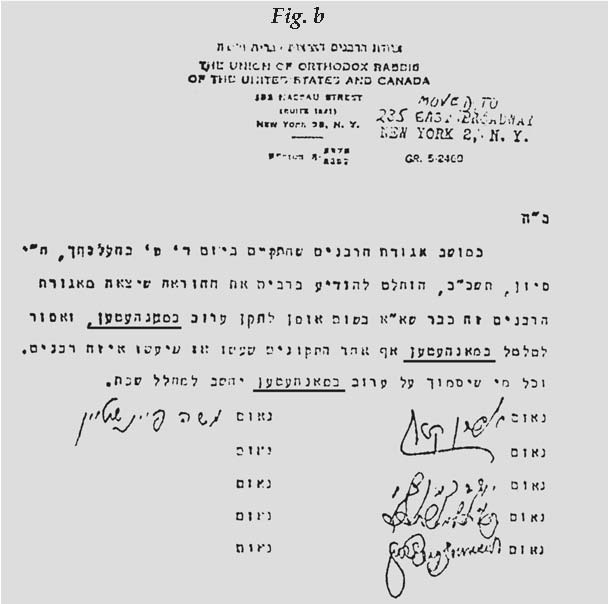
The text of the 1979 kol korei against a Flatbush eruv [Fig. a] refers back to the 1962 Manhattan kol korei [Fig. b], claiming that it includes Brooklyn in the Manhattan issur and listing among the signatories Hagaon Harav Eliyahu Henkin zt“l. However, as the original copy of the 1962 Manhattan kol korei demonstrates, the takanah then against erecting eruvin only applied to Manhattan and not to Brooklyn. This correlates with what Hagaon Harav Menashe Klein shlita wrote (Oim Ani Chomah, siman 7) that Hagaon Harav Moshe Feinstein zt”l told him in 1979 - in the presence of Rav Elimelech Bluth shlita, Rav Shalom Dresner shlita, and Rav Mordechai Tendler shlita - that contrary to what someone in the Agudas HaRabbonim was promoting, the 1962 issur from the Agudas HaRabbonim was only regarding Manhattan.
i

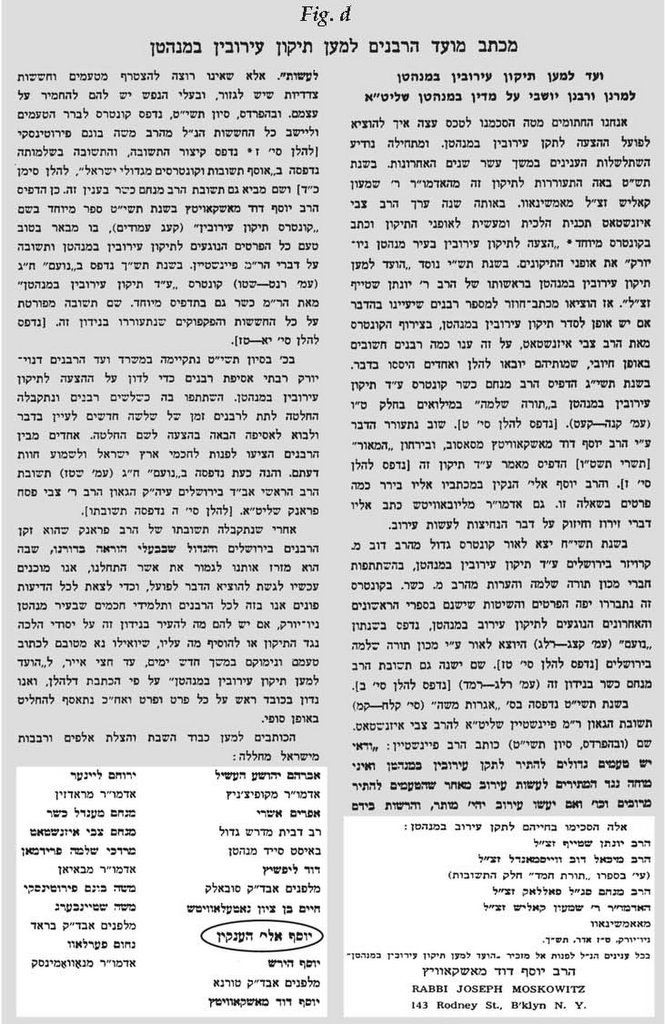
Additionally, it shows only five signatures. Nowhere is Rav Eliyahu Henkin’s signature to be found. For more proof that Rav Eliyahu Henkin never signed the 1962 kol korei, see the copy of the 1962 kol korei that the Agudas HaRabbonim advertised in the HaPardes in 1966 (40th year, vol. 8) [Fig. c]. Note that even at this later date there was still no signature from Rav Eliyahu Henkin to be found. Even more so, from Rav Henkin’s letters (Kisvei Hagriah Henkin, p. 33) and from the 1960 kol korei on behalf of the Manhattan eruv (Divrei Menachem, O.C. vol. 2, p. 10) [Fig. d], we see he was a proponent of the Manhattan [and Brooklyn] eruvin. Additionally, Hagaon Harav Moshe Feinstein zt”l never gave a p’sak l’maaseh against eruvin as the 1979 kol korei falsely claims. On the contrary, he declined to issue a p’sak since the Aruch HaShulchan and other Achronim disagreed with him (Igros Moshe, O.C. 4:87).i
i

i

Wednesday, November 30, 2005

Part 2: The Truth About Warsaw

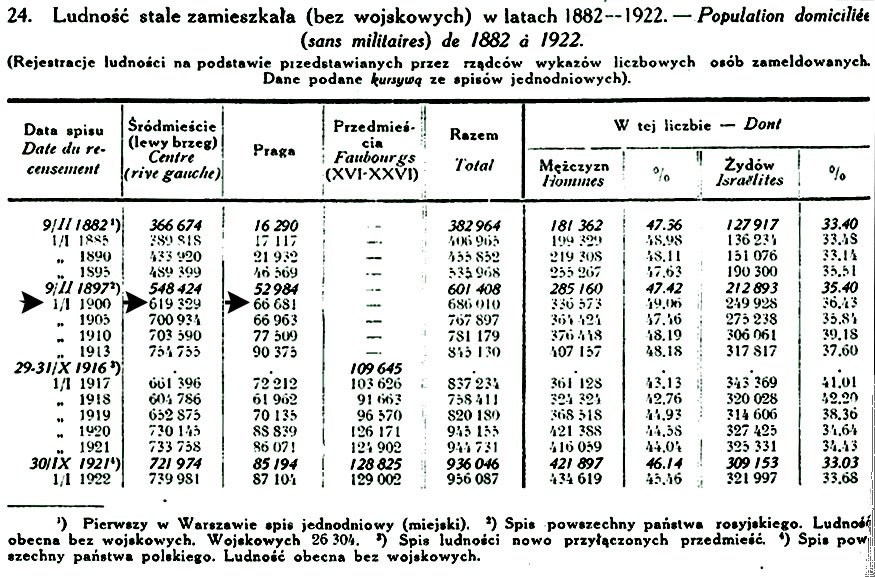
Many statements regarding the population of Warsaw have been tossed around e.g. that the Vistula River divided the population of Warsaw and therefore there was no shishim ribo on either side of the river. This is all fiction; the larger side, which was called Warsaw, contained a population greater than 600,000 by the year 1900. The smaller side, known as Praga, contained a population of approximately 66,000. This information was published in Rocznik Statystyczny Warszawy 1921 i 1922, 1924 p. 14, see copy below. For more about Warsaw see Part 1: The Truth About Warsaw.

[Even Rav Moshe zt"l acknowledged that Warsaw’s population was greater than 600,000. The reason Rav Moshe formulated his chiddush in shishim ribo (that there would need to be a population of 3,000,000 over twelve mil by twelve mil in order for that area to be classified as a reshus harabbim) was because he realized that there were European cities (Igros Moshe, O.C. 4:87), such as Warsaw (ibid., 5:28:5), whose populations were greater than 600,000 and nevertheless eruvin had been established there. Therefore, to say that the criterion of shishim ribo (600,000) is dependent on a city goes against the established minhag.]
i

Mefulash According to the Shulchan Aruch

The text of the Shulchan Aruch reads:
“What is a reshus harabbim? A street or marketplace that … is not walled and even if they are walled but they [the street or marketplace] are open from city gate to city gate, they [the street or marketplace] would be considered a reshus harabbim ….”

Even though the Shulchan Aruch cites the criterion of mefulash m’shaar l’shaar in conjunction with a walled city, the Tur does not differentiate between a walled city and an open city and the Bais Yosef (siman 345) does not disagree with the Tur. Therefore, mefulash would be considered a criterion of a reshus harabbim even in a city that is not walled (see Bais Av, 2:9:1 for a detailed explanation). The Gra offers a different perspective (Bi’ur HaGra, O.C. 345:7) and explains that the words of the Shulchan Aruch, “is not walled,” refers to a street [sratya]. The Dmesek Eliezer clarifies the Gra that a sratya is a road which does not have a wall around it. The Gra explains further that, “even if they are walled,” refers to a marketplace [platya]. The Dmesek Eliezer explains that a platya is a city street that is walled on two sides and the remaining two sides are open straight from city gate to city gate. What we see from this Dmesek Eliezer is that what the Shulchan Aruch refers to as, “walled,” pertains to the streets of the city and not the city walls. Therefore, it is understandable why the Gra (Sh’nos Eliyahu, introduction to Meseches Shabbos and Chidushi HaGra, Shabbos 6a) when discussing the criterion of mefulash m’shaar l’shaar does not attribute it to a walled city. It follows that our streets which are lined with houses would be classified as walled streets and would have to be mefulashim u’mechuvanim m’shaar l’shaar to be categorized as a reshus harabbim. Note that since the term city gate [shaar] does not always pertain to the gate of a walled city (Rashi, Yoma 11a), mefulash m’shaar l’shaar can refer to a city that is not walled as well.

Tuesday, November 29, 2005

Part 2: A Critical Analysis of Rav Yisroel Hirsch’s Critique of Eruvin in Brooklyn

Continued from part I

Page 3 comment 2:
“Furthermore, there was no reason for the אר"י to question the eruv of צפת whereas great halachic authorities have publicly forbidden the construction of an(y) eruv in New York City. So there is every reason to question its construction. Also, the אר"י did not question the eruv in צפת after it had already been constructed; our present situation deals with – precisely – the halachic basis for such a construction.”

In fact there was reason to question the eruv of Tsfas. The, “lamdanim and some of the talmidi chachamim,” of Tsfas questioned the eruv since in the non Jewish section of the city there was a street more than sixteen amos wide and some of the streets in the Jewish section opened on to it. On this issue the Maharit Tzahalon (siman 251) commented that for a street to be classified as a reshus harabbim, we require shishim ribo to traverse it. Additionally, these, “lamdanim and some of the talmidi chachamim,” of Tsfas were questioning the existing eruv. (Ironically, the fact is Rav Hirsch’s comments on the Kensington eruv were written after the fact as well.)


Page 3 comment 4:
“But the logic that sees a contradiction because of the “collection of disparate sources” is untenable. Different aspects of any argument may be accepted or rejected, without having to accept the entire thesis. So long as one does not both partially accept and partially reject the same aspect, or selectively accept two aspects of the same argument that are contradictory, one may find one point valid and the other not.”

This is not the argument put forth by the kuntres at all. If the reason that we have to follow Rav Moshe’s zt"l p’sak is because he was the Gadol Hador then why would the anti-eruv group bring other shitos against eruvin (shitos that Rav Moshe never subscribed to) from others whom they do not consider the Gadolei Hador? It must be that the goal is to asser eruvin hence the need to collect shitos yachidos from disparate sources.

To quote The Community Eruv kuntres, “Of course, it is always possible to cite shitos yachidos to invalidate an eruv; however, ruling according to shitos yachidos is not the correct approach in halachah. [The Chasam Sofer writes (Y.D. 37) that if we were to collect all the shitos ha’ossrim we would not be able to eat bread or drink water.] Even more so, in hilchos eruvin, since all criteria have to be met for the area to be classified as a reshus harabbim, even if we were to employ a shitas yachid regarding reshus harabbim that would then disqualify the eruv based on only one criterion, the other conditions would not be met and an eruv would be permissible l’chatchilah. Consequently, to invalidate an eruv, one would have to selectively choose from disparate shitos yachidos ― which in many cases are contradictory ― and that is an unjustifiable approach to halachah. The reality is that if someone learns hilchos eruvin with an open mind, he would realize that since it is almost impossible to meet all the criteria of a reshus harabbim, creating an eruv l’chatchilah is a real possibility.”


Page 3 comment 5:
“Granted, the halacha is not like ר' יהודה; rather, לא אתו רבים ומבטלי מחיצתא. But if the pirtzah is more than 10 amos (maybe 16) that is another matter. In such a case many rishonim would say the entire mechitzah is invalid. R’ Aharon Kotler spends much time in his קונטרס showing this to be the position of the רמב"ם.”

If it’s granted that the halachah is not like Rav Yehudah since most poskim pasken as such, then it’s established as well that the halachah of pirtzos esser is only a rabbinical proscription. As a matter of fact Rav Hirsch admits later (comment 32) that “many” poskim maintain pirtzos esser is d’rabbanan. However, the fact is it’s not just many poskim but the overwhelming majority of poskim who maintain as such (see Pirtzos, Biblical or Rabbinical proscription?). Actually Rav Moshe zt”l maintains that a pirtzos esser is d’rabbanan (Igros Moshe, O.C. 2:89). It is obvious that we don’t pasken like Rav Aharon zt”l (and the Mishkenos Yaakov). If we would pasken like Rav Aharon that pirtzos esser is d’Oraysa and asu rabbim u’mevatlei mechitzta and that a rabbim is less than shishim ribo we would not be able to establish eruvin in any town big or small. [It’s important to note that since Brooklyn’s mechitzos are at the waterfront there is no rabbim traversing them and Rav Aharon would admit that a tzuras hapesach at the pirtzos would be sufficient; see Mishkenos Yaakov, O.C. 122 p. 144.] There is no Rishon who states explicitly that a pirtzos esser is a d’Oraysa – Rav Aharon and others extrapolate from some Rishonim as such. However, the fact is there are three Rishonim who state unequivocally that pirtzos esser is only d’rabbanan (Hashlama, Eruvin 5a; Tosafos HaRosh, Eruvin 17b, and HaEshkol, p. 167). Regarding a pirtzah of sixteen amos even the Mishkenos Yaakov (O.C. 122 p. 144-45) admits to the Bais Ephraim that it is not a qualifier of a pirtzah in a mechitzah.

Part III

Pirtzos, Biblical or Rabbinical proscription?

Nearly all poskim maintain that pirtzos esser is me’d’rabbanan (Mabit in Kiryat Sefer, Shabbos Perek 16; Bais Meir, siman 364; Pri Megadim, Mishbetzes Zahav, 363:1; Shulchan Aruch HaRav, O.C. 345:11; Zera Emes, Eruvin 17; Bais Ephraim, O.C. 26-27; Tikkun Eruvin Krakow, teshuvah 1; Melamud Leho’il, siman 68; Avnei Nezer, O.C. 265:13, 265:25, 276:1, 279:3; Aruch HaShulchan, O.C. 362:26; Mahari Slutsk, O.C. 11; Achiezer, 4:8; Chazon Ish, O.C. 107:5-8, 112:5; Chavatzelet HaSharon, O.C. 19; Kol Mevaser, 1:20:2, and Igros Moshe, O.C. 2:89).

None of the Rishonim state explicitly that a pirtzos esser is a d’Oraysa – Rav Aharon Kotler zt"l and others extrapolate from some Rishonim as such. However, the fact is three Rishonim state unequivocally that pirtzos esser is only d’rabbanan (Hashlama, Eruvin 5a; Tosafos HaRosh, Eruvin 17b, and HaEshkol, p. 167). Furthermore, even those few Achronim who state that a pirtzos esser is d’Oraysa would admit that when utilizing a tzuras hapesach to close the pirtzah it is as though the pirtzah itself ceases to exist (Mishkenos Yaakov, O.C. 122 p. 144). Additionally, it’s difficult to understand Rav Aharon’s (Mishnas Rav Aharon, 6:2) statement that Rabeinu Chananel (101a) maintains pirtzos esser is d'Oraysa. Since Rabeinu Chananel is referring to Yerushalayim and Rav Aharon adds there was shem daled mechitzos there, consequently, according to R’ Yehudah, the pirtzah would have to be at the minimum 13 1/3 amos. Why would Rabeinu Chananel only go according to R’ Meir (even more so, the Yerushalmi states this part of the Mishna is according to R’ Yehudah). Moreover, according to the way the Meiri (11b) explains the Rabeinu Chananel we see that he maintains pirtzos esser is d’rabbanan. (See Divrei Yechezkel, siman 5:13 for a different explanation of Rabeinu Chananel, 101a.)

When clarifying that a pirtzah of ten amos is a rabbinical proscription, almost all poskim do not differentiate between a pirtzah of ten amos and one of thirteen amos which is proof that they maintain there is no difference halachically between them. Additionally, there are poskim who clearly state that a pirtzah of thirteen amos is me’d’rabbanan as well (Zera Emes, Eruvin 17; Bais Ephraim, O.C. 26; Avnei Nezer, O.C. 265:25, 276:1; Aruch HaShulchan, O.C. 362:26, and Chazon Ish, O.C. 107:5-8). Furthermore, even those few poskim who state a pirtzah of thirteen amos is me’d’Oraysa would admit that when utilizing a tzuras hapesach to close the pirtzah it is as though the pirtzah itself ceases to exist (Mishkenos Yaakov, O.C. 122 p. 144).

Regarding a pirtzah of sixteen amos even the Mishkenos Yaakov (O.C. 122 p. 144-45) admits to the Bais Ephraim that it is not a qualifier of a pirtzah in a mechitzah.

Monday, November 28, 2005

Part 1: Halachah K’Divrei Hameikil B'Eruvin

Most poskim maintain that we pasken halachah k’divrei hameikil even in issues regarding mechitzos: Mordechai, Eruvin 1:482; Rosh, Eruvin 2:4 see the Gra, O.C. 358:5 and the Bais Shlomo, siman 42; Maharash Elgazi, Halichos Eli, Klali 5 Ois 251 cites the Rabbeinu Chananel, Rambam and Tosfos; Mayim Rabbim, siman 36, 38; Chacham Tzvi, siman 59; Bach HaChadash, Kuntrus Achron siman 3; Yeshuas Yaakov, 363:5; Chasam Sofer, 6:82, and Maharsham, 4:105, 8:58:5, 9:18.

Sunday, November 27, 2005

Part 1: A Critical Analysis of Rav Yisroel Hirsch’s Critique of Eruvin in Brooklyn

Part of an ongoing commentary on the bias against city eruvin.

We have been told that after Rav Hirsch published his Critique of Eruvin in Brooklyn, a member of his congregation pressed him to answer what Rav Moshe Feinstein zt"l's shita was regarding mechitzos. After analyzing the way it was elucidated in Eruvin in Brooklyn, he admitted that what was stated therein was accurate. Additionally, the later edition of Eruvin in Brooklyn, The Community Eruv kuntres covered many of Rav Hirsch’s comments and there really is no need to reply to his criticism per se. However, since his analysis is still posted on his shul’s website, we will analyze his words in a linear fashion.


Rav Hirsch writes in his introduction (page 1-2):
“In the spring of 1962, a group of the most preeminent halachic authorities in the United States gathered to discuss the plausibility of an eruv in Manhattan. The meeting was chaired by HaGaon R’ Aharon Kotler zt”l, in the presence of HaGaon R’ Moshe Feinstein, HaGaon R’ Yaakov Kamenetsky, and HaGaon R’ Eliyahu Henkin zt”l among others. While there was (probably) no unanimity of opinion concerning the issue from an academic standpoint, an absolute consensus was reached toward an halachic prescription. They publicly declared that “it is impossible under any circumstances to erect an eruv in Manhattan and that it is forbidden to carry even after all the improvisations that have or will be implemented by any rabbi(s).”

If Rav Eliyahu Henkin zt”l was at the meeting as Rav Hirsch claims why then didn’t he sign this kol korei (see The 1979 Flatbush Kol Korei Exposed). Therefore, his statement that, “an absolute consensus was reached toward an halachic prescription,” is untrue since Rav Henkin abstained from partaking in this prescription against the establishment of the Manhattan eruv. In fact in 1960 Rav Henkin signed on to the committee to establish an eruv in Manhattan (Divrei Menachem, O.C. vol. 2, p. 10; see also Kisvei Hagriah Henkin, p. 33 where he urges the rabbanim of the Bronx and Brooklyn to erect eruvin). Additionally, most rabbanim at that time were in favor of the eruv in Manhattan such as: Rav Tzvi Eisenstadt, Amshinover Rebbe, Kapishnitzer Rebbe, Boyaner Rebbe, Noverminsker Rebbe, Radziner Rebbe, Rav Michol Dov Weissmandel, Rav Yonasan Steif, Rav Tzvi Pesach Frank, Rav Menachem Kasher, and the Shatzer Rebbe, zt”l. In Iyyar of 1962 an eruv was established under the supervision of the Shatzer Rebbe. Only after the Manhattan eruv was established did this aforementioned meeting of the, “preeminent halachic authorities [Agudas HaRabbonim],” take place and then they issued a kol korei against the Manhattan eruv.

It’s important to note, when Rav Moshe zt"l signed on the 1962 takanah with Rav Aharon Kotler zt"l, we see that he was not at ease with the language, since after he quoted this takanah in his teshuvah, he omitted the last line which stated that, “those who rely on the eruv in Manhattan are considered a mechalel Shabbos” (Igros Moshe, Addendum to O.C. 4:89).


“R’ Moshe, who was a member of that convocation, maintained that although that prohibition was issued only with regard to Manhattan, its relevance extended to the whole city of New York, minus the clearly defined exceptions, i.e. Queens (Kew Gardens Hill) etc.”

This is pure fiction since Rav Moshe zt"l never stated that the 1962 issur against establishing an eruv in Manhattan included all of New York City. This is a fabrication of the 1979 Flatbush kol korei (see The Community Eruv kuntres, Appendix 10). If Rav Hirsch is correct then when the rabbanim of Flatbush asked Rav Moshe for his p’sak about erecting an eruv (Igros Moshe, O.C. 4:87) Rav Moshe should have referred back to the 1962 kol korei and stated that the issur then included erecting an eruv in Brooklyn. Not only did Rav Moshe not declare that it was prohibited to construct an eruv, he was not mocheh and did not even recommend that they not erect an eruv (ibid.). What he did tell them was, “I do not want to join you in this matter, because there are many opinions on this topic, as we see in the Shulchan Aruch.” Only when some people misunderstood these words as somehow supporting the eruv did Rav Moshe feel there was a need to clarify his personal approach regarding the issue. Hence he wrote this teshuvah clarifying his opinion, explaining that he had a chiddush, which accordingly would prohibit the construction of an eruv. However, he declined to issue a p’sak, since, as he acknowledged, his chiddush was not mentioned in the Achronim, and moreover it was obvious that the Aruch HaShulchan would not agree with him.

Rav Menashe Klein shlita wrote (Oim Ani Chomah, siman 7) that Rav Moshe told him in 1979 ― in the presence of Rav Elimelech Bluth shlita, Rav Shalom Dresner shlita, and Rav Mordechai Tendler shlita ― that contrary to what someone in the Agudas HaRabbonim was promoting the 1962 issur from the Agudas HaRabbonim was only regarding Manhattan. More so, Rav Tuvia Goldstein zt”l, a Talmid/Chaver of Rav Moshe zt”l, said on numerous occasions that even after the 1979 kol korei against the Flatbush eruv was published, he spoke with Rav Moshe who agreed that if the rabbanim wanted to erect an eruv they could do as they saw fit. Moreover, he stated that even Rav Moshe himself would have allowed an eruv in its present construction. Therefore, we can’t extrapolate what these signatories of the 1962 kol korei would maintain regarding Brooklyn and definitely not their stance concerning the present eruv.


“The attempt to construct an eruv in Brooklyn flies in the face of rabbinic consensus.”

Again there was no consensus and where is it stated that there is a need for a rabbinic consensus when constructing an eruv? On the contrary, every rav has a responsibility to establish an eruv in his town (Teshuvos V’Hanhagos, 1:844; see also Chasam Sofer, O.C. 99).


“New York City already has its ruling. It must not be ignored!”

Even if there was a ruling, the Bach (Choshen Mishpat, siman 25) states that after the passing of a rav other rabbanim, even in his hometown, can make permissible that which he had forbidden. More so, since regarding Brooklyn Rav Moshe was misled (regarding the population size and mechitzos) the Mharsham (7:48) brings the Rivash and the Mharashdam that to begin with there is no din of chacham sh’osser.

Part II

Friday, November 25, 2005

A Rambam Eruv in Brooklyn?

The Rambam considers a tzuras hapesach a valid mechitzah only when utilizing at the minimum two mechitzos that are omed merubeh al haparutz (Shulchan Aruch, O.C. 362:10). Where this is not the case, each pole can be no more than ten amos apart from the other. The Kaf HaChaim (362:92) quotes the sefer Minchas Yehudah (siman 26) that states if a city has omed merubeh of its houses, they can be used to qualify the tzuras hapesachim as a Rambam eruv. Since the proximity of property lots in Brooklyn is such that they are omed merubeh al haparutz ― particularly the fences that surround the property lots ― any eruv in Brooklyn would be considered a Rambam eruv

Brooklyn and Queens: Same or Different?

As there are many similarities between Brooklyn and Queens, all the arguments why an eruv cannot be erected in Brooklyn can be said of Queens as well. [For example, the claim that there are many illegal immigrants who are not included in the Brooklyn census can be said of Queens as well and nevertheless we do not see that this issue concerned Rav Moshe Feinstein zt”l regarding Brooklyn or Queens.]

There are people who attempt to rationalize why Rav Moshe allowed an eruv to be erected in Queens. For example, some claim that Kew Gardens Hills is considered a suburb of Queens while others allege that Queens was not incorporated into the city as a whole unit, but rather as a set of disparate neighborhoods. Therefore, they argue, the population of Queens is considered divided and each neighborhood is independent of the other, which is why Rav Moshe allowed an eruv to be erected there. This assumption is incorrect; Rav Moshe never claimed that Kew Gardens was a separate entity, only that it was a small neighborhood in Queens (Igros Moshe, O.C. 4:86 and Addendum to O.C. 4:89). Additionally, Kew Gardens Hills is part of Queens just as Boro Park and Flatbush are part of Brooklyn, as can be seen on any map of the area. Every neighborhood in Queens is built up to the adjoining neighborhood and forms one contiguous borough just as all neighborhoods do in Brooklyn. Why then did Rav Moshe allow an eruv in Queens and oppose one in Brooklyn? Even more so, since both Brooklyn and Queens have similar populations of over 2,000,000, why did Rav Moshe not apply the same gezeirah that he implemented regarding Brooklyn and Detriot to negate an eruv in Kew Gardens Hills, Queens as well (see previous post Three Million: More or Less?)?

Additionally, in a speech given a while ago about the eruv in Flatbush, there was a claim made that the reason Rav Moshe allowed an eruv in Kew Gardens Hills, Queens was that the area is encircled with mechitzos. This is a fabrication, as Rav Moshe never refers to mechitzos in any teshuvah concerning Kew Gardens Hills (ibid., 4:86 and Addendum to O.C. 4:89). Nor does anyone else mention mechitzos regarding Kew Gardens Hills (See Minchas Chein, siman 24 and Minchas Asher, 1:51-52, 2:56-57, 2:59). More so, since Brooklyn is encircled with mechitzos as well, why should it be any different than Kew Gardens Hills? If Brooklyn would require dalsos at it’s pirtzos, Kew Gardens Hills would require dalsos as well (Igros Moshe, O.C. 1:139:3).

The underlying principle must be that Rav Moshe allowed an eruv in Kew Gardens Hills because the tzuras hapesach there separated the neighborhood just as he stated the eruvin in Europe demarcated the Jewish quarters from their cities (ibid., 5:28:5). Rav Moshe considered the eruv, in and of itself, a separation of the shishim ribo and allowed the eruv there. Consequentially, Rav Moshe was not concerned about the possibility that a twelve mil by twelve mil section of Queens which includes Kew Gardens Hills might be classified as a reshus harabbim, even though Queens ― like Brooklyn ― had a population well over 2,000,000. The important issue was that in Kew Gardens Hills, a neighborhood in Queens, they were dividing only a part of Queens, which contained less than shishim ribo with a tzuras hapesach in contrast to Brooklyn where Rav Moshe was under the impression that the tzuras hapesach encircled more than shishim ribo (Igros Moshe, O.C. 5:28:5 and Addendum to O.C. 4:89).

These are the facts:
Census figures reveal that in Boro Park the eruv includes a population of less than 100,000 people and in Flatbush a population under 200,000 people (NYC Department of City Planning, Community District Profiles, 2002). Had Rav Moshe known these figures, he certainly would have agreed to an eruv of tzuras hapesachim in these Brooklyn communities, which would set them off from their borough, just as he allowed that an eruv in Kew Gardens Hills, Queens and the eruvin in European communities set them off from their respective cities.

Three Million: More or Less?

In one of his teshuvos regarding eruvin in Brooklyn (Igros Moshe, O.C. 4:88), we see that Rav Moshe Feinstein zt”l realized that the total population of Brooklyn was perhaps less than 3,000,000. Nevertheless, he maintained that despite this an eruv should not be constructed since in a large city one may think that there is shishim ribo over a twelve mil by twelve mil area. [See also ibid., 5:29 regarding Detriot, a city with a population of approximately 1.2 million (in 1980, at the time this teshuvah was written). Despite the fact that the population was 1.2 million, Rav Moshe maintained that an eruv should not be established in the city of Detroit proper because of this gezeirah.] Since Brooklyn’s population is less than 3,000,000 an eruv according to Rav Moshe is not a matter of a d’Oraysa only a gezeirah.

This gezeirah does not pertain to us as well for the following reasons:
1. Rav Moshe only stated this gezeirah because he was led to believe that Brooklyn did not have mechitzos. Once we have established that Brooklyn is circumscribed by mechitzos, Rav Moshe would certainly not have objected because of a gezeirah since in any case with mechitzos Brooklyn is considered, me’d’Oraysa, a reshus hayachid.

2. Since we have erected a tzuras hapesach in each neighborhood, the area enclosed contains a population of much fewer than shishim ribo, which would definitely not be mistaken as a reshus harabbim. In fact, Rav Moshe allowed the separation of a neighborhood with a tzuras hapesach (see ibid., 5:28:5).

It is interesting to note the similarities between the Brooklyn and Chicago eruvin. Both Brooklyn and Chicago have a population of approximately 2,500,000 people over a twelve mil by twelve mil area. Despite this number of people Rav Dovid Feinstein shlita was cited in the Chicago eruv pamphlet (West Rogers Park Eruv, 1993 p. 23) as being in agreement that, according to his father, an eruv could be established in Chicago. This gezeirah was not considered a serious enough issue to impede the construction of eruvin in Chicago and should not interfere with an eruv in Brooklyn as well.

Monday, October 10, 2005

Rav Moshe zt"l and the Walking Stick

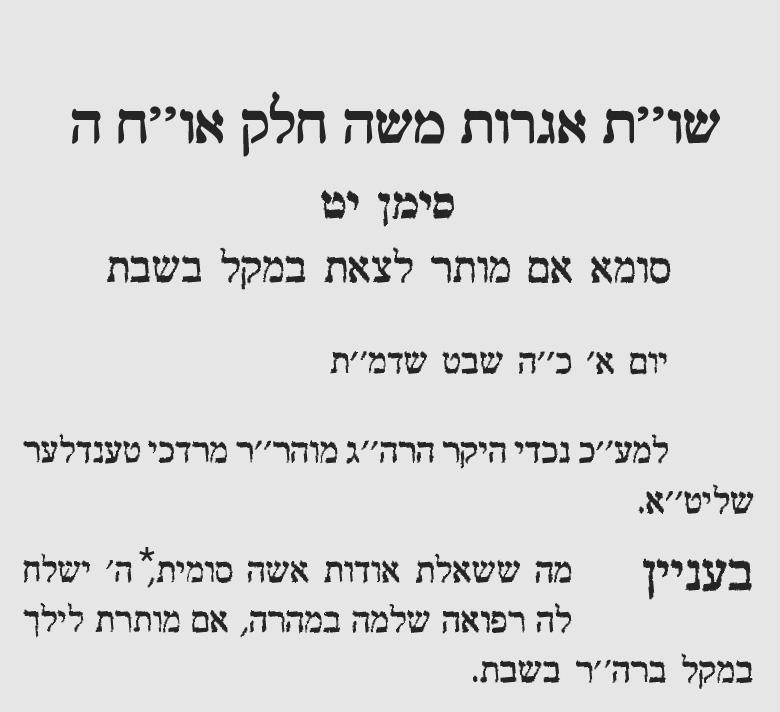
The detractors of eruvin have always claimed that when Hagaon Harav Moshe Feinstein zt”l stated that there is no reshus harabbim today because we rely on the heter of shishim ribo (Igros Moshe, O.C. 3:94, 5:24:10), he certainly did not mean Boro Park or Flatbush. The most illuminating of all his teshuvos is this final one on the issue, regarding a blind woman using a walking stick on Shabbos (ibid., vol. 8, O.C. 5:19). Rav Moshe ends this teshuvah by stating that today we rely on the fact that there is almost no true reshus harabbim. In Kovetz Am HaTorah (1986 no. 11), where this teshuvah was first printed, it clearly states that this woman lived in Boro Park. This very important fact was purposefully omitted from the teshuvah when Igros Moshe volume 8 was printed posthumously!


* Note the omission of the woman’s place of residence.

Saturday, October 08, 2005

The Overwhelming Majority of Rishonim Maintain Lo Asu Rabbim U’Mevatlei Mechitzta

Some think they understand the Rishonim better than the Bais Ephraim and the Gedolie H’Achronim, and that more Rishonim paskin asu rabbim. Therefore, to address this misconception we will list the overwhelming majority of Rishonim who pasken lo asu rabbim: 1. Tosfos (see Bais Ephraim, p. 39b and Avnei Nezer 276:2) 2. Rabeinu Chananel (see Ravyah p. 321) 3. Rambam (17:10, 17:33 and in Mishnayos, Eruvin 2:4) 4. Maggid Mishnah (ibid.) 5. Hagaos Maimones (ibid., basra 9) 6. Ravyah (p. 270) 7. HaEshkol (Eruvin siman 55) 8. Sefer HaBattim (perek 13) 9. Tosfas Ysheinim (Shabbos 6b) 10. Or Zarua (Eruvin 33b) 11. Piskei Mahrach Or Zarua (Eruvin Perek 2 ois 57) 12. Ramak (as cited in Hagaos Ashri, 20b) 13. Rabeinu Chananel Ben Shmuel (Eruvin 22a) 14. Rivevan (Eruvin 22a) 15. Tosfos Rid (Eruvin 22a, and in Piskei 20a) 16. Piskei Ri’az (2:1:6) 17. Sefer HaMeoros (Eruvin 17b).

More so, the Raved, Rabeinu Yonasan, Rashba (who quotes the Raved), Ran, Ramban (see Gaon Yaakov, Eruvin 6), and Meiri (Eruvin 20, 22a) maintain that if we have mechitzos that are omed merubeh al ha’parutz (as opposed to shem daled mechitzos), even Rav Yehudah would agree lo asu rabbim (this was only realized when the aforementioned Rishonim’s Chiddushim were published). [From this we see that the Bais Ephraim and the Chazon Ish were guided min hashomayim. They stated that only the Ritva explicitly states Yerushalyim was omed merubeh al ha’parutz and we pasken asu rabbim like Rav Yehudah which is not contradicted by any of the Rishonim discovered recently.]

The Overwhelming Majority of Achronim Maintain Lo Asu Rabbim U’Mevatlei Mechitzta

Once walls are omed merubeh al haparutz [that is, more than 50 percent of the length of each side must actually consist of a wall] on three sides, nearly all poskim maintain that the multitudes [rabbim] do not negate the enclosure, lo asu rabbim u’mevatlei mechitzta.

What follows is a list of the Achronim who paskin lo asu rabbim u’mevatlei mechitzta: Chacham Tzvi, siman 5, 37; Knesset Yechezkal, siman 2:3; Mayim Rabim, siman 34-36; Maharit Tzahalon, siman 251; Tosfos Shabbos, siman 363; Pri Megadim, Rosh Yoseph, Shabbos 6b; Even HaOzer, Eruvin 6b, 22a; Bais Ephraim, O.C. 26; Noda B’Yehudah, O.C. Mahadura Tinyana, 42 and Teshuvah M’Ahavah, siman 112; She’eilas Yaavetz, siman 7 and Mor U’Ketziyah, siman 363; Shulchan Aruch HaRav, O.C. 363:42, 364:4 and Kuntres Achron, O.C. 345:2; Keren Oreh, Eruvin 7a; Michtam L’David, siman 1; Tiferes Tzvi, siman 11; Chasam Sofer, O.C. 89; HaEleph Lecha Shlomo, siman 181; Aishel Avraham, siman 345; Chai Adam, klal 71:15; Gaon Yaakov, Eruvin 11a, 21a; Chesed L’Avraham, siman 39; Maharham Shick, O.C. 171, 181; Maharia HaLevi, siman 94; Bais Shlomo, siman 43, 51; Tzemach Tzedek, Shabbos 100a and Eruvin, the end of Perek 5; Nefesh Chayah, siman 25; Avnei Nezer, O.C. 273:16, 279:2, 289:2; Aruch HaShulchan, O.C. 364:1; Maharsham, 3:188, 9:18; Yeshuos Malko, siman 21; Harei B’samim, 5:73; Imrei Yosher, siman 102 and Minchas Pitim, siman 364; Kaf HaChaim, O.C. 364:12; Divrei Malkiel, 3:10, 14; Rav Chaim Berlin in Tikkun Shabbos Odessa, p. 28 and in Nishmas Chaim, siman 29; Achiezer, 4:8; Even Yikrah, siman 58, and Chazon Ish, O.C. 74:10, 107:4.

Thursday, October 06, 2005

Part 1: Shishim Ribo According to Hagaon Rav Moshe Feinstein zt”l

Like most poskim, Rav Moshe originally maintained (Igros Moshe, O.C. 1:109) that the criterion of shishim ribo was dependent on the street having shishim ribo traversing it. However, later (ibid., 1:139:5) he formulated his chiddush in which shishim ribo when applied to a city was not dependent on a street but over a twelve mil by twelve mil area. Rav Moshe added that the criterion of shishim ribo ovrim bo would require a sizable population living and commuting into the twelve mil by twelve mil area so that it could physically satisfy the condition of 600,000 people collectively traversing its streets. When these criteria are met, the area would be classified as a reshus harabbim and a tzuras hapesach would not be adequate; dalsos at the pirtzos would be needed. However, at this time Rav Moshe did not quantifying how many people would be required to live in this twelve mil by twelve mil area.

In the first teshuvah quantifying how many people would be required to live in this twelve mil by twelve mil area, Rav Moshe stated (ibid., 4:87) that since in the past eruvin had been erected in cities with populations exceeding shishim ribo, one could not classify a city as a reshus harabbim solely on the basis of the existence of a population of 600,000. He then added that although the actual number of inhabitants could possibly vary according to the city, in Brooklyn it would most likely require four to five times shishim ribo. In the final two teshuvos which followed regarding Brooklyn we see that Rav Moshe codified his chiddush that the requirement is, "just about 3,000,000 people," (ibid., 5:28:5) or, "at least five times shishim ribo," (ibid., 5:29) which could amount to even more than 3,000,000 people. Consequently, in the Chicago eruv pamphlet (West Rogers Park Eruv, 1993 p. 23) it is stated that Rav Dovid Feinstein shlita was in agreement that according to his father's shitah there must be a minimum of 3,000,000 people in order for the city to be defined as a reshus harabbim.

It’s important to note that Rav Moshe maintained the above only regarding shsihim ribo as it applied to a city. However, with regard to a sratya [intercity road] Rav Moshe stated (ibid., 1:139:5, 4:87, 5:28:16) that the shishim ribo would have to traverse the road itself every day.

Sunday, October 02, 2005

The Brilliant Chiddush of the Chazon Ish

Since many people are under the impression that the Chazon Ish’s chiddush ― that there are no cities today that would be classified as a reshus harabbim ― is based only on mechitzos habatim we would like to elaborate on his approach.

The Chazon Ish (O.C. 74:10, 107:4-7) states since, me’d’Oraysa, a break in an enclosure that is omed merubeh does not negate the enclosure, when a street which continues through a city ends, either with houses or a dead end, the whole length of that street with the mechitzos habatim on both sides and its dead end would be considered omed merubeh on three sides, and me’d’Oraysa, a reshus hayachid. As a result, the intersections of that street, which were pirtzos, would halachically be termed k’omed dami, closed. Consequently, all streets that run perpendicular through this street ― which now has three mechitzos and halachically closed intersections ― would in turn be surrounded with three mechitzos themselves, their own mechitzos habatim on both sides of the street and a third wall, the omed of the intersection. This creates a spiraling effect throughout the whole city. The Chazon Ish concludes that there never would be in large cities a reshus harabbim because we would always find one street that is enclosed by three walls. This Chazon Ish is one of the reasons why in Eretz Yisroel eruvin are maintained (Rav Yisroel Yaakov Fisher zt”l in Even Yisroel, 8:36; Kinyan Torah, 4:40, and Rav Chaim Kanievsky shlita in Shoneh Halachos, siman 363).

The Shulchan Aruch Explained

It seems from the Shulchan Aruch (364:2) that if an area encompassed by walls meets the criteria of a reshus harabbim, it would require, at the minimum delasos reuyos l'hinael and a tzuras hapesach would not be sufficient. However, it’s important to note that the Shulchan Aruch is discussing a situation where the area is enclosed by only two mechitzos (a mavoi, see 364:1) and not a walled city. The first opinion of the Shulchan Aruch, the Rif, maintains that to be considered shem daled mechitzos the delasos would need to be neulos ba’laila. According to the second opinion even delasos reuyos l'hinael would suffice to be considered shem daled mechitzos (Rosh Yosef, Shabbos 6b; Even HaOzer, Eruvin 6a, 22a; Shulchan Aruch HaRav, siman 363:42, 364:4; Bais Ephraim, O.C. 26; Avnei Nezer, O.C. 268:4, 276:1, and Chazon Ish, siman 107:4; see also Part 1: Delasos – Me’d’Oraysa or Me’d’rabbanan).

Therefore, if an area is circumscribed with either shem daled mechitzos or three mechitzos omed merubeh al haparutz the Bais Ephraim and all the poskim who paskin like the Chachamim only require a tzuras hapesach at the pirtzos and not delasos reuyos l'hinael.

Saturday, October 01, 2005

Part 1: The Truth About Warsaw

The fact that the city of Warsaw had an eruv is very important to the history of city eruvin since it’s population was greater than shishim ribo. Consequently, the heter to allow an eruv in Warsaw would allow us today to establish eruvin in all large cities. This explains the misinformation disseminated by the anti-eruv camp that the reason why an eruv was permitted in Warsaw was that the Wistula River split the cities population in two and that both sides had less than shishim ribo.

These are the facts:
Rav Shlomo Dovid Kahane zt”l (Divrei Menachem, O.C. vol. 2, pp. 42-43), one of the main rabbanim of Warsaw before World War II, posited that the heter to erect an eruv in a large city such as Warsaw, which was not walled from the year 1877 (Encyklopedia Warszawy, 1994 p. 187), was universally accepted as the streets were not mefulash u’mechuvanim m’shaar l’shaar. More so, he claimed, a small city would have a greater problem establishing an eruv since its streets would be mefulash. In a small city there is usually one main street running straight through the center of the town as opposed to a large city where the streets are generally not straight from city gate to city gate. From the year 1900 Warsaw had a population of more than shishim ribo on one side of the Vistula River which divided the city in two ― the larger side known as Warsaw and the significantly smaller side known as Praga (Rocznik Statystyczny Warszawy 1921 i 1922, 1924 p. 14).

Thursday, September 22, 2005

The Case of the Vanishing Comment

Part of an ongoing commentary on the bias against city eruvin

While R’ Gil Student’s blog, Hirhurim, is one of the finest Jewish interest blogs on the net, when the subject is eruvin, like many others, he consistently shows a partiality. In this post I will illuminate what transpired in the comment section of a post on Hirhurim titled, “The Weirdest Eruv on the Block.” In one of R’ Gil’s prior posts regarding the Flatbush eruv (see the comments to Flatbush Eruv II) he claimed that pirtzos esser is me’d’Oraysa and therefore the mechitzos encompassing Brooklyn are deficient. In the course of that exchange he was shown that Rav Moshe Feinstein zt"l and 99 percent of the poskim maintain that a pirtzos esser is only d’rabbanan. No longer sure what Rav Moshe maintained, R’ Gil fell back on Rav Ahron Kotler zt”l (see comments to The Weirdest Eruv on the Block). Not surprisingly when he was shown that even Rav Ahron would allow the mechitzos circumscribing Brooklyn he summarily deleted that comment. So much for being open minded. What follows is the dialogue - note the last comment which was deleted.

R’ Gil Student commented - It doesn't matter. Eruvin without mehitzos are perfectly acceptable.

Reply - For many reasons there is no comparison between an eruv consisting mostly of tzuras hapesachim with an eruv made up of mechitzos. For one we don’t have to rely on shishim ribo as a heter.

R' Gil Student commented further - If Brooklyn is, indeed, a reshus ha-rabim, then the mehitzos they are using for the eruv are insufficient to enclose the area according to R. Aharon Kotler (I don't know about R. Moshe Feinstein) because they have breaks of more than 10 amos. If Brooklyn is not a reshus ha-rabim then an eruv of tzuros ha-pesah is sufficient.

Reply - Rav Ahron Kotler zt”l would agree that if a tzuras hapesach closes a pirtzas esser and it’s not crossed by a rabbim, even a pirtzos esser does not negate the mechitzos (see Mishkenos Yaakov, O.C. siman 122 p. 144). Since the Brooklyn mechitzos are at the waterfront there is no rabbim traversing the pirtzos. Never mind that Rav Aharon is a daas yachid and even Rav Moshe Feinstein zt”l didn’t agree with him concerning pirtzos esser (see Igros Moshe, O.C. 2:89). To begin with, this whole issue really has no basis since there is no question that the first Flatbush eruv relied on some kulos such as tzuras hapesach min hatzad. Therefore, there is no question that the new Flatbush eruv is superior.

Thursday, September 08, 2005

The Obligation of Eruvin

The Gemara in Eruvin (68a) describes an encounter between the Amoraim Rabbah bar Rav Chanan and Abaye. Rabbah bar Rav Chanan asked Abaye why in a city of two great Amoraim [himself and Rabbah] neither of them had erected an eruv. In an attempt to vindicate himself and Rabbah, Abaye answered that it was not fitting for Rabbah’s dignity to go from door to door collecting the requisite matzos, and that he, Abaye, was so preoccupied with his learning that he had no time to supervise the eruv of the city.

The Mordechai infers from this Gemara that under normal circumstances when the rabbi of an area is not similarly preoccupied, he has an obligation and a mitzvah to erect an eruv for his community.

Following this reasoning the Rosh in a famous teshuvah (21:8) sharply criticizes the leadership of a city whose policy was not to erect an eruv: “ I have already written to you concerning the concept of an eruv, that it is customary in all areas where Jews [reside] to allow carrying in those streets that are open on either end to the [streets where the] gentiles [reside] with [the rectification of] a tzuras hapesach. You forbade such [an eruv] for the congregation of Freres, and you wrote me your proofs, and I informed you that they amount to nothing. I warned you that you must recant and notify the congregation that they should rectify their streets [with an eruv] as their gedolim have accustomed them to. Now I have been told that you still uphold your position, and are thus causing the multitudes to desecrate the Shabbos. I therefore compel you, upon receipt of this letter before witnesses, to rectify the streets that open into the reshus harabbim of the [streets where the] gentiles [reside], with a tzuras hapesach, within a span of a few weeks upon seeing this letter. If you do not rectify the streets as I have written, I will excommunicate you. If you had been in the times of the Sanhedrin they would have executed you, as your aim is to uproot the Talmud edited by Rav Ashi, and to argue with all the gedolim until our times, those who are no longer with us z”l, and those who are still alive” (see also Tashbetz, 2:37).

Sunday, September 04, 2005

Historical Overview of City Eruvin

Since the times of Shlomo HaMelech, cities were fortified with walls that qualified as eruvin. Although these walls at times had breaches, the breaks were small and rectifiable. Relying on city walls for the purpose of eruvin (see for instance Chacham Tzvi, siman 5) was a practice that continued well into the 17th century at which time practically all the Jewish citizenry lived on the Judengasse. The Judengasse usually consisted of a few streets that were sealed with doors, which unintentionally eliminated the need to rectify any breaks in the city’s walls because the boundaries of the Jewish neighborhood were now intact.

During the latter part of the 17th century, when Jews were allowed to move outside those streets, cities had outgrown their walls and newer cities were built without walls altogether. For the purpose of eruvin it was no longer a given that cities were closed and therefore mechitzos had to be constructed. It was obviously easier to use natural walls that circumscribed entire cities, such as riverbanks and canals, than to erect tzuras hapesachim, which would have required permission from the civil authorities. Teshuvos written at that time addressed the possibility of utilizing canals and rivers as the necessary walls to enclose cities such as The Hague (Chacham Tzvi, siman 5 and Ohel Yaakov, siman 73) and Rotterdam (Shev Yaakov, siman 17 and Shvus Yaakov, 3:28). During the latter part of the 19th century, as telegraph, telephone, and electric wires sprung up all over the countryside, they were incorporated into the community eruv as well (Eitz HaChaim, siman 246-249; Maamer Mordechai, siman 31, and Nefesh Chayah, siman 34).

Prior to World War II almost all cities with Jewish populations established eruvin including Vilna (Mishmeres Sholom, 24:10) and Radin (Dugmah M’Darchei Avi, p. 31). In the times of Rav Shmuel Salant zt”l tens of thousands of people utilized the eruv and carried in Yerushalayim on Shabbos (Chazon Ish O.C. 39:5). Even the following large cities with populations of 600,000 erected eruvin: Warsaw (Mishmeres Sholom, 24:10; Divrei Menachem, O.C. vol. 2, pp. 42-43, and Rocznik Statystyczny Warszawy 1921 i 1922, 1924 p. 14), Lodz (Mishmeres Sholom, 24:10 and Encyclopedia Judaica, 1996 vol. 11 p. 426), Odessa (Divrei Malkiel, 3:14-18, 4:3; Tikkun Shabbos, and Tuv Yehoshua), Manchester (introduction Bais Av vol. 2 and Encyclopedia Britannica, 1911 vol. 17 p. 547), St. Louis (Tikvas Zechariah and Encyclopedia Britannica, 1911 vol. 24 p. 24), and New York in 1905 (Oznei Yehoshua, 1:18; Tirosh VaYitzhar, siman 73; Eruv V’Hotzaah, and US Census, 1900).

In order to satisfy the civil authorities and remain inconspicuous, the eruvin of our grandparents’ time relied on existing enclosures such as riverbanks and telegraph wires. As a result of the circumstances under which these eruvin were constructed, the poskim usually permitted major leniencies. As is evident from nearly all the teshuvos written about eruvin prior to World War II, the question then was not whether an eruv was permissible, only how to construct one. Just as it was the responsibility of each rav to insure that there be a kosher mikveh in his community it was incumbent on each rav to erect an eruv as well (Teshuvos V’Hanhagos, 1:844; see also Chasam Sofer, O.C. 99). If the rav of the city did not erect an eruv, it was not for the lack of effort; the civil authorities did not permit the construction of one.

Today we are fortunate that we can erect our own tzuras hapesachim and to construct eruvin that are far superior to the ones that were erected in the preceding era.

Watch this Space for an Upcoming Exposé

Stay tuned for an exposé on an eruv builder based out of Chicago who travels across America, actively seeking flaws in community eruvin . ...