Thursday, August 04, 2011

Arichas Shulchan HaLevi: Rejoinder to HaGaon HaRav Belsky Shlita, Part 1

הקדמה
 עריכת שלחן הלוי

תשובת הגר"י בעלסקי שליט"א בענין תיקון עירובין בעיירות גדולות שדרים בה יותר מס' רבוא, שהדפיס זה מקרוב בספרו החדש "שלחן הלוי" (פרק י"א) בלשון הקודש, הוא מהדורה מורחבת לתשובתו שהדפיס בספרו בשפת אנגלית.
    הגר"י בעלסקי ידוע ומפורסם בגולת אמריקה, ובספרו זה שהופץ לאלפים, פרסם את דעתו השלילית נגד תיקון עירובין בעיירות גדולות, ובתשובתו זו האריך פי כמה וכמה מכל שאר תשובותיו בעניניו השונים.
    אכן דבר גדול עשה בעמיו הגר"י בעלסקי בתשובתו זו, כי עד הנה נשארו כמה וכמה "נבוכים" שנמנעו לסמוך על היתר הטלטול בעירוב, כי לא נחתו לברר מה היתה מסורת ההוראה הנהוגה בעיירות הגדולות, וע"כ החליטו ד"שב ואל תעשה עדיף". אך מעתה שהעלה על שלחנו החדש את כל טענותיו השליליים, נפתחה האפשרות להשיב עליהם, אחת לאחת, מבלי להשאיר לנבוכים שום ספיקות ופקפוקים.
    ברם חזינן ב'הלכתא רבתא דשבתא' פליאה נשגבה, מדוע מחלוקת תורנית זו שונה משאר המחלוקות ההלכתיים שבתורה, שאלו מתירים ואלו אוסרים, אלו מקילים ואלו מחמירים, שכנהוג כל אחד סומך על מורו ורבו בהוראת איסור והיתר, מבלי שום התגודדות. משא"כ בהלכות עירובין נראים הדברים כאילו אין רשות לרב ומורה צדק פלוני להורות אחרת ממה שפוסק רב ומו"צ אלמוני. ומדוע לא יצא הקצף בעניני מקוואות, או בעניני שחיטה וניקור, שמנהגי הוראותיהם אינם דומים זה לזה, והנה על מצות תיקון עירובין מקימים קול צווחה, בהתפרצות זעם וחימה, עד כדי מקלליה מות יומת ר"ל.
    התירוץ הוא פשוט, דבעירובין עסקינן ב"רשויות"! דהיינו מיהו כאן ה"בעלים" על השכונה, ותו לא מידי.
    וכבר הגדיר זאת בחכמתו הגאון הגדול רבי מיכאל דוב ווייסמאנדל זצ"ל כמה שבועות סמוך לפטירתו, כאשר נכנסו אליו קבוצה מתלמידיו לבקרו בבית החולים, ובין השיחים הציע הגאון שאלה לתלמידיו: היודעים אתם מדוע עדיין לא נתקן עירוב בברוקלין? ומניה וביה השיב בלישנא חכימא: "הסיבה היא: כי על עירוב יש רק "ברכה אחת"... ועדיין לא הוחלט מי מהרבנים יתכבד בברכה זו..." (מפי תלמידו הרבני הנגיד מו"ה נחום הירש הי"ו ממונסי שהיה נוכח בין המבקרים).
    כאמור האריך הגאון בעל שלחן הלוי שליט"א בתשובתו זו, להראות את הצד השלילי שבשלילי, מבלי להעלות על דעת הקוראים שיש בכלל איזה צד חיובי ומעלים לגמרי את ההשקפה הטהורה של גדולי דורות הקודמים שהשתדלו לעשות כל טצדקי לתקן עירובין (אף אם נזקקו לסמוך עצמם על קולות ע"ג קולות בהשתמשם על עמודי הטעלעגראף), כי מבלי עירוב כמעט לא שייך להשמר מאיסור הוצאה החמורה, כמבואר היטב ב"קונטרס התשובות" (סימן א) שבסוף ספר "טהרת ישראל" (ווארשא, תרפ"ג) דמונה שם כמה וכמה מכשולות - המצויים אף בזמנינו, עי"ש בעמודים 252-251), שע"כ אין לשהות בשבת מבלי עירוב אפילו שעה אחת, כי הוא צורך גדול ושעה"ד. וכ"ש בזמנינו שאין צורך כלל לסמוך על שום קולות, והעירוב דידן הוא למהדרין מן המהדרין.
    וסימן לדבר שמחלוקת זו אינו לשם שמים, מדחזינן תוצאותיה בריש גלי שאפילו בעיירות הקטנות נמנעים רבנים חרדיים מלהזדקק לבדוק את כשרות העירובין ברחבי ארה"ב, שרובם נבנו לפני הרבה שנים ע"י הרב הגאון רבי שמעון איידער ז"ל תלמיד בעל האג"מ זצ"ל, ומאז פטירתו נזנח מאד בדיקת כשרותם והמכשלה מרובה, ואין ספק שמערכה זו היא הגורם לכך, כי מצוות "עירוב" נהפך אצלם למושג של גנאי ר"ל, עד שאין זה מכבודם (ס'פאסט ניט) של הרבנים החרדיים להזדקק לבודקם, בו בזמן שתפקיד זה של בדיקת כשרות העירובין היה מוטל מאז ומקדם על רבני העיר, כמו כשרות השחיטה והמקוואות. והרי לנו דוגמא ממכשלת העירובין של השכונות החרדיות בלייקוואד, כל שכונה בפני עצמה (חתיכות חתיכות) שחלקם הגדול אין עליהם פיקוח והשגחת רבנים כראוי, והמכשלה מצויה.
    לאור כל הנ"ל ראינו לנכון ולנחוץ לערוך שולחן נגד, זה לעומת זה, להראות את צד השני של המטבע - שטבעו חכמים, למען ידעו שמנהג "מסורת ההוראה" של רבותינו פוסקי הדורות, הי' לתקן עירובין בכל תפוצות ישראל, אף בעיירות גדולות מרובות באוכלוסין יותר מס' רבוא. והרי תורה היא וללמוד אנו צריכין לדעת ולהבין יסודות טעמיהם ונימוקיהם.
    ולא מבעיא שסברותיו והמצאותיו של בעל שלחן הלוי הם מנוגדים מכל וכל לדעת פוסקי הדורות הקודמים כמו המשנה ברורה והערוך השלחן, אלא הם מנוגדים אף לדברי גאון דורינו בעל אג"מ זצ"ל, למרות שכביכול מדבר וכותב בשמו, כאשר יראו ויווכחו עיני הקוראים.
    אשר על כן, העתקנו מתשובתו הנ"ל כל קטע וקטע בפני עצמה שיש עליה השגה או פירכא, והשתדלנו להעיר עליה כיד ה' הטובה, מבלי שום משוא פנים בהלכה. ואם אשתמוטי קא משתמיט איזה לשון ביקורתי הנראית כזלזול בכ"ת, אין זאת אלא תגובה טבעית על דברי הזלזול והבזיון מצד כ"ת נגד כמה וכמה מורי הוראה בישראל, שכ"ת הפליטם בפני תלמידי הישיבה, בהזכירו את שמותם של הרבנים, בתוספת כינויים של גנאי, שאין לך אח וריע בזלזול וחילול כבוד רבני ישראל, באשר כל "חטאם" שאינם סוברים בהלכה כדעתו, ועכ"ז עמו הסליחה על שהכריחנו למחות נגדו, עכ"פ בדברי תורה.


או"ק א
וזה לשון הגר"י בעלסקי שליט"א:
רשות הרבים דאורייתא אי אפשר לערבה בצורת הפתח בלבד, וצריך שיהיו לה מחיצות גמורות וגם שיהיו דלתותיה ננעלות בלילה.

אמת, אך:
הואיל ורוב הפוסקים ס"ל שצוה"פ מועיל מן התורה לרה"ר, הרי דלאחר שתיקנו צוה"פ, א"כ כל הנידון אינו אלא מדרבנן, ובמלתא דרבנן סגי כל צד וספק להיתר 
    ואלו הם הפוסקים שצוה"פ מועיל מה"ת: פמ"ג בספרו ראש יוסף (שבת ו ע"ב), שו"ע הרב (או"ח סימן שס"ד סעי' ד), הגר"ח מוואלוז'ין (בריש ספר אוצר רבי חיים ברלין - שו"ת נשמת חיים), גאון יעקב (עירובין יא ע"א), צמח צדק (עירובין סוף פרק ה), אשל אברהם (סימן שמ"ה), שו"ת ישועות מלכו (או"ח סימן כ"א), שו"ת אבני נזר (או"ח סי' רע"ג או"ק טז, וסי' רע"ט או"ק ב, רפ"ט או"ק ב), ערוך השלחן (או"ח סימן שס"ד סעי' א), שו"ת לבוש מרדכי (או"ח סימן ד).

וזה לשון הגר"י בעלסקי שליט"א:
ואיזוהי רשות הרבים, מפורש בגמ׳ שהיא דרך הרחבה ט״ז אמות (שבת צט ע״ב). ורש״י במס׳ עירובין (ו ע״א ד״ה רשות הרבים) כתב דבעינן גם ״עיר שמצויין בה ששים רבוא״. והסכימו עמו התוס׳ שם (ד״ה רשות הרבים), ועוד רבוותא מן הראשונים.

אכן, אך יש להעיר:
א) מה שהזכיר רש"י "עיר", יתבאר היטב להלן (באו"ק ד') דאין זה כפשטות דבריו, כי מהבנת דברי הראשונים והאחרונים, תליא בדריסה על רחוב העיר דייקא, ולא על דיורי העיר. 
     ב) מקור דברי רש"י הוא מאילנות גדולות, הלא הם רבותינו הגאונים, ובראשם רבינו הבה"ג, כמבואר בתוס' (עירובין ו ע"א) וז"ל: "וכן יש ב'הלכות גדולות' דבעינן דריסת ס' רבוא". וכן הזכירו הרמב"ן (עירובין נט ע"א) דב'הלכות גדולות' נמצא כן, והרי הדבר תלוי באילנות גדולות" (עי' כוונת הרמב"ן בזה בשו"ת בית אפרים סוף סימן כ"ז), וכן נזכר הבה"ג בחידושי הר"ן (שבת ו ע"א), ובמהר"ם מרוטנבורג (פסקים עירובין אות ט), ובתוס' הרא"ש (עירובין ו ע"ב). ומלבד הבה"ג הזכירו עוד גאונים שיטת ס' רבוא, והם רב עמרם גאון (הלכות פסוקות מן הגאונים, סימן ע), רב שר שלום גאון (חמדה גנוזה סימן ע ושערי תשובה סימן רט), וספר העתים (אות רו) בשם גאון.
     וידועים דברי התוס' (חולין מד ע"א ד"ה כדי תפיסת היד) שדברי הבה"ג הם דברי קבלה ויש לסמוך עליהם, וכן כתב הרא"ש בשם הראב"ד (ברכות פ"ד אות יד), ובש"ך (יו"ד סימן כה ס"ק ב) וז"ל: וכמה מצינו שהתוס' וכל הפוסקים חששו לדברי בה"ג אפילו היכא דלא מסתברא טעמיה, אפילו להקל, מפני שכל דבריו דברי קבלה".
    ג) תימה, איך מתעלם כ"ת דיש עוד תנאי יסודי לרה"ר, והוא "מפולש ומכוון מעבר לעבר", דמבלעדי תנאי זה, לא הוי רה"ר. ולהלן באו"ק ו' יתבאר העלם דבר זה מחמת "סיבות מסויימות"!! 

וזה לשון הגר"י בעלסקי שליט"א:
לעומת זאת, רבים מן הראשונים נחלקו על זה וס״ל דלא מצינו בשום מקום בתלמוד דבעינן ס׳ רבוא בעיר כדי שיחשב רה״ר, וע״כ כל מקום שהוא רחב ט״ז אמות ה״ה רה״ר מדאורייתא. (עי׳ ב״י או״ח סי׳ שמה, שהביא בקצרה הדעות בזה).

אמת, אך כבר נמנו וגמרו בדורות האחרונים:*
דרוב בנין ורוב מנין של הראשונים (42 נגד 11) נקטו דבעינן ס"ר לרה"ר, הלא הם:  
א. הלכות גדולות (בה"ג)  ב. רב עמרם גאון  ג. רב שר שלום גאון  ד. גאון המובא בספר העתים ה. רש"י ו. תוספות ז. האשכול ח. המנהיג ט. ספר התרומה י. סמ"ג  יא. ספר העיתים יב. ראב"ן  יג. פסקי הרי"ד יד. רוקח טו. ראבי"ה  טז. ריא"ז  יז. אגודה  יח. ריבב"ן  יט. אגור כ. מהרמ"ק כא. רבינו ירוחם כב. אור זרוע  כג. פסקי מהר"ח או"ז כד. מהר"ם מרוטנבורג כה. סמ"ק כו. צידה לדרך כז. מחזור ויטרי  כח. העיטור כט. רא"ש  ל. הגהות אשר"י לא. ספר הנייר לב. הגהות מיימונית לג. מרדכי  לד. אורחות חיים לה. טור  (ובנוסף יש עוד גאון וכמה ראשונים שכתבו דלית לן רשות-הרבים בזמן הזה: לו. רב פלטוי גאון לז. שבלי הלקט לח. תניא רבתי לט. ריקאנטי  מ. מהרי"ל  מא. לקט יושר  מב. תוס' ישנים.
*כמבואר ב"ערוך השלחן" (סימן שמ"ה סעי' י"ז) וז"ל: "והנה מפרשי השו"ע (ט"ז ומג"א) כתבו דרוב הפוסקים סוברים כשיטה זו (דבעינן ס' רבוא), האמנם אחד מהגדולים בדור שלפנינו (ה"ה המשכנ"י) הרעיש העולם על העירובין שלנו והראה בעליל שהאוסרים הם הרבה יותר מהמקילים, אך מפרשי השו"ע לא ראום, כי לא נדפסו בימיהם", עכ"ל, עד"ז חזינן שאכן הופיע רוה"ק בבית מדרשם של מפרשי השו"ע רבותינו המ"א והט"ז, כי בדורות האחרונים נתגלו עוד  כמה וכמה ראשונים שלא נדפסו בזמנו של המשכנות יעקב ואף לא בדורו של המשנה ברורה.

וזה לשון הגר"י בעלסקי שליט"א:
ושנים מגדולי הפוסקים אחרונים הלא המה המשכנות יעקב והבית אפרים, נחלקו הלכה כמי. המשכנות יעקב (בשו״ת שלו, סי׳ קכ-קכב), ס״ל שיש להחמיר, ולהחשיב כל רחוב הרחב ט״ז אמות כרה״ר אף אם אין ס״ר בעיר. לעומת זאת הבית אפרים (שו״ת, סי׳ כו), פסק להקל כרש״י ותוס׳ שאין להחשיב רה״ר עד שיהיו ס״ר בעיר.

אחר המחילה, מחלוקת זו אינה בגדר "ספק השקול":
דהרי אנו בני אשכנז גרירן בתר הרמ"א ז"ל (או"ח סימן שמ"ו ס"ק ג') שפסק להלכה דלית לן רה"ר בזמן הזה וכל רשויות שלנו הם כרמלית, והוא משום דאין מצוי ס' רבוא בוקעין. ולמעשה שיטת הי"א נתקבלה אצל כל גדולי הפוסקים, כמבואר בשו"ת מהרי"ט צהלון (סימן רנא הובא בשערי תשובה), ושו"ת מהרי"ט (ח"א סימן צד), ושו"ת פני יהושע (סימן טו) ופני יהושע (שבת דף ה), שו"ת בית אפרים (סימן כו), שו"ת ישועות יעקב (סימן שמ"ה סוף ס"ק ד), שו"ת הרי"ם (או"ח סימן ד), שו"ת מהר"י אסאד (או"ח סימן נד), שו"ת מהרש"ם (ח"א סימן קסב וח"ג סימן קפח, קצח), שו"ת דברי מלכיאל (ח"ג סימן י), כף החיים (סימן שס"ד אות א), חזון איש (סימן פו או"ק טו).
     וכן כתב בשו"ת ישועות מלכו (או"ח סימן כא) "כבר נהגו לסמוך על שאין רשות הרבים בזה"ז, והוא דעת בה"ג ורש"י ותוספות (עירובין נט.), ומי הוא זה שיתחזק לבטל המנהג שנהגו זה כמה מאות שנים".
      ואכן כך הורה פוסק דורנו הגאון הגדול בעל שו"ת אגרות משה ז"ל (באו"ח ח"ה סימן כד) דנוהגין בהחלט כשיטת הי"א, וז"ל "צריך להבין מה שנשים נוהגות היתר בלבישת בתי ידים ברחובות שבמדינתינו וכו', משום דבמקומותינו נוהגין בהחלט כרש"י שליכא דין רשות הרבים כשאין בוקעין ס' ריבוא".

וזה לשון הגר"י בעלסקי שליט"א:
ואף שהמשנ״ב כתב כמה פעמים שבעל נפש יחמיר על עצמו (עי׳ סי׳ שמה ס״ק כג, וביה״ל שם ד״ה שאין. ובסי׳ שסד ס״ק ח וביה״ל שם ד״ה ואחר), המנהג ברוב הקהילות היה לסמוך לקולא, שחייב להיות שישים רבוא כדי שתחשב רשות הרבים דאורייתא.

אכן, ובדידן ההיתר מרווח ומחוור אף לבעל נפש:
ומה שכתב המשנ"ב דבעל נפש יחמיר לעצמו, הוא משום דנמשך בזה אחר המשכנ"י (שהעתיק דבריו בביאו"ה ד"ה וי"א) שעפ"י מניינו רוב ראשונים לא סברו כדעת רש"י, והאוסרים הם רבים מן המקילים. אך לאור שחזר ונתברר בתקופתינו שדעת המתירים המה הרבים, וכדברי הט"ז והמג"א,  ובפרט דאיכא רוב גדול מאד (42 נגד 11) דקאי בשיטת הבה"ג ורש"י והתוס' דלית רה"ר מבלי דריסת ס' רבוא, א"כ פשוט דהיתר הטלטול בצוה"פ הוא מרווח ומחוור אף לבעל נפש [וזהו מלבד שאר תנאי רה"ר שאינם קיימים ברחובותינו, וכדיתבאר להלן, וכדברי המ"ב עצמו בביאו"ה (שם) בשם האלי' רבא שבמקום שיש עוד (אפילו רק) "צד" להקל, אף בעל נפש יכול לסמוך על שיטת הי"א].
     ועוד, חובה להזכיר טענת הגאון רבי ישראל יעקב פישער זצ"ל בספרו שו"ת אבן ישראל (ח"ח סימן לו) וז"ל "משנה ברורה הביא דברי המשכנות יעקב, ולא ראה דברי הבית אפרים שהוכיח דלא כן הוא, וכן נקטו גדולי הפוסקים כשיטת רש"י, המג"א והט"ז והפמ"ג ושו"ע הרב, דמעיקר הדין נקטינן להקל, וכ"כ שם בסוף סימן לז: "לרוב הראשונים אין רשות הרבים דאורייתא אם אין בעיר ס' רבוא כמו שהאריך בשו"ת בית אפרים, והמשנ"ב לא ראהו, ולא הביא רק דברי המשכנות יעקב". וכבר כתבו כן בספר תולדות שמואל (ח"ג מצוה ל"ב סימן פ"א או"ק ז ובסימן פ"ו או"ק ח), ובשו"ת בית אב (ח"ב ס"ה) שהמשנה ברורה לא ראה את דברי הבית אפרים.
ואכן מוכח כן מהמשנ"ב עצמו בהל' ברכת הפירות סימן ר"ח סעי' ט, וז"ל המשנה ברורה בביאו"ה שם ד"ה אינו מברך: "עי' בשערי תשובה שכתב וכו' ולא ביאר טעמו [וספר בית אפרים שלו אין בידי]". ובכאן 'סילוק השולחן' על או"ק א'.

או"ק ב

וזה לשון הגר"י בעלסקי שליט"א:
הצדדים הקלושים להתיר: עד לדור האחרון לא היה בשאלה נפק״מ למעשה, כי לא היו אז ערים כה גדולות כמו שהיו מצויים ברחבה בזמן הגמ׳, אבל בתקופה מאוחרת יותר, כאשר גדלו הערים הגדלות והיה לחזון נפרץ שיש ערים שדרים שם שישים רבוא, טרחו למצוא טעמים וסיבות להתיר את העירוב גם בעיר גדולה, ולמצער לומר על חלקים מסויימים של העיר שלא נחשבים לרשות הרבים דאורייתא.


דברי כ"ת שליט"א בתיאור גודל הערים עד הדור האחרון, המה מופלאים:
דהנה מה שכתב ש"עד לדור האחרון לא היו אז ערים כה גדולות כמו שהיו מצויים ברחבה בזמן הגמרא", המה מוכחשים מכמה וכמה פוסקים:  א. החכם צבי (סימן ל"ז) וז"ל "אינגלטריה (ענגלאנד) שהיא ארץ רחבת ידים ויש עליה כמה סרטיות ופלטיות בתוכה דדרסי בה רבים ואולי ס' רבוא". ב. היעב"ץ (במור וקציעה סימן שס"ג) וז"ל "שהים במקום הנמל שספינות רבות עוברות שם, כגון אמשטרדם ולונדון שאפשר ששים רבוא בוקעים בנמליהם, יהא לו דין רשות הרבים". ג. הבית אפרים (בסימן כ"ו) וז"ל "דאף הפוסקים דתלו טעמייהו שאין ר"ה משום שאין רחב י"ו אמה ולא הזכירו ס"ר, לפי שהי' מצוי שם כמה עיירות גדולים במדינת אשכנז וצרפת ואינגלטירא שהי' בו ס"ר כגון עיר הגדולה פאריז לונדן ווינא ופפד"מ ועוד רבים כהנה כרכים גדולים אשר המה רוכלי העמים ומרובה באוכלסין מאוד". ד. האשל אברהם (סימן שמ"ה סעיף י"ד) וז"ל "והרבה מקומות יש בהם ששים רבוא בוקעים בכל יום". ה. הדברי מלכיאל (בח"ד סוף סימן ה) וז"ל "נהגו לערב בכרכים גדולים מאוד, ולא חששו למה שיש שם ס' ריבוא". ו. הנשמת חיים (סימן כ"ט) וז"ל "העיר אדעסא נודעת לרבתי עם, רוכלת העמים, ויוכל היות שס' רבוא בוקעים בה". ז. האחיעזר (ח"ד סימן ח) וז"ל "והנה בודאי נראה שפאריז היא רה"ר גמורה מה"ת, שיש בה ששים רבוא בוקעים". ח. האגרות משה  (באו"ח ה סימן כ"ח או"ק ה) וז"ל "ומווארשא שעשו שם עירובין, אף שהיה כרך גדול ידוע לפי חשיבות כרכים גדולים שברוסלאנד ופולין לא היו בה ס' רבוא ברחובות שהוא רק בעיר שדרים בה ערך קרוב לשלושת מיליאן נפשות, ועוד.

וזה לשון הגר"י בעלסקי שליט"א:
אולם כל הטעמים והתירוצים שנאמרו בזה להתיר אין להם יסוד, כפי שיראה הרואה.

אכן נעיין בדברי כ"ת ונשתדל לדון בהם כהלכה ללא שום משוא פנים.

וזה לשון הגר"י בעלסקי שליט"א:
יש שחדשו סברא שלמדרכה [sidewalk] יש דין אחר מאשר באמצע הכביש, מפני שהמדרכה נחשבת ״צידי רשות הרבים״. אולם אין שום ממש בסברא לומר שהמדרכה היא צידי רשות הרבים, כי הגדרת ״צידי רשות הרבים״ היא, שה״צידי״ הוא חלק של הרשות הרבים, אלא ״שאין תשמיש אותו מקום נח לעבור ולהשתמש בו הרבים דרך הלוכם״ (לשון הרשב״א בעבודת הקודש בית נתיבות שער ג סי׳ א). וזהו מקום ״סמוך לכתלים שאין דרך בני אדם לעבור שם ולהתחכך בכותלים״ (לשון רש״י כתובות פו ע״ב ד״ה צידי) - וכן כיוצא בזה נמצא למכביר בלשונות הראשונים. והלא הסיבה היחידה שיש מדרכה היא כדי שיהיה יותר קל ללכת, ושתנועת כלי הרכב לא תפריע להילוך הרבים - ואיך יעלה על הדעת להגדירו ״כצידי רשות הרבים״.

אמת ויציב ונכון, אבל:
מעולם לא שמענו טענה זו מהרבנים התומכים בהעירוב, אפילו בתורת "סניף" להיתר. ואם זכרוננו אינו בוגד בנו, טענה זו דוקא נשמעה בהקלטת (טייפ) שכ"ת השמיע לתלמידיו בישיבת תו"ד בשנת תש"ס, בהנוגע לרחוב 48 (הנקרא Bobov Promennade ) כהיתר (כביכול) על צוה"פ שתיקנו על המדרכה.

וזה לשון הגר"י בעלסקי שליט"א:
עוד אומרים, שישנם רחובות צדדיים שאינם נקראים רשות הרבים, והתעלמו לגמרי מהדין שמבוי המפולש בשתי יציאותיו לרשות הרבים נחשב לרשות הרבים, ואין בזה שום מחלוקת.

לא זכינו להבין דבריו המופלאים:
ממה נפשך, לאלו הנוקטים שהס"ר תלוי באוכלוסי העיר, כל ענין זה אינו נוגע כלל, כי כל העיר הוא רה"ר. ומאידך רוה"פ הנוקטים שהס"ר תלוי בדריסה על רחוב העיר, סוברים שגם המבוי המפולש מן הצד צריך להיות בעצמו ס' רבוא, "ואין בזה שום מחלוקת". ולא עוד, דהנוקטים שהס"ר תלוי בדריסה על רחוב העיר, לא יתכן כלל שהמבוי יפולש לרה"ר, כי הרי אין רחוב שיש עליה דין רה"ר. 

וזה לשון הגר"י בעלסקי שליט"א:
ויש מי שהפליג לטעון שמאחר ומצד ״דינא דמלכותא דינא״ על כל אחד לעצור ב״אור אדום״, לכן נחשב ה״אור אדום״ כמו חומה המפרידה בין רחוב אחד לשני. ועל יסוד רעוע זה וכיוצא בו רוצים להעמיד את כל ההיתר לעירוב בערים הגדולות.

אחר המחילה מכ"ת, כבר הורו לנו חז"ל דבמקום שיש חילול ה' אין חולקין כבוד לרב:   
א) מדוע מסתיר, כאן, את "מי שהפליג"? בעוד שכ"ת מזכירו בעצמו להלן (באו"ק ה') דה"ה כ"ק האדמו"ר מקלויזנבורג זצ"ל. ב) מאחר שכ"ת יודע מיהו אותו גדול,  ואפילו הסתייע בדבריו (להלן באו"ק ה'), והאיך מזלזל כ"כ בענין נימוקו (אור אדום) עד כדי כך שאין בו שום ערך אפילו להתייחס עליו??? ג) הואיל וכ"ת יודע מקור מוצא הנימוק הנ"ל, האיך שותל טעם זר בדבריו (כמו "חומה המפרידה") שמעולם לא יצא מפי קדשו ולא מתחת קולמוסו, בעוד שכ"ת הרי ראה מפורש באותה תשובה שטעמו ונימוקו הוא מצד "עיכוב הפילוש", ומתבסס על יסוד שכתבו כמה מגדולי הפוסקים (אשל אברהם, שו"מ, אבנ"ז) דכל עיכוב בפילוש מבטל רה"ר. ד) בתשובתו הנ"ל כתב מפורש כ"ק האדמו"ר מקלויזנבורג זצ"ל על נימוקו זה דהוא סניף ו"צירוף" ולא יסוד, ובא כ"ת ומהפך הקערה על פיה וזועק ד"על יסוד רעוע זה וכיוצא בו רוצים להעמיד את כל ההיתר לעירוב בערים הגדולות", הרי אין לך חילול ש"ש וכבוד התורה וחכמיה יותר מזה.

וזה לשון הגר"י בעלסקי שליט"א:
סברות כמו אלה המשמשות פעם אחר פעם בבניית עירובים בערים הגדולות, הן סברות קלושות שבשום תחום אחר של הלכה לא ימצא מי שיעז להשתמש בהן - מלבד כשהוא נוגע בדין ברשות הרבים - שהוא מהאיסורים היותר חמורים בתורה (עי׳ בסוף דברינו).

מה נאמר ומה נדבר:
"סברות התורה" כמו אלה שהזכירו רבותינו גאוני עולם, כהאשל אברהם, השואל ומשיב, והאבני נזר, ועוד ועוד, פשיטא דשקולים יותר מסברות כרסיות עצמיות, כי טובה צפרנן של ראשונים מכריסן של אחרונים. ובכאן 'סילוק השולחן' על או"ק ב.

Tuesday, July 12, 2011

The Flatbush/Williamsburg Eruv Imbroglio Continues

Part of an ongoing commentary on the bias against city eruvin.


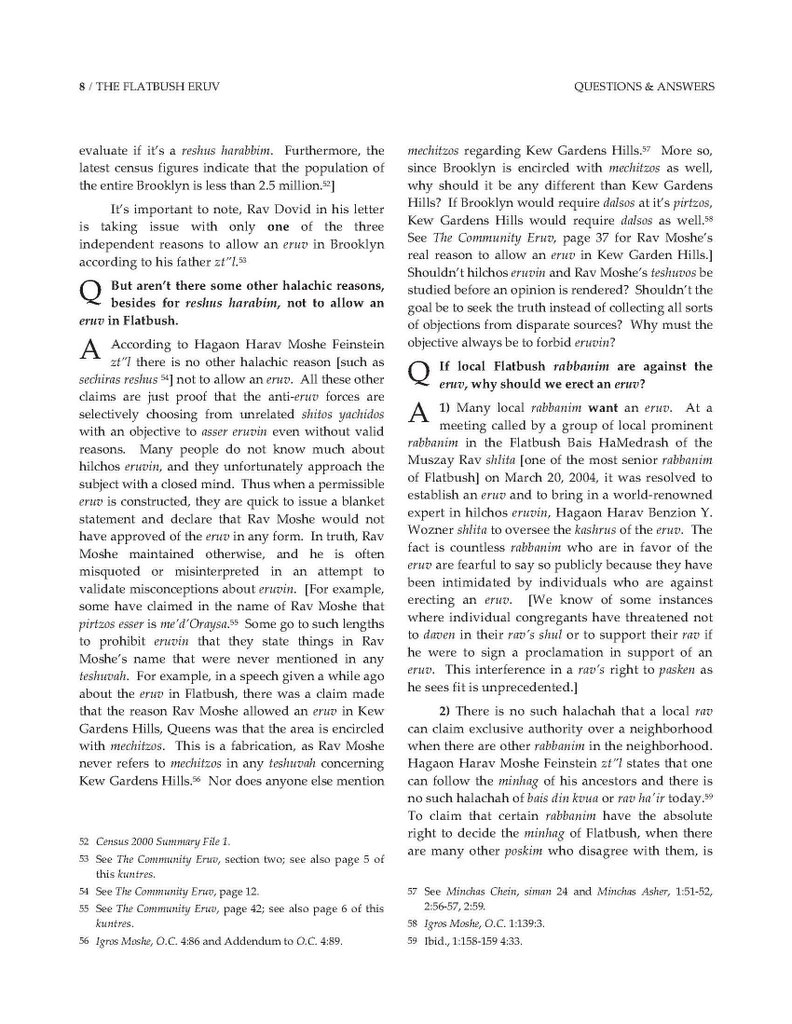
Recently (April 28, 2011), Rav Moshe Scheinerman shlita, rav of Kollel Bnai HaYeshivos in Flatbush, gave a speech at an asifa opposing the eruv in Williamsburg. [Since he maliciously attacked and was mevazeh the rav who gives the hechsher on the Flatbush eruv, I will not (as of yet) disseminate the audio clip.] Much can be said regarding many of the points raised (and those not mentioned) by Rav Scheinerman in his speech; however, to illustrate the irrationality practiced when the subject is eruvin, I will raise a few rhetorical questions.

  • All the Satmarer rabbanim gave their approval for an eruv to be established in Williamsburg from the years 1972-1981 (Part 1: The Truth About the Satmar Rebbe and a Williamsburg Eruv). Does Rav Scheinerman know better than these rabbanim what the Satmarer rebbe’s opinion regarding eruvin really was?
  • Until the current group of eruvin was established no one ever claimed that the Satmarer rebbe maintained that Brooklyn is a reshus harabbim. On the contrary, the fact that the major Satmarer rabbanim allowed an eruv and that street eruvin were always erected in Williamsburg is clear proof that the rebbe did not maintain that Brooklyn is a reshus harabbim. Does Rav Scheinerman know better than these rabbanim what the Satmarer rebbe’s opinion was regarding reshus harabbim? [The fact that some in Satmar believe today that the rebbe was of the opinion that Brooklyn is a reshus harabbim demonstrates how good the anti-eruv cabal is at rewriting history.]
  • Is Rav Scheinerman arguing that one should not follow his rav? Isn’t the halachah k’basrai?
  • Didn’t Rav Moshe Feinstein zt”l maintain that when one follows one’s rav on any issue, even on issurei chilul Shabbos, albeit the halachah is not like his rav’s interpretation, no aveirah is transgressed (Igros Moshe, O.C. 1:186)? In light of this Igros Moshe, does Rav Scheinerman still maintain that one should be mocheh against those who are just following the ruling of their rav?
  • If Rav Scheinerman has the right to preach his anti-eruv rhetoric which is in opposition to the rabbanim hamatirim, in Williamsburg [note that the Williamsburg eruv is supported by the foremost halachic authority in America], why doesn’t Rav Benzion Y. Wosner shlita ― an expert on the construction of eruvin, who was summoned by the rabbanim supporting an eruv in Flatbush (see Questions and Answers Regarding the Flatbush Eruv, p. 8) ― have the right to give a hechsher on the Flatbush eruv, despite the fact that there are rabbanim haossrim?
  • Surely there are many matters regarding Yidishkeit in Flatbush that the rabbanim of Williamsburg would protest against. Would it be appropriate for the Williamsburg rabbanim to protest against these perceived laxities in the Flatbush community?
  • Does Williamsburg, a neighborhood with fifty years of protest experience against issues that they maintain are important to Yidishkeit, need to import a rav from Flatbush to teach them the importance of protest?
These inconsistencies ought to come as no surprise to those who have followed the bias against the establishment of city eruvin.

It is telling that he claims victory in Flatbush but yet feels the need to viciously attack those who disagree with him. Clearly he believes that the issue of eruvin only belongs to those who he deems are the gedolim.

Finally, the anti-eruv group was mostly content with publicly harassing the layman who use the Brooklyn eruvin and only subtly denigrating the rabbanim who support the eruv. However, Rav Scheinerman has brought the war down to a new level — he is willing to publicly flog the supporting rabbanim.

[It is of interest to note that Rav Scheinerman proved what I have argued all along that the anti-eruv cabal lied to Rav Dovid Feinstein shlita. He claims that after the cabal consulted with Rav Dovid, he declared conclusively that his father never retracted his opposition to a Brooklyn eruv, when in fact no one ever argued otherwise. The only claim that the supporters of the Brooklyn eruvin made was that if Rav Moshe would have known the facts, he would have allowed the current eruvin.]

Wednesday, July 06, 2011

Rav Moshe Feinstein Zt”l: A New Discovery, Part 2

After having read part 1 of this post, the significance of my discovery can be more readily understood. Lately 
I happened across Rav Yecheskel Grubner’s Kenesses Yecheskel (vol. 1, 2009) where he documents the proceedings of the Detroit eruv. His account validates my understanding of Rav Moshe’s shita regarding distinguishing a neighborhood that contains a population of less than shishim ribo with a tzuras hapesach.
From the above, we see that Rav Moshe was apprised of the fact that the city of Detroit proper is built up and contiguous with these two neighborhoods, and they were not delineated from Detroit proper in any way. Additionally, while Rav Moshe knew that the whole area including the two neighborhoods are part of Metropolitan Detroit, nevertheless, he allowed the establishment of these eruvin.

Furthermore, Rav Grubner included an unpublished teshuvah of Rav Moshe Stern, the Debrecener rav author of Be’er Moshe regarding the Detroit eruv.

From this teshuvah we see that the Debrecener rav clearly agreed and understood that Rav Moshe’s shita was that one can demarcate a neighborhood from a large contiguous built up city even though it’s under the rubric of a metropolis. Furthermore, the Debrecener rav maintained that not only was it permissible to establish an eruv in these cities, it was even a mitzvah. [This teshuvah confirms the well known fact that the Debrecener rav’s objection to the Brooklyn eruvin was for hashkafic and not halachic reasons. Since there is no difference halachically between Brooklyn and Detroit, the only reason why the Debrecener rav would have objected to a Brooklyn eruv was because of a matter of hashkafah. It is a known fact that those who fought the establishment of the Brooklyn eruvin used all means to negate them. Because the Debrecener rav and the Pupa rav (and others) did not believe that there were any halachic issues, they were told that there were problematic hashkafic issues in these communities which an eruv could exacerbate. There is a corroborating letter from Rav Yaakov Yitzchak Neiman zt”l from Montreal (Agurah B’Ohalecha, vol. 2 siman 56) stating that his rebbe, the Pupa Rav zt”l, only objected to the Brooklyn eruvin on hashkafic grounds which do not pertain to us today. Moreover, the Debrecener rav clearly maintained that Brooklyn is a karmelis (Be’er Moshe, 1:40), which proves that the matter was not halachic.]

In summation, there is no doubt that had Rav Moshe known that the populations of both Boro Park and Flatbush was much less than shishim ribo, he would have allowed a tzuras hapesach to distinguish them from their respective neighborhoods because no one would have mistaken them as a reshus harabbim. Furthermore, those who claim that Rav Moshe’s shitos would negate eruvin in other cities such as London are simply incorrect. If Detroit can establish an eruv because a tzuras hapesach can demarcate a neighborhood therein no doubt Rav Moshe would allow the same for London.

A few more points that need to be expounded on:
1) There are people who attempt to rationalize why Rav Moshe allowed an eruv to be erected in Queens. For example, some claim that Queens is not conceptualized from a halachic perspective as one city while others allege that Queens was not incorporated into the city as a whole unit, but rather as a set of disparate neighborhoods. Therefore, they argue, the population of Queens is considered divided and each neighborhood is independent of the other, which is why Rav Moshe allowed an eruv to be erected there.

These assumptions are an excuse after the fact. Rav Moshe never said that Queens is not conceptualized as one, only that Kew Garden Hills is a small neighborhood in Queens (ibid., 4:86 and Addendum to O.C. 4:89). Rav Moshe never said that Brooklyn is conceptualized as one, only that Boro Park and Flatbush individually contain shishim ribo, and therefore, an eruv can’t be erected (ibid., 5:28:5 and Addendum to O.C. 4:89). Additionally, Kew Gardens Hills is part of Queens just as Boro Park and Flatbush are part of Brooklyn, as can be seen on any map of the area. Every neighborhood in Queens is built up to the adjoining neighborhood and forms one contiguous borough just as all neighborhoods do in Brooklyn.

Moreover, as mentioned above, according to Rav Moshe, it makes no difference whether or not Queens is considered as one city since Rav Moshe’s main thesis is that we look at an area of twelve mil by twelve mil and not how the boroughs are conceptualized. If the twelve mil by twelve mil area contains a population of three million, an eruv cannot be erected in any part it (ibid., 1:139:5, 4:87-88). Kew Garden Hills is part of the twelve mil by twelve mil area of Queens just as Boro Park and Flatbush are part of the twelve mil by twelve mil area of Brooklyn. If the population of Queens doesn’t meet the requirement of Rav Moshe’s chiddush to be classified as a reshus harabbim, neither does the population of Brooklyn.

In any case, this discussion is beside the point. Rav Moshe declared that both the Boro Park and Flatbush neighborhoods independently contain shishim ribo without including the population of Brooklyn. Evidently, Rav Moshe did consider the neighborhoods in Brooklyn as distinct entities, and nevertheless, he objected to an eruv therein because their populations were greater than shishim ribo (ibid., 5:28:5 and Addendum to O.C. 4:89).

2) Some argue that the above rationalizations (see number 1) of why Rav Moshe allowed an eruv for Kew Garden Hills comes from reputable sources, so why shouldn’t we accept their oral explanations? Furthermore, they claim that those who disagree with these oral explanations of why Rav Moshe allowed an eruv in a neighborhood in Queens are undermining his teshuvos because this is the only reason why he could have allowed an eruv there as opposed to Brooklyn. Consequently, they are denigrating Rav Moshe’s kavod by undermining his position.

I reiterate, these arguments are excuses post facto. Rav Moshe clearly set forth his chiddushim in eruvin in his teshuvos. To argue that we should accept what someone claims Rav Moshe verbally expressed when it contradicts what he had clearly written is dangerous to advocate. If so, maybe Rav Moshe verbally discounted all of his teshuvos and none of them are reliable, chas v’shalom (see also Noda B’Yehudah, Tinyana, Y.D. 29-30).

Moreover, all these purported, “oral explanations,” differentiating between Brooklyn and Queens were clearly fabricated in order to justify why Rav Moshe allowed an eruv in Queens but not in Brooklyn. However, those people generating these fictitious accounts did not fully study all the pertinent teshuvos in Igros Moshe and didn’t realize that their excuses contradict his written words. In essence, these people are arguing that we should believe that Rav Moshe did not know his own shitos in eruvin. I would rather believe that these claims were created after the fact by people who do not know Rav Moshe’s shitos. In any case, there is no need to rely on hearsay since Rav Moshe indicated in his teshuvos why he allowed an eruv in a neighborhood in Queens — because he allowed the neighborhood to be delineated with a tzuras hapesach.

It’s fascinating that those promoting these contradictory statements as an excuse for an eruv in Queens have the temerity to claim that those promoting an eruv in Brooklyn are denigrating Rav Moshe’s kovod. In fact, they are making Rav Moshe look as if he did not know his own teshuvos. Clearly, they are the ones who are denigrating Rav Moshe’s kavod. Don’t they see the irony in the situation? In their campaign to argue against Brooklyn eruvin, they are quick to make claims in Rav Moshe’s name even if they contradict his teshuvos. Contrast that with the rabbanim supporting the eruv who spent a considerable amount of time studying Rav Moshe’s teshuvos and investigating the mechitzos in order to satisfy Rav Moshe’s shitos in eruvin. So who is more respectful of Rav Moshe’s kavod — the proponents of eruvin who study every word he wrote or those objecting to eruvin whose arguments contradict his teshuvos?

3) There are those who tried to argue that Rav Moshe mentioned in this teshuvah the highways in Queens because he was making use of the mechitzos that bounded them.

This is a total fabrication, as Rav Moshe never refers to mechitzos in any teshuvah concerning Kew Gardens Hills (ibid., 4:86 and Addendum to O.C. 4:89). Nor does anyone else mention mechitzos regarding Kew Gardens Hills (see Minchas Chein, siman 24 and Minchas Asher, 1:51-52, 2:56-57, 2:59). More so, since Brooklyn is encircled with mechitzos as well, why should it be any different than Kew Gardens Hills? If mechitzos are adequate for a Kew Gardens Hills eruv, so too would they be sufficient for Boro Park and Flatbush.

4) Some try to debase my above clarification of Rav Moshe’s shitos claiming that it’s not possible that Rav Moshe allowed a tzuras hapesach to demarcate an area containing less than shishim ribo in Kew Garden Hills because a reshus harabbim cannot be delineated with a tzuras hapesach.

They are mistaken. Rav Moshe is not the only one to maintain as such. There are Rishonim and Achronim who posit that a tzuras hapesach can demarcate an area containing less than shishim ribo (see Tosfos Rid, Eruvin 22a; Or Zarua, Eruvin 22a; Rav Yonasan Stief zt”l in Mahari Stief, siman 68; Rav Chaim Michoel Dov Weissmandel zt”l in Toras Chemed, p. 93, and Rav Elya Meir Bloch zt”l in Kol Tzvi number 7).

5) It’s important to note that, in the end, Rav Moshe objected to a Brooklyn eruv not because of his gezeirah but because he was led to believe that while Brooklyn’s population is actually somewhat less than three million there were over a million people who came into Brooklyn to work and visit (see the teshuvah below). Thus, the total population of Brooklyn would be much greater than three million, and the prohibition to establish one is no longer a matter of a gezeirah, but of a d’Oraysa.
שו"ת אגרות משה אורח חיים חלק ד סימן פח
אבל עתה נודענו במפה שניתן מהעיריה (הסיטי) ונמצא שכל ברוקלין הוא רק י"ב מיל על י"ב וקצת יותר ודרים שם בקביעות קרוב לשלשה מיליאן ועוברים ושבים ממקומות אחרים למסחר ולהתראות עם קרובים ולעבודה קבועה קרוב למליאן שא"כ יש ממש יותר הרבה מס' ריבוא ברחובות שודאי בהי"ב מיל על י"ב מיל יש ג"כ יותר מס' ריבוא, ולהשוות בריבוע הוא בהכנסת מקצת מנהעטן שנכנס שם האיסט סייד שהוא גם וואל סטריט וסיטי האל והסביבה שהוא עוד איזה מיליאנים, אבל כיון שמופסק בהנהר אין לצרף זה לברוקלין ולכן נחשב כמעט כל ברוקלין שג"כ איכא הרבה יותר מס' ריבוא וא"כ הוא רה"ר דאורייתא דודאי אין לתקן עירובין מדינא
However, this is obviously incorrect. The number of people who actually commute into the borough to work is approximately 235,000 people (NYC Department of City Planning, Table CTPP P-6, 2003); thus, the total falls far short of the required three million. Had Rav Moshe known these facts, he would concur that Brooklyn does not have the status of a reshus harabbim of shishim ribo.

6) Finally, it’s important to note that Rav Moshe’s gezeirah was not thought of as a reason in and of itself to negate eruvin. Both Brooklyn and Chicago have a population of approximately 2.5 million people over a twelve mil by twelve mil area. Despite this number of people, Rav Dovid Feinstein shlita agreed that, according to his father, an eruv could be established in Chicago (West Rogers Park Eruv, 1993 p. 23). This gezeirah was not considered a serious enough issue to impede the construction of an eruv in Chicago and should not interfere with an eruv in Brooklyn either.

Rav Moshe Feinstein Zt”l: A New Discovery, Part 1

The following background information is necessary reading before I discuss my new discovery in part two.

Those who read my blog know I have consistently argued that there are three reasons according to Rav Moshe Feinstein zt”l why the current Brooklyn eruvin would be allowed:
1) The population of a twelve mil by twelve mil area in Brooklyn, including the people who commute into the borough to work, is less than the three million inhabitants required by Rav Moshe.
2) Even if the total population of Brooklyn would be more than three million, since the tzuras hapesachim erected in our neighborhoods encircle a population of less than shishim ribo, Rav Moshe would have allowed an eruv to be erected in our neighborhoods in Brooklyn.
3) Even if Brooklyn would have a population of three million and the eruv would encircle more than shishim ribo, since there are mechitzos encompassing Brooklyn, Rav Moshe would definitely have allowed an eruv to be erected in any neighborhood in Brooklyn, without the need for delasos at the pirtzos.

While I have discussed and expounded on all three of the above premises, people always argue that reason number two is the weakest of all my rationales, being that Rav Moshe did not elucidate that a tzuras hapesach can demarcate an area of less than shishim ribo. I strongly disagree because this underlying principle is the only rationale that neatly sums up Rav Moshe’s shitos in eruivn, and there is no other coherent explanation why Rav Moshe allowed the eruvin in Queens and Detroit and why it mattered to him that both Boro Park and Flatbush independently contain a population greater than shishim ribo.

Regarding Kew Garden Hills, Queens, Rav Moshe wrote:
שו"ת אגרות משה אורח חיים חלק ד סימן פו

הכשר העירוב בקיו גארדענס הילס, ט' ניסן תשל"ד, מע"כ ידידי הרה"ג מוהר"ר פרץ שטיינבערג שליט"א

הנה בדבר העירוב אשר תיקן כתר"ה סביבות קיו גארדענס הילס והיה זה בהסכם כל הרבנים אשר בקיו גארדענס הילס ונעשה זה באופן שלא נכנס הדרך הכבושה לרבים הנקרא היי וויי וגם נעשה באופן שהחששות ליפסל ע"י איזה קלקול הם רחוקים מאד וגם העמידו משגיח שיראה בכל ערב שבת קדש, הנני רואה בזה תועלת גדולה והצלה ממכשול בשוגג ובמזיד, ואין דומה כלל לנוא יארק שלא היה זה ברצוננו ורצון הגאון ר' אהרן זצ"ל ועוד גדולי תורה מאגוד"ר כי נוא יארק עיר גדולה מאד וכדבארתי בתשובה בספרי א"מ אבל קיו גארדענס הילס היא קטנה לענינים אלו וליכא הטעמים שכתבתי שם דלכן הוא טובה גדולה ותועלת לשמירת שבת ואני אומר שיפה עשיתם
In the same vein Rav Moshe wrote:
שו"ת אגרות משה יורה דעה חלק ג השמטה לאו"ח ח"ד סי' פ"ט

וכן לא שייך לקיו גארדענס הילס שהסכמתי להעירוב שתיקנו (לעיל או"ח סי' פ"ו) שהיא עיר קטנה ודרך הכבושה לרבים הנקרא היי וועי לא הכניסו בתוך העירוב, שהוא פשוט וברור שבערים כאלו עושין צוה"פ ועירובין ולא שייך לטעות כלל
Rav Moshe wrote likewise regarding Detroit:
שו"ת אגרות משה אורח חיים חלק ה סימן כט

תיקון עירוב ליד דעטראיט, בע"ה ח' אלול תש"מ, מע"כ ידידי הנכבד מאד הרב הגאון כש"ת מוהר"ר יחזקאל הלוי גרובנער שליט"א

נתאחרתי במכתבי מחמת שנדמה לנו שכתר"ה עוד יכתוב לנו מביתו בזה, אבל כיוון שלא נתקבל יותר, אראה לכתוב רק במה שחתמו כל חברי ועד הרבנים, שהוא אם לעשות תיקון עירובין במקום שדרים רוב היהודים, שאין זה בדעטראיט שהיא העיר הגדולה שנחשבת בין הערים הגדולות, אלא בשני מקומות קטנים. ואף שבמכתב מיום ד' מנ"א שחתמו כולם לא הוזכר זה, אבל כתר"ה אמר לי זה אשר כמעט כל היהודים ובפרט שומרי תורה דרים כולם בשני מקומות הקטנים, שכל הציבור הוא פחות ממאה אלף …אבל עתה שהנידון הוא על שני מקומות שביחד יש שם פחות ממאה אלף תושבים, וגם עוברים ושבים ממקומות אחרים אין שם אלא מעט
For those who believe that Rav Moshe would never allow an eruv in Brooklyn, the Kew Gardens Hills teshuvah is the most disquieting of all of Rav Moshe’s eruvin teshuvos.

Rav Moshe argues that Kew Gardens Hills is a small town in comparison to Manhattan, thus he allowed an eruv there. However, Rav Moshe’s main thesis in eruvin was that we examine an area of twelve mil by twelve mil, and if the area contains a population of three million (see Part 2: Shishim Ribo According to Hagaon Rav Moshe Feinstein zt”l ), an eruv cannot be erected in any part of it (Igros Moshe, O.C. 1:139:5, 4:87-88). Kew Garden Hills is part of the twelve mil by twelve mil area of Queens just as Boro Park and Flatbush are part of the twelve mil by twelve mil area of Brooklyn. Consequentially, it follows that if an eruv can be established in Kew Gardens Hills, since the population in a twelve mil by twelve mil section of Queens is less than three million, so too can an eruv be established in a neighborhood of Brooklyn since its population is also less than three million. [Regarding not including the highways in the parameters of the eruv, there is no difference between Kew Gardens Hills and Brooklyn since highways are not included in Brooklyn’s eruvin either. Additionally, there are those who claim that the reason Rav Moshe permitted an eruv in Kew Gardens Hills was because, as he mentioned, there was a rabbinical consensus supporting an eruv. This excuse was created after the fact, because this issue did not play a major role in Rav Moshe’s thinking. Had the position of all the other rabbanim been a vital consideration, Rav Moshe would not have allowed the Manhattan rabbanim to do as they saw fit and establish an eruv (ibid., 4:89 and HaPardes, 33rd year, vol. 9). Moreover, even regarding the Flatbush eruv, we see from Rav Moshe’s teshuvah (Igros Moshe, O.C. 4:87) that he did not argue with the rabbanim who erected an eruv that this issue would negate the eruv there.]

The same can be asked regarding the eruvin Rav Moshe allowed in the two Detroit neighborhoods, Oak Park and Southfield. Rav Moshe established that Detroit would be classified as a large city, but argued an eruv would be allowed since it was only encompassing two small neighborhoods. Certainly, if an eruv can be established in these Detroit neighborhoods, since the population in a twelve mil by twelve mil section of Detroit is less than three million, so too can an eruv be established in a neighborhood of Brooklyn since its population is also less than three million.

However, Rav Moshe added a caveat regarding large city eruvin:
שו"ת אגרות משה אורח חיים חלק ד סימן פח

הנה כבר בארתי בעל פה הטעם שאני סובר דאין לעשות תיקון עירובין בברוקלין אפילו בחלק אחד כהא דפלעטבוש, אף אם נימא שמשך י"ב מיל על י"ב מיל כשיתחילו למדוד מאיזה צד דתחלת העיר דברוקלין אין שם סך גדול כמספר בני ישראל שהיו במדבר על משך כזה, דהאומדנא היתה שנמצאים ברחובות בחוץ ס' ריבוא, משום דכיון דעיר גדולה כברוקלין צריך לברר מי שאומר שאין שם סך ס' ריבוא כשרוצה להתיר, דהא הרבה אינשי הם באומדנא שיש בברוקלין בכל חלק כזה די"ב מיל על י"ב מיל ס' ריבוא ויותר מאחר דכמובן הבתים גדולים שיש בתים דהרבה קומות בעלי ארבע וחמש ושש שהם כמעט רוב הבתים ואף הנמוכים הם בעלי שתים ושלש ונמצאים גם בתים גבוהים ביותר ומגיעין גם לבעלי עשרים קומות, נגד מחנה ישראל במדבר שהיו באהלים שהוא רק אהל בקומה אחת על הקרקע, שלכן אף שהרחובות הם רחבים ערך פי שנים מרחובות דבמדבר שהיו רק ט"ז אמה מ"מ הוא לפי אומדנא דסתם אינשי שהם יותר מכפי שהיו במדבר במשך שטח זה, שלכן אם הוא פחות לענין המציאות צריך לברר זה, ומכיון שצריך לברר זה אף שהאמת הוא שאין שם ס' ריבוא וגם אפשר לברר זה, הרי ודאי רובא דרובא מאינשי לא ידעו מברור זה לא רק מעלמא אלא אף הדרים כאן לא ידעו זה ויאמרו דמותר לעשות תיקוני עירובין דצורת הפתח ברה"ר גמור דיש שם ס' ריבוא ויותר ויבא לקלקולא

וזה אמרתי אף כשאמרו לי שלפי ידיעה הברורה אין במשך י"ב על י"ב מיל ס' ריבוא בברוקלין, והוא טעם לאסור על כל כרכים ששייך לאמוד לסתם אינשי שיש שם ס' ריבוא ברחובות מחוץ להבתים, דאפילו אם האמת שלאחר הברור נתברר שאין שם ס' ריבוא אין לתקן עירובין דרובא דאינשי אין יודעין הברור
Rav Moshe reiterates the above in his Detroit teshuvah:
שו"ת אגרות משה אורח חיים חלק ה סימן כט

אם לעשות תיקון עירובין במקום שדרים רוב היהודים, שאין זה בדעטראיט שהיא העיר הגדולה שנחשבת בין הערים הגדולות, אלא בשני מקומות קטנים. ואף שבמכתב מיום ד' מנ"א שחתמו כולם לא הוזכר זה, אבל כתר"ה אמר לי זה אשר כמעט כל היהודים ובפרט שומרי תורה דרים כולם בשני מקומות הקטנים, שכל הציבור הוא פחות ממאה אלף. ותמוה שעיקר כזה לא הוזכר בהמכתב, אבל זהו עכ"פ המציאות … והנה בשנה העברה כתבתי לפלעטבוש (ונדפס באג"מ אורח חיים חלק ד' סוף סימן פ"ח) אשר פשוט שבערים גדולות ששייך לאינשי לחשוב שיש שם שישים ריבוא בחוצותיה, אף שלפי האמת נודענו משלטונות (אפיס) העיר ומהמשטרה (פאליס) דהעיר שאין שם מספר כזה, אין לתקן שם עירובין, דהא אתי לתקלה, דהא רובא דאינשי אין יודעין הבירור. ומהאי טעמא לא היה אפשר בדעטראיט לתקן שם עירובין, כי היא נחשבת בין ערים הגדולות שיושביה עולה למיליאנים. אף שלפי האמת שמעתי שאינה כל כך גדולה, שיהיה שייך לאמוד שימצא בחוצותיה ששים ריבוא, דהוא שייך רק כשיהיו תושבי העיר עם העוברים ושבים ממקומות אחרים לכה"פ חמשה פעמים ס' ריבוא דהוא ערך שלשה מיליאן. מ"מ אין לתקן שם עירוב מאחר דיש הרבה שיאמרו באומדנא שלהם שהיא גדולה עד שוודאי איכא ששים ריבוא. וכן הוא בכל ערים הגדולות ששייך לאינשי לאמוד שאיכא ס' ריבוא … אבל עתה שהנידון הוא על שני מקומות שביחד יש שם פחות ממאה אלף תושבים, וגם עוברים ושבים ממקומות אחרים אין שם אלא מעט, ולא שייך לשום אדם לטעות כלל על יותר מכ"ה או שלשים אלף, שא"כ הוא ידוע ומפורסם שאין שם רה"ר, ואין לחוש לשום תקלה כשיתקנו שם עירובין שיבואו לתקן גם בערים גדולות
In these teshuvos, Rav Moshe added to his chiddushim in eruvin that even if a large city’s population is less than three million, an eruv should not be constructed since one may think that there is shishim ribo over a twelve mil by twelve mil area [clearly, this prohibition is no longer a matter of a d’Oraysa, but only of a gezeirah]. Consequentially, even after Rav Moshe was told that the total population of Brooklyn was somewhat less than three million, he argued that an eruv should not be established because of this gezeirah. Rav Moshe declared the same regarding Detroit, a city with a population of approximately 1.2 million (in 1980, at the time this teshuvah was written). Despite the fact that the population was only 1.2 million, Rav Moshe maintained that an eruv should not be established for the city of Detroit proper because of this gezeirah (as opposed to the two small neighborhoods where he did allow, see further).

Why then did Rav Moshe allow eruvin in Kew Garden Hills, Queens; Oak Park and Southfield, Detroit? A careful reading of the above teshuvos illuminates the basis for why Rav Moshe allowed these eruvin. Rav Moshe argued that these neighborhoods were only small sections of their respective cities and so they would not be mistaken as a reshus harabbim of shishim ribo.

This concept is reiterated in the following teshuvah:
שו"ת אגרות משה אורח חיים חלק ה סימן כח

ומווארשא שעשו שם עירובין, אף שהיה כרך גדול ידוע לפי חשיבות כרכים גדולים שברוסלאנד ופולין, לא היו בה ס' ריבוא ברחובות שהוא רק בעיר שדרים בה ערך קרוב לשלשת מיליאן נפשות. ובווארשא לא היו שם כל כך אינשי ואף המחצה מזה לא היו שם. ועוברים ושבים ג"כ לא היו כל כך שישלימו המספר. ובשאר הכרכים לא היו עירובין, אלא בחלק קטן בהעיר מקום שדרו שם רוב היהודים ושם לא היו ס' ריבוא
Rav Moshe states here that the reason why eruvin could be allowed in Europe (according to his chiddushim) was because the eruvin were only established in the Jewish quarters which were only a small section of the city and did not contain shishim ribo. Apparently, Rav Moshe considered the eruv, in and of itself, a separation of the shishim ribo. Consequentially, Rav Moshe was not concerned about the possibility that a twelve mil by twelve mil section of Queens, which includes Kew Gardens Hills, might be classified as a reshus harabbim, even though Queens ― like Brooklyn ― had a population of well over 2 million. The important issue was that in Kew Gardens Hills, a neighborhood in Queens, they were dividing only a part of Queens, which contained less than shishim ribo with a tzuras hapesach. This is clearly confirmed by Rav Moshe regarding the Detroit neighborhoods. Rav Moshe explicitly stated that his reason to allow an eruv there was because the two neighborhoods that were demarcated contained a population of much less than shishim ribo so no one would mistake them as a reshus harabbim. [Lately, some claim that Rav Moshe only allowed the delineation of these neighborhoods when the cities in question were not a matter of a d’Oraysa but only a gezeirah. Since Brooklyn’s population would classify it as a reshus harabbim, they argued that a neighborhood therein could not be delineated. This explanation was fabricated post facto and is false. In fact, when Rav Moshe allowed the eruvin in Queens and in Europe to be demarcated with a tzuras hapesach, he did not argue that since these cities are not an issue of a d’Oraysa (but only of a gezeirah) an eruv can be established. No doubt, even if these cities would have been a matter of a d’Oraysa, Rav Moshe would also have allowed them to be delineated with a tzuras hapeasch, and Brooklyn should be no different. Besides for which, Brooklyn is not a reshus harabbim to begin with since its population does not meet Rav Moshe’s requirement for shishim ribo, and an eruv could only be proscribed because of his gezeirah. Consequentially, since these neighborhoods in Brooklyn contain a population fewer than shishim ribo, they would be able to be delineated with an eruv, as well.]

This leaves us with the obvious question, why then didn’t Rav Moshe allow an eruv to demarcate Boro Park or Flatbush?

The following two Brooklyn eruvin teshuvos clarify this conundrum:
שו"ת אגרות משה יורה דעה חלק ג השמטה לאו"ח ח"ד סי' פ"ט

אבל על ברוקלין שתלוי בדין הס' ריבוא אם נמצאו בשטח דלא יותר מי"ב מיל על י"ב מיל וכיון שנתברר שפלעטבוש יש שם הרבה יותר אף שהוא עוד על שטח הפחות מי"ב על י"ב מיל וכן בארא פארק הוא אסור מדינא בלא דלתות.

שו"ת אגרות משה אורח חיים חלק ה סימן כח

אבל ברוקלין, הא כל חלק חשוב כמו פלעטבוש ובארא פרק וכדומה הם רה"ר בפ"ע, דיש בכל אחד על משך שעוד פחות מי"ב על י"ב מיל ס' ריבוא. שאף אם שייך לחלקם לשני מקומות חלוקין, הוי כל אחד בפני עצמו רה"ר דס' ריבוא
From these two teshuvos we see that the difference between Boro Park and Flatbush as opposed to the other neighborhoods where Rav Moshe allowed eruvin — Kew Garden Hills, Queens; Oak Park and Southfield, Detroit; and the Jewish quarters in Europe — was because Rav Moshe was led to believe that independently Boro Park and Flatbush have populations greater than shishim ribo; therefore, an eruv could not demarcate these Brooklyn neighborhoods. On the other hand, in those neighborhoods where Rav Moshe allowed an eruv, the population was less than shishim ribo. [Rav Moshe states that while each one of these Brooklyn neighborhoods encompasses an area less than twelve mil by twelve mil, nevertheless, they contain a population greater than shishim ribo. Conversely, Rav Moshe affirmed that Brooklyn includes an area of more than twelve mil by twelve mil (ibid., 4:87-88). Consequently, these teshuvos must indicate that each neighborhood independently has shishim ribo and not just the whole of Brooklyn.]

However, Rav Moshe was obviously misled since the area included in the Boro Park and Flatbush eruvin contains a population considerably less then shishim ribo (approximately 100,000 and 200,000 respectively − NYC Department of City Planning, Community District Profiles, 2002). Consequentially, no one would mistake that these neighborhoods are a reshus harabbim. Had Rav Moshe known these figures, he certainly would have agreed to an eruv of tzuras hapesachim for these Brooklyn communities, just as he allowed that an eruv in Kew Gardens Hills, Queens; Oak Park and Southfield, Detroit; and the eruvin for European communities set them off from their respective cities.

Monday, July 04, 2011

Eruvin in the News: Los Angeles, CA 3

Massive 405 Freeway project respects the boundaries of a Jewish tradition


By Mitchell Landsberg

Carmageddon, schmarmageddon.

Like just about everybody else, Orthodox Jews in Los Angeles have their issues with the 405 Freeway widening project. Unlike most people, however, their primary concern is not necessarily the impending closure of a stretch of the freeway on the July 16-17 weekend. Read on...

Thursday, May 05, 2011

Such is the “Matzav”

Part of an ongoing commentary on the bias against city eruvin.

This past Friday (April 29, 2011) Matzav.com the site that claims to be “The Jewish world @ your fingertips” included a post titled “Organization Encourages Children to Promote Controversial Boro Park Eiruv.” The audacity of this post is that it masquerades as a news article while being blatantly biased. The post is also full of inaccuracies some which clearly belittle Gedolei Olam. Furthermore, this site censors all posted comments giving the impression that most commenter’s agree with their biased opinion (however, in order to pretend that they are objective, they do allow a few tame comments in support of the eruv).

The following is a detailed rebuttal of the post:

“Back in the day, when the vast majority of our youth veered from Torah, Zeirei Agudath Yisroel and Young Israel was founded to help the young of Israel cling to the Torah. Thankfully, these organizations are not needed for that purpose today. A new organization has now cropped up, however. It is for children - perhaps only boys - between the ages of 8 and 12. Any child of said age who signs up to promote the Boro Park Eiruv was offered free rides this past Chol Hamoed. Additionally, they will be taken fishing on Fridays, free of charge. Other trips and perks are in the offing as well.”
In order to make this absurd analogy, they purposefully misconstrue the function of this organization. This eruv organization was not established to promote the eruv per se but only to raise money for the upkeep of possibly the most mehudar eruv in the world. This is no different than similar fundraising programs promoted by other organizations in the neighborhood.

“The organization is called Zierei Vaad Hoeirev, and young children are being persuaded to believe in the validity of the Boro Park Eiruv, which has been deemed halachically unacceptable by leading poskim of this and the previous generations.”
What? No young children are being persuaded to believe in anything. The concept behind the campaign is to offer the child an incentive to raise money for the organization. It is understood that this is with his parents’ consent. Why should this be any different than the other controversial organization that runs a similar program for children? Did Matzav express any reservations regarding the other organization’s campaign? Moreover, parents who oppose the Boro Park eruv would never allow their children to partake in this campaign. Consequentially, for children whose parents allow them to carry in the Boro Park eruv, this campaign is not controversial at all.
The author and Matzav know very well that there are rabbanim supporting the Boro Park eruv. Everyone has a right and a chiyuv to follow his rav. Is Matzav arguing that we should only follow whom they deem “leading poskim” and not our rabbanim? Who do they think approve of the Boro Park eruv, some katla kanya’s? Rav Fischel Herskowitz shlita and Rav Yechezkel Roth shlita are not “leading poskim?” Pray tell me then who are the leading poskim in our community (or even the entire America)? Clearly, this post is mevazeh some of the “leading poskim” of our generation.

“Among those who do not carry in the Boro Park Eiruv are Chassidim of Bobov, Satmar, Ger and Klausenburg, among others.”
This paragraph is mostly incorrect. Actually, many Bobover Chassidim from Rav Mordechai Dovid shlita’s kehilah do carry, as some of his most chushver Chassidim are strong supporters of the eruv. Many Satmarer do carry in Boro Park. Almost the entire Klausenburg carries in the Boro Park eruv. In any case, it’s irrelevant which group does or does not support the eruv. Every rav has a right and a chiyuv to establish an eruv if he deems it appropriate.

“The aforementioned “organization,” officially sponsored by the Vaad Ho’eirev of Boro Park, published brochures, signs and pamphlets and have had them placed all over Boro Park. The boys who participate will be taken to see how the eiruv “works” and the area that it ostensibly covers. Because of the strong opposition to the eiruv by leading poskim, many have expressed consternation at the idea of involving children in this endeavor.”
The Vaad HaEruv of Boro Park is under the aegises of some the foremost poskim in America. If these psokim deem it appropriate to establish an eruv, why shouldn’t children be allowed to join this worthy cause. Who is Matzav fooling when they claim that “many have expressed consternation?” It is only the author of this shameful post and maybe a few more people who are making a ruckus.

“Even if you carry in Boro Park, is this organization justified?” a Boro Park askan, expressed to Matzav.com. “Why raise children to get involved in such battles?”
Battles? Who is perpetuating a battle? Is it the person following his rav who allows him to carry or is it his children whom he allows to join this organization? Is he forcing you to carry or even to support the eruv? If the author of this post would have stopped to think about it, it is the people who harass passerbys whose rav allows them to carry who are perpetuating the machlokas. Oh, and by the way, does this so called Boro Park askan have any other worries or is this maybe his only askanus.

”And if this organization is altruistic, why is it limited to those who carry on Shabbos? If one chooses - as the majority do - not to rely on this eiruv on Shabbos, why should his son not get the free rides or free trips?”
How inane. If I don’t eat your hechsher, is it your problem that my kids cannot eat in your house? Tell me, if you do not support the eruv why would your kids want to be involved in this campaign? I am sure that those who vocally oppose the eruv have children who are on the same page as their parents. However, I can assure all of you that, notwithstanding one’s opinion regarding the validity of the eruv, if one would allow their children to partake in this tzadaka organization, he would be granted all incentives being offered.

“At this time, some are afraid that the vocal opposition to the eiruv is waning and the laxity it is causing is being ignored, with people being indifferent to the matter. At this time, it is not clear if this new effort has received any rabbinic backing.”
Finally they admit what is the underlying reason for this post, “the vocal opposition to the eruv is waning.” It is understandable that “some” people are afraid, because they lost the battle which they created. Of course they are worried that the future generation involved in this campaign would grow up supporting the eruv. Instead of these mecharchei riv being ostracized, they are supported by a mouth piece such as Matzav. Actually, this campaign does have rabbinic backing which is more than you can say for about this post.

Shame on the editors of Matzav for allowing such a thinly veiled biased article to be posted, an article that is, in essence, trying to negate the fact that some of the foremost poskim actively support the Boro Park eruv. Finally I think it’s high time that the truth is revealed about what happens when a Charedi community which Matzav claims to represent does not allow the establishment of a neighborhood eruv. Stay tuned. We shall see if the editors of Matzav will take a stand about the shameful practice of chillul Shabbos happening under their very own noses.

Tuesday, April 12, 2011

Rabbi Ruven Feinstein on His Father’s Shitos in Eruvin

In the Israeli chareidi newspaper HaMevaser (Parshos Tzav, 12 Adar II, Torani Gilyon 117) commemorating the twenty-fifth yarzeit of Hagaon Rav Moshe Feinstein zt”l, there is a fascinating interview with his son Rav Ruven shlita.


When asked about his father’s opinion regarding establishing eruvin in a section of a large city in America, Rav Ruven answered that it was not his father who opposed the establishment of these eruvin but the Agudas Harabbanim, and that his father went along with their objection. Rav Ruven expounded on his father’s shitos that in a borough the size of Brooklyn whose area is 63 square miles and whose population is greater than four million, each twelve mil by twelve mil section would contain a population of more than shishim ribo. Consequently, an eruv cannot be established in any section of Brooklyn.

There are a few issues that I would like to clarify:
According to Rav Moshe, twelve mil by twelve mil is over 64 square miles (in regards to Shabbos, Rav Moshe maintained that an amah is 21.25 inches). Brooklyn covers an area of 71 square miles and not just 63 square miles as Rav Ruven stated (71 square miles is exclusive of inland waters, and I believe that, according to Rav Moshe’s shita, we should include inland water in the twelve mil by twelve mil area). Rav Moshe himself stated that Brooklyn is somewhat larger than twelve mil by twelve mil (Igros Moshe, O.C. 4:87-88). Consequently, the population of any twelve mil by twelve mil area in Brooklyn would be less than the entire population of Brooklyn.

Rav Moshe’s shita is that if the population of an area of twelve mil by twelve mil is roughly 3 million then any section of that area cannot erect an eruv (ibid., 5:28:5; 5:29). Brooklyn’s population is not greater than four million, as Rav Ruven declared, but is approximately 2.5 million. It is possible that Rav Ruven is repeating what was told to his father that the population of Brooklyn is approximately 3 million and that over a million people come into the borough to work daily (see the end of ibid., 4:88). However, this is simply incorrect. Brooklyn’s population is approximately 2.5 million, and around 235,000 people come into the borough to work daily (see Part 2: The Permissibility of a Brooklyn Eruv According to Rav Moshe Feinstein zt”l). Consequently, according to Rav Moshe, there is no reason why an eruv cannot be established in Brooklyn. Furthermore, there are two additional reasons why an eruv can be established in Brooklyn (see Part 3: The Permissibility of a Brooklyn Eruv According to Rav Moshe Feinstein zt”l, Part 4a: The Permissibility of a Brooklyn Eruv According to Rav Moshe Feinstein zt”l).

The most illuminating statement by Rav Ruven is that the issur on all eruvin in large cities in America was from the Agudas HaRabbanim and not his father. In fact, the only issur from the Agudas HaRabbanim was for an eruv in Manhattan in 1962. It was this kol korei that Rav Moshe signed onto because, as he mentioned, Rav Aharon Kotler zt"l and other Roshei Yeshivos made a takanah not to erect a Manhattan eruv (ibid., 4:86 and Addendum to O.C. 4:89). The issur on eruvin for the rest of New York and America was an invention of the 1979 Flatbush kol korei and not the Agudas HaRabbanim (see The 1979 Flatbush Kol Korei Exposed, Part 2: The 1979 Flatbush Kol Korei Exposed). This statement by Rav Ruven’s demonstrates what I have been arguing all along that there was a lot of deception used by those who oppose eruvin.

Finally, the above proves my point ─ many people (even family members) may argue points in Rav Moshe’s name regarding eruvin, but they actually do not know his shitos very well.

Tuesday, March 29, 2011

Punch “Lines”: An Eruv Comedy


As much as I enjoyed the spectacle of this self-hating Jew making a fool of himself, this clip needs some corrections.

1) The word eruv most definitely does not translate as “loophole.” The meaning of the word is mixture, an amalgamation of courtyards.

2) Once and for all, I would like to put to rest the claim that an eruv is a loophole, a circumvention of Biblical law (not that it is anyone’s business if our rabbis maintain that they can create loopholes). In a Biblically proscribed domain, an eruv would not be effective (what is classified as a Biblically forbidden area is a matter of considerable debate). In order that one would not come to carry in a Biblically proscribed domain, the rabbis prohibited carrying in other domains, as well. However, the rabbis allowed one to carry in rabbinically proscribed domains if there was an eruv. In other words, it was the rabbis who proscribed carrying and it was the rabbis who permitted carrying in non-Biblical domains.

Sunday, March 20, 2011

A Purim Line From the Past

I am thrilled to be able to share with you a rare find! This poem was sent as a Purim greeting, urging recipients to donate funds for the upkeep of the eruv of Lublin in 1899. Notice the acrostic in the poem which reads “Purim Tikun Eruvin.”

Courtesy of The Library of The Jewish Theological Seminary

See also the following teshuvos regarding an eruv in Lublin: Shu”t Maharshal (siman 18); Shu”t Rema (siman 120), and Shu”t Bach (HaChadashos siman 3).

Monday, March 07, 2011

Eruvin in the News: Plano, TX

Council Approves Religious District in Plano

By Jessica Rush

The Plano City Council has agreed to allow Orthodox Jewish residents to create a symbolic sacred area within the city, which would allow them to honor their religious customs more easily.

The council unanimously approved a ceremonial lease agreement for the Plano Eruv District at Monday’s regular meeting. The established area will allow practitioners to carry, transport or push objects normally prohibited on the Sabbath and other Jewish holy days. Read on...

Thursday, February 24, 2011

Eruvin in the News: St Ives, Australia 7

Eruv Pole-ing Day Looms

KU-RING-GAI Planning Panel will face perhaps its toughest test when it votes on the controversial Jewish northern eruv in St Ives in the coming weeks.

March 23 and April 6 have been pencilled-in as the two potential dates for when the three-member State Government-appointed panel will decide on 11 development applications associated with the eruv. Read on...

Wednesday, February 09, 2011

Eruvin in the News: Eretz Yisroel 3

Israel's Left Against the Eruv

הרבנות במודיעין נגד פעילי שמאל: "ניסו לחבל בעירוב"

עירוב שהוצב לאחרונה ביישוב מכבים רעות, עומד במרכזה של סערה מקומית. בסיור שערכה רבנות העיר מודיעין הסמוכה, התגלה כי יד אלמונית חיבלה בחוטי העירוב שהוצבו סביב היישוב.

ברבנות מודיעין מעריכים כי מי שעומד מאחורי ההתנכלות הוא פעיל שמאל מוכר. הלה החל לאחרונה במסע שכנוע מתושבי היישוב לדרוש מהעירייה לפרק את עמודי העירוב שהוקמו לאורך שדרות יאיר פרג.
המשיך

Thursday, January 20, 2011

Eruvin in the News: Westhampton Beach, NY 26

Verizon Sues 3 Towns on Behalf of Jews

By Adam Klasfeld

Brooklyn (CN) - Verizon sued three Long Island towns on behalf of observant Jews. The villages prohibit the phone company from posting "lechis" on utility poles - little strips that create an "eruv," or zone where Orthodox Jews can carry objects or push baby carriages or wheelchairs to synagogue on the Sabbath and on Yom Kippur.

Verizon New York and co-plaintiff Long Island Lighting Co. say the towns must allow Orthodox Jews to tie the lechis to utility poles, to comply with religious observances. Read on...

Eruvin in the News: Westhampton Beach, NY 25

Eruv Suit In Hamptons Fueling New Tensions

Federal action by eruv supporters seeks to bypass towns; ‘the real Jewish
people in village oppose it.’


By Stewart Ain

There are observant Jews in the Village of Westhampton Beach who have had to hire gentiles to push their baby carriages, strollers and wheelchairs alongside them so they could attend synagogue on the Sabbath and Yom Kippur.

But a federal lawsuit filed last week — which is leading to renewed tensions between Orthodox and non-Orthodox Jews in the East End resort area — is designed to put an end to that. If successful, it would allow congregants to erect an eruv, or symbolic boundary, that would permit them to perform such actions, as well as the carrying of such things as house keys, reading glasses, books and identification outside of the home without violating Jewish law. Read on...

Friday, January 14, 2011

Eruvin in the News: Westhampton Beach, NY 24

Lawsuit Filed in Hamptons Religious Symbol Fight

Garden City, N.Y. — A long-simmering controversy over whether Orthodox Jews can place a religious symbol on utility poles in a Hamptons community on eastern Long Island appears headed to court.

Attorneys for the East End Eruv Association have filed a federal civil rights lawsuit claiming officials in the town of Southampton and villages of Westhampton Beach and Quogue are intentionally infringing on their religious freedom by not allowing the placement of an "eruv." Read on...

Eruvin in the News: Westhampton Beach, NY 23

Hamptons Religious Fight Starts Up

By Jessica DiNapoli

The battle over a symbolic religious boundary in the Hamptons is heating up again.

The East End Eruv Association filed a lawsuit in U.S. District Court Thursday claiming that local officials are infringing on their religious freedom by not allowing them to create an eruv encircling Quogue, Westhampton Beach and unincorporated areas of Southampton Town. An eruv is typically delineated by U-shaped PVC piping on utility poles and allows observant Jewish people to push and carry objects on the Sabbath, activities usually forbidden. Read on...

Thursday, January 13, 2011

Eruvin in the News: Westhampton Beach, NY 22

East End Eruv Association Sues Local Municipalities

By Erica Jackson

The East End Eruv Association issued a press release Wednesday afternoon saying that it has filed lawsuits against the Village of Quogue, the Village of Westhampton Beach and the Town of Southampton. The association is arguing that their constitutional and civil rights have been violated in their effort to create a symbolic eruv boundary around the municipalities.

“Our efforts for rational discussion and fair treatment have been met with harsh words and obvious discrimination,” said Marvin Tenzer, president EEEA in the release. “These villages and town are violating our constitutional and civic rights by engaging in an active campaign to obstruct our ability to practice our religion.” Read on...

Eruvin in the News: Westhampton Beach, NY 21

Hamptons Eruv Dispute Heads to Court

By Sumathi Reddy

An Orthodox Jewish group trying to erect an eruv in the Hamptons filed a suit in federal court Thursday, alleging that local officials are discriminating against them and violating their constitutional right to freedom of religion.

The East End Eruv Association is suing officials in the villages of Westhampton Beach and Quogue, as well as Southampton town. Read on...

Eruvin in the News: Westhampton Beach, NY 20

Group Pushing For Religious Boundary Files Suit

By Michelle Trauring

Advocates looking to establish a largely symbolic religious boundary in western Southampton Town filed a civil rights lawsuit in federal court on Thursday, alleging that local elected officials are discriminating against Jewish people by blocking the boundary’s establishment, according to the litigation.

The East End Eruv Association, a not-profit group that has been pushing for the establishment of the boundary, called an eruv, since last year, and a handful of local residents are listed as plaintiffs in the lawsuit, which, among other things, demands that the villages of Westhampton Beach and Quogue, as well as Southampton Town, drop all objections to the boundary’s establishment. Read on...

Monday, January 03, 2011

Eruvin in the News: Westhampton Beach, NY 19

Westhampton Eruv Battle Rages On

By Lisa Finn

The Long Island Power Authority and Verizon have yet to respond to correspondence from the Village of Quogue and Town of Southampton regarding a proposal by the East End Eruv Association to create an eruv boundary on utility poles around parts of Quogue, Westhampton Beach and the Town of Southampton.

An eruv is symbolic boundary erected so Torah-observant Orthodox Jews can push strollers or engage in tasks otherwise not allowed on the Sabbath. Read on...

Friday, December 31, 2010

Eruvin in the News: Jerusalem 10

Jerusalem Eruv Linked to Northern Neighborhoods

Jerusalem city councilwoman Yael Antebi has informed residents of the Pisgat Ze'ev and Neve Ya'akov neighborhoods, at the northern end of the city, that the city's religious council has connected the eruv, a symbolic border, to that of the two neighborhoods. The eruv demarcates the area in which Jews are allowed to carry objects or do things such as pushing baby carrieages on Shabbat without being in violation of Jewish law. Read on...

Wednesday, December 29, 2010

Eruvin in the News: Woodside Park, London

Woodside Park is Looking to Join the Eruv Club

By Jay Grenby

Woodside Park Synagogue is putting the finishing touches to its plans for an eruv, which it intends to submit to Barnet Council in early spring.

The move follows community and general public consultation meetings. If approved, the eruv will cover four square miles, taking in Whetstone, Oakleigh Park and Totteridge, as well parts of Finchley. Read on...

Thursday, December 23, 2010

Eruvin in the News: Far Rockaway/Lawrence, NY 2

The Five Towns Eiruv: The Inside Story

By Menachem Kagan

Neither rain nor snow nor sleet nor hail . . . This article is not about the U.S. Postal Service, but about the Five Towns eiruv. Like mail carriers, the individuals who make sure the eiruv is up each week work through all kinds of weather—sometimes with a cooler full of drinks, other times with raincoats and layers of warm clothes—ensuring that any problems with the eiruv are fixed in time for Shabbos. Maintaining the eiruv involves two steps: carefully checking the eiruv every week, and hours of maintenance to fix the myriad of problems that arise. The checkers are mostly volunteers from the Yeshiva Gedolah of the Five Towns. “I feel fortunate to have the z’chus to enhance so many peoples’ oneg Shabbos. It must be that the others feel this way as well, because no one ever complains—even when the weather is particularly bad and we’re sloshing through the snow in our boots while most people are warm and dry inside,” said one of the kollel members. The checking involves many of the bachurim and kollel members. “If you happen to be at the Yeshiva Gedolah’s parking lot at the right time you can see them all pile into cars and drive off in all directions!” said another kollel member. The checkers are organized and overseen by the maintenance crew, who are constantly conferred with regarding different changes and problems. Read on...

Thursday, December 16, 2010

Eruvin in the News: Dallas, TX 3

How Fishing Wire Helps North Texas Jews Live in the Modern World

By Pamela Gwyn Kripke

You might not know that you are in it, when you are in it. I have been in it, and have not known. Okay, I have noticed the kosher deli at the Tom Thumb supermarket and the three kosher deli men behind the counter. This is not remarkable, coming from New York. I have noticed the fringe from their prayer shawls peeking out from their white coats. But known that I was in something? Actually within a place, a province, a spiritual arrondissement? God, no. Read on...

Friday, December 10, 2010

Eruvin in the News: Borehamwood, London 12

Jewish Community Feels 'Transformed' After Eruv Installation

By Suruchi Sharma

The Borehamwood Eruv has proved to be a contentious subject since the original planning application was passed in 2007.

An eruv is a symbolic religious boundary to allow Orthodox Jews to carry out tasks usually prohibited on the Sabbath, such as carrying or pushing. Read on...

Wednesday, December 08, 2010

Eruvin in the News: Pinner, London

An Eiruv for Pinner

Pinner United Synagogue (part of the United Synagogue in London) plans to build an Eiruv in its environs. This talk, presented in the Community's SHAPE Adult Education Programme, introduces the members to the concepts behind an Eiruv and addresses some of their concerns. Read on...

Tuesday, December 07, 2010

Eruvin in the News: Queens, NY 3

Eruv Extended to Six Neighborhoods

By Bob Doda

Those that observe Torah law in six Queens communities will now be able to move about freely on the Sabbath and during the High Holy Days thanks to a yearlong process which culminated at Queens Borough Hall last week.

The Margaret Tietz Nursing and Rehabilitation Center – with the help of prominent community rabbis – have extended an eruv – a wire connected to light posts creating an enclosed boundary – linking six communities to the nursing and rehabilitation center, allowing those who practice Torah law to travel within those confines while carrying items during the Sabbath. The objective of the extension was to allow members of the community to push strollers and visit loved ones at Margaret Tietz without obstructing Torah law. Read on...

Friday, December 03, 2010

Eruvin in the News: Stanmore, London 5

Harrow Approves Stanmore Eruv

Harrow Council has granted planning permission to create the largest boundary in London to give Orthodox Jews greater freedom on the Sabbath.

Within the Stanmore Eruv, one of just hundreds worldwide, observant Jews will be able to perform duties on the Sabbath - from pushing babies in prams to carrying essential medicines - which they are otherwise forbidden to do. Read on...

Eruvin in the News: Brondesbury Park, London

Another Eruv Planned

By Robyn Rosen

Brondesbury Park Synagogue is planning the latest London eruv, allowing the Orthodox to carry items or push buggies and wheelchairs on Shabbat.

An eruv committee has been formed and meetings are being held to confirm the boundaries, taking in Brondesbury Park, Queens Park, Mapesbury and parts of West Hampstead. Read on...

Eruvin in the News: Queens, NY 2

Tietz Center Sets Up Eruvs

Symbolic Fence Allows For More Mobility During the Sabbath

By Joe Anuta

A Jamaica Hills nursing and rehabilitation center has been working to connect orthodox Jewish communities in several northern Queens neighborhoods — literally.

Representatives from the Margaret Tietz Center gathered at Borough Hall Tuesday to celebrate the extension of a traditional structure that allows Orthodox Jews to move about on the sabbath and, more importantly, allows them access to the center at 164-11 Chapin Pkwy. Read on...

Eruvin in the News: Westhampton Beach, NY 18

Eruv Proposal Sends Villages Scrambling for Legal Advice

By Erica Jackson

Westhampton Mayor says he is unsure of the legality of an Eruv.

A proposal by the East End Eruv Association to create an Eruv around Westhampton Beach and parts of Southampton Town the the Village of Quogue has led local municipalities to seek legal counsel.

The Village of Westhampton Beach has scheduled a meeting with its lawyers this week to discuss the proposal that has many local up in arms. Read on...

Monday, November 29, 2010

Eruvin in the News: Cresskill, NJ

Cresskill’s Jews Get a New Eruv

By Alexa Kravitz

After the sun sets Friday on the Borough of Cresskill, Shabbat-observant Jews can walk to shul carrying their tallit bags and pushing their baby strollers, thanks to the town’s newly constructed eruv.

Literally, an eruv is a small piece of black plastic or rubber over the town’s telephone poles. Figuratively, it is symbolic fence that encloses a safe space for observant Jews to carry items such as keys or tallit bags or push baby strollers on Shabbat and holidays, when they are forbidden from carrying anything in public spaces. On Nov. 10, Cresskill put up an eruv, thrilling the local Jewish community, according to Rabbi Mordechai Shain, director of Tenafly’s Lubavitch on the Palisades, which spearheaded the effort to create the eruv. Read on...

Eruvin in the News: Borehamwood, London 11

Eruv to 'Go Live' in Borehamwood and Elstree This Weekend

By Suruchi Sharma

A symbolic religious boundary to allow Orthodox Jews to carry out tasks usually prohibited on the Sabbath will be used for the first time this weekend across Borehamwood.

The original planning application for the boundary was passed in 2007 and amendments to the plan were unanimously approved by Hertsmere Borough Council's planning committee in November last year. Read on...

Eruvin in the News: Stanmore, London 4

Expanded Stanmore Eruv Plan is Approved

By Robyn Rosen

An application for an expanded Stanmore eruv has been approved by Harrow Council.

The original application was passed by the council in June of last year but the eruv committee decided to extend the north and south boundaries.

Additional streets include Hilltop Way, Fallowfield, Aylmer Close, Little Common, Abercorn Road, Belmont Lane, Oak Tree Close, Acorn Close, Golf Close, Courtens Mews and Wolverton Road. It will cover Stanmore Synagogue and some small minyanim and will border the Edgware eruv. Read on...

Eruvin in the News: Stanmore, London 3

Permission Granted to Complete Eruv

Approval has been granted to create an Eruv in Stanmore, which will be the largest area of its kind in London.

The Eruv is a symbolic boundary used by Orthodox Jews which allows greater freedom and easier mobility on the Sabbath. Read on...

Friday, November 19, 2010

Eruvin in the News: Stanmore, London 2

Harrow Council Grants Permission to Expand Stanmore Eruv


By Jack Royston

An area of Stanmore where Orthodox Jews can break tradition on the Sabbath will become part of the biggest of its kind in London.

The boundaries of the Eruv will be extended to link it to one in Edgware, allowing those who follow the faith to do day-to-day tasks like pushing prams and carrying shopping on the religion's holy day. Read on...

Thursday, November 18, 2010

Eruvin in the News: Westhampton Beach, NY 17

Quogue Village Hires Attorneys Over Eruv


The Quogue Village Board on Friday agreed to spend up to $20,000 on private attorneys, asking them to investigate whether or not a non-profit interested in creating a symbolic Jewish religious boundary can legally do so without securing village approval. Read on...

Wednesday, November 03, 2010

Eruvin in the News: Westhampton Beach, NY 16 ― Anti-Orthodox Bias Rears its Ugly Head Yet Again

Nonprofit Gets Preliminary OKs For Hamptons Eruv

A nonprofit formed to create an eruv in the Hamptons has received preliminary permission from two utilities to use their poles in creating the symbolic religious border in the Westhampton Beach area.

The East End Eruv Association, a nonprofit created in March, had applied to Verizon and the Long Island Power Authority for permission to string wires on their utility poles to create the eruv. Read on...

Wednesday, October 27, 2010

Eruvin in the News: Westhampton Beach, NY 15

Eruv Proposal Moves Forward, As Verizon And LIPA Give Initial Approvals

By Will James

A non-profit organization has cleared two major hurdles on the path to establishing a symbolic Jewish religious boundary, known as an eruv, that would encompass Westhampton Beach Village and the hamlet of Quiogue, the head of the organization said on Wednesday.

Marvin Tenzer, the Westhampton Beach resident who heads the East End Eruv Association, said he received word from Verizon on Tuesday evening that the company intends to allow his organization to attach markings, known as “lechis,” to utility poles in order to delineate an eruv that would encompass Westhampton Beach and Quiogue, and also include parts of Quogue and Westhampton. The Long Island Power Authority, which owns other utility poles in the area, agreed to allow the organization to mark its poles this summer but is currently reviewing that agreement, according to a spokeswoman. Read on...

Wednesday, October 13, 2010

Eruvin in the News: Westhampton Beach, NY 14

Battle 'Lines' in Hamptons

By Selim Algar

A Hamptons holy war is flaring again.

A renewed push for a symbolic Jewish boundary on the East End has sparked a bitter battle between supporters of the religious marker and opponents who brand it divisive.

Led by Manhattan attorney Marvin Tenzer, an Orthodox Jewish group is lobbying to install the boundary -- known as an eruv -- in West Hampton Beach, Quiogue and parts of Quogue and greater West Hampton. Read on...

Watch this Space for an Upcoming Exposé

Stay tuned for an exposé on an eruv builder based out of Chicago who travels across America, actively seeking flaws in community eruvin . ...