Tuesday, December 13, 2005

Part 5: A Critical Analysis of Rav Yisroel Hirsch’s Critique of Eruvin in Brooklyn

Continued from part IV

Page 5 comment 16:
“R’ Moshe (Iggeros Moshe, Orach Chaim 3:94, 5:19) was not discussing the laws of eruvin and made mention of ששים רבוא only as it was tangentially pertinent. He therefore did not see a need to clarify its intricacies."

Rav Moshe zt”l permitted a blind women who resided in Boro Park to use a walking stick on Shabbos because today we rely on the fact that there is almost no true reshus harabbim (Kovetz Am HaTorah, 1986 no. 11; see Rav Moshe zt"l and the walking stick). Rav Moshe objected to an eruv in Brooklyn because he maintained that Brooklyn is a reshus harabbim but from this teshuvah we see that he maintained conclusively that Boro Park is not a reshus harabbim. Therefore, there is no reason why an eruv can’t be established.


Page 6 comment 18:
"I am unaware of the circumstances which surrounded the eruv in Paris. But the information provided herein proves, ostensibly, that the authors of this work are not better informed. No meaningful point can be extrapolated from this case until all its specifics are revealed."

There are many significant points that can be garnered from this Achiezer (4:8). The Achiezer clearly states that the situation in Paris was that there was more then shishim ribo traversing it’s streets (1936, population 2,829,746; Encyclopedia Britannica, 1968 vol. 17 p. 355). However, since there was mechitzos encompassing the city an eruv could be established. On the other hand there were many pirtzos in these mechitzos and some were even ten amos. The Achiezer then goes on to declare emphatically that we pasken lo asu rabbim and that pirtzos esser is only d’rabbanan. The situation in Brookyn is no different then Paris and the Achiezer would allow an eruv in Brooklyn as well.


Page 6 comment 20:
"There are no detractors of eruvin – a rabbinic precept promulgated by the court of Shlomo Ha’Melech. There are only those – as in this case – who feel that many cities do not meet the necessary conditions within which the construction of an eruv would be plausible."

Unfortunately there are detractors of eruvin. There are those who claim that an eruv negatively impacts the sanctity of the Shabbos by encouraging unbecoming behavior. These statements are in fact blanket statements against all eruvin and are proof that the anti-eruv campaign would like to uproot eruvin the world over. These arguments can be used against eruvin in both large and small cities and even eruvin in bungalow colonies, not just an eruv in Brooklyn. More so, why are there so many lies spread regarding eruvin ― such as the claim that Rav Henkin zt”l signed on the 1962 Manhattan kol korei or the fact that when they published vol. 8 of Igros Moshe they omitted the place of residence Boro Park ― if not that there are people who don’t believe in eruvin.


Page 6 comment 21:
"[What is stated in the kuntres that Rav Moshe zt”l maintained that a city requires five times shishim ribo] is inaccurate."

Rav Hirsch is mistaken (see Part 2: Shishim Ribo According to Hagaon Rav Moshe Feinstein zt”l).


Page 6 comment 22:
"[What is stated in the kuntres that Rav Moshe zt”l maintained that 12 mil by 12 mil is approximately 8.5 by 8.5 miles] is inaccurate."

Actually, Rav Moshe zt”l’s shiur for a amah was anywhere from 21 ¼ to 23 inches so 12 mil could be either more or less than 8.5 miles (Igros Moshe, O.C. 1:136).


Page 6 comment 23:
"[What is stated in the kuntres that Rav Moshe zt”l was led to believe that a million people come into the borough to work] is inaccurate."

Rav Hirsch is incorrect. Rav Moshe zt”l states clearly (see the end of Igros Moshe, O.C. 4:88) that Brooklyn’s population is a little less then 3,000,000 and that together with the nearly one million people who come into the city to work, Brooklyn is definitely a reshus harabbim. Actually, Rav Moshe was misled; there is nowhere near one million people who work in Brooklyn. The approximate number according to NYC statistics is 236,000 people (NYC Department of City Planning, Table CTPP P-6, P-7, 2003).


Page 6 comment 24:
“R’ Moshe lived for 90 years and published 5 volumes of responsa without giving any (written) number for what would constitute ששים רבוא. It wasn’t until his very last volume of responsa that he suggested a general, but not absolute, number. The reason for this was simple. The determination of a mobile ששים רבוא is the product of an educated estimate, subject to fluctuating contingencies. What needs to be determined is: how many people must reside in a city for the human traffic to be 600,000? There is no fixed number! It depends on demographics, climate, the health of the inhabitants, and other factors. Even before giving a general numerical range, R’ Moshe says this explicitly: “It would seem as probable that not all cities are equal in this matter” (Iggeros Moshe, Orach Chaim 4:87). However, in that very responsum, he does formulates the ratio of inhabitants to traffic as 4:1 or 5:1. This translates precisely to 2,400,000-3,000,000….”

If one were to study all of Rav Moshe zt”l’s teshuvos where he discuses his chiddush in shishim ribo he will see that it evolved incrementally. Therefore, if Rav Hirsch admits that Rav Moshe in the end does formulate a general ratio for shishim ribo, why didn’t Rav Hirsch mentioned the last two teshuvos (Igros Moshe, O.C. 5:28:5, 5:29) where Rav Moshe clearly codified his chiddush in shishim ribo that the requirement is 3,000,000 people (see Part 1: Shishim Ribo According to Hagaon Rav Moshe Feinstein zt”l)? Additionally, Rav Dovid Feinstein shlita would not agree with Rav Hirsch. Rav Dovid maintained that his father’s shita in shishim ribo was that it necessitated a population of 3,000,000 (West Rogers Park Eruv, 1993 p. 23) and therefore Rav Dovid allowed an eruv in Chicago.

Part VI

Friday, December 09, 2005

Eruv Stories: A Burning Issue

The history of city eruvin has many fascinating aspects to it. What follows is a truly amazing story about Harav Mordechai Benet zt"l (1753-1829), a world renowned posek who was Chief Rabbi of Moravia from 1790 until his passing. Harav Mordechai Benet authored many seforim including Gedulas Mordechai, Mharam Benet, Magen Avos, and Parshas Mordechai. For further reading on Harav Mordechai Benet see Pe’er Mordechai by Ruven Faerber, 1951.


Der Eruw

A Cabalistic Legend from Nikolsburg

By Dr. Berthold Huller

[The German original, here translated by Mark Tritsch, appeared in Hickl's illustrierter Jüdischer Volkskalendar, 1926/27, Brünn, a few years after the last great fire in Nikolsburg]

As the centuries old roofs of Nikolsburg burned like dry tinder during the fire catastrophe still all too fresh in everyone's memory, there was one house, covered with wooden tiles like all the others, that remained quite unaffected. It really seemed like a miracle, and people could only shake their heads in wonder...

Now, that house stood in the Quergasse, at the point where people used to pass from the Jewish into the Christian town, and there is a wonderful legend connected with it which deserves to be brought back out of the mists of time and reawakened to new life. It involves none other than the famous Cabalist Mordechai Benett, who was Moravian Chief Rabbi at the time of which this story tells, and whose memory is garlanded with many charming tales and legends. He must have been a quite extraordinary man, part scholar and part mystic. He died in Lichtenstadt near Karlsbad where he was taking the waters, and lies buried in Nikolsburg. A massive gravestone there reminds later generations of his fame.

Once upon a time, the Jewish community decided that it wanted to set up an eruw at the house on the Quergasse which is the subject of this tale. An eruw was a special chain, intended to remind the pious of how far they were permitted to go abroad on a Saturday without infringing the law of the Sabbath. However, the plan could not be carried out because the owner of the house, the honorable master butcher Topolanski, a Christian, stubbornly refused to allow the chain to be set up. This was not so much due to any scruples of his own as because of his neighbors, who objected to the presence of this symbol of an alien belief in their proximity.

The governor of the town, to whom both parties appealed for arbitration, decided in favor of the house owner. After that, there was only one person who could still help, and that was Mordechai Benett, who was the object of almost idolizing veneration by both Jews and Christians and whose judgment was accepted unconditionally by all.

As a deputation of the community elders entered his study, Benett sat bent over an enormous folio deep in thought. Becoming aware of their presence, he asked curtly in his usual manner what they wanted. Hearing the litany of complaints which now poured forth over the villainy of Master Topolanski, he answered again in the same taciturn way, assuring his listeners that he would soon attend to solving the problem...

And indeed the next day saw this tall, patriarchal figure making his lonely way through the streets and alleys of Jewish Nikolsburg, on his head the imposing bearskin hat, in his hand the staff of ivory.

Master Topolanski was sitting in front of his house relaxing and smoking his pipe, after completing the day's work. As he saw the Rabbi coming, he rose and went a few steps towards him. After all, it was a great distinction when this famous man paid him the honor of a visit! Mordechai Benett explained in his brief manner the reason for his coming. Master Topolanski responded with a bewildered shaking of his head and a torrent of objections: he himself was "not an enemy of the Jews", but "the wicked neighbors will complain" and he "wanted to live in peace with all". And anyway, the authorities had decided against the whole thing, he added.

The Rabbi listened quietly then replied: "As the authorities have decided in your favor, no-one can make any complaint against you or force you to comply with any wish of mine. But pay heed to the words of a man who has already seen eighty years sweep over this wretched earth. The justice of men is a fairground comedy. Enthroned above us all there is a supreme judge, for whom these childish games are at most the cause of a weary smile. Indeed all the different religious confessions, which divide pitiable humans against each other and fill them with blind hatred for one another, are his children, all equally dear and valued in his fatherly heart. And so you need not be afraid of complying with my request. Your God will not be angry as a result. And furthermore, you and your descendants will be richly rewarded: I shall utter a blessing on your house which will for all time protect it from fire". The deep earnest with which Mordechai spoke and his flashing eyes made the greatest impression upon the Master. He had heard too many wondrous things of the Rabbi, not to believe him now...

After a moment's silence he agreed to comply with the request and some days later the eruw was set up. And what Benett had promised came true. When a terrible fire destroyed much of Nikolsburg in the 1830s, that house was protected from the flames. Time and again since then fire has broken out and destroyed part of the ancient town! In the year 1866, as the Prussians occupied Nikolsburg and Bismarck negotiated peace with Austria there... In the seventies and eighties of the nineteenth century... And so on decade after decade! In the confusion of flames, smoke and rubble that so often fell on Nikolsburg, that house always remained unaffected. And once again during the last fire, the biggest ever in Nikolsburg, the flames seemed to be brought to a halt before they reached that house, as if by some unimaginable sorcery.

Today, people come from far and wide to see this great wonder with their own eyes. For the calm rationalist it may be just a case of so many coincidences, but for one trembling before the mysteries of life it seems to be one more proof that much more lies between heaven and earth than can be dreamt of in our dry school wisdom...
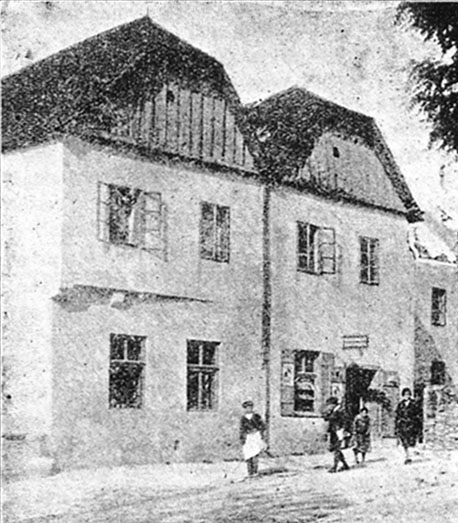
l

This photograph of the house in the preceding story was printed in Hickl's illustrierter Jüdischer Volkskalendar, 1926/27. According to Mark Tritsch the house was demolished during the communist era. In a related vein, after a fire consumed a house in Siget the Yatev Lev of Siget declared that the cause was because there was no eruv there. He then went on to guarantee that those who establish an eruv would be protected from all harm (Gedulas Yehoshua; see Pinini HaMaor, 3 p. 273 regarding the Chasam Sofer).

_________________________________________________


The following letter by the Dayan of Nikolsburg Harav Moshe Lieb Cohen zt”l (niftar 1890) is another mention of the Nikolsburg story and was published in Kovetz Kerem Shlomo, 1998.

ברכת צדיק עושה רושם

ניקלשבורג שנת תרל"ד לפ"ק

בעזה"י ניקאלסבורג יום א' י"ב מרחשון תרל"ד

ת"ר מה שלחו בני לשכת הגזית לחוני המעגל, ותגזר אומר ויקם לך, אתה גזרת מלמטה והקב"ה מקיים מאמריך מלמעלה (תענית כ"ג ע"א).

על דברי אמת במאמר הזה נתעוררנו, בראותנו פה עדתינו מעשי ה' ונפלאותיו. – שלשום בנטות צללי ערב, ובא העת הגיע היום שבת קודש לה', והנה פתע פתאום גדלה צעקת אנשי העיר גם רבה, כי אש אלקים נפלה משמים ותבער בית איש נוצרי ברחוב היהודים.בעזרת ה' עושה גדולות ונפלאות, טרם בא הכנסת כלה, כבר אש אבדון כלה, ונאום האדון ה' צבאות למשרתיו אש לוהט: עד פה תבא ולא תוסיף.

אכן כל עין רואה כן יתמה וישתומם על המראה ואין מבין, כי קרוב הבית מאוד אל בית שכנו הנוצרי עד אפס מקום, וחצר א' לשניהם, והנה כידודי אש יתמלטו מפה ומפה, וגדרות צאן של שכנו מחופות בתבן ובחציר יבש, נצבות מבלי נזק מאומה, הלא זה אוד מצל מאש. – וכולם פה אחד השיבו מלים: אין זה כי אם ברכת צדיק וטוב עליו תבא, ולא לבד מאחינו בני ישראל נשמע כן, אף גם בגוים אומרים ככה.

והמעשה אשר נעשה, היא ממעשה תוקפו וגבורתו ופרשת גדולת מרדכי. – בעת אשר האיש מרדכי גדול ליהודים הי' רועה עדתנו, ה"ה אמ"ו הרב הגאון קדוש ישראל מ' מרדכי בנעט זצוק"ל זי"ע, קרה כי הנוצרי (אדון הבית הניצל) לא אבה להציג מוטה העירוב אצל חומת ביתו, ולדברים רבים דברים טובים ונכוחים, אזניו הכביד משמוע, ונתן כתף סוררת, לכל לשון מדברת, עד כי נקרא אל מורנו הרב הגאון הנ"ל, והוא הבטיחו על משענת הקנה אם יסמך אל ביתו, ישא ברכה מאת ה', כי לא תשלוט בו אש להבה. וכשמוע את הברכה הזאת חרד לבו והטה אזנו לשמוע בקול דברי איש האלקים הזה, ועד היום הזה מוצב ארצה.

והנה אנכי יודע ועד, כי לא א' ולא פעמים שמעתי מאדון הבית הזה קמוט בכלחו משבח ומפאר עצמו בברכה הזאת, כי תצא אש ונאכל הגדיש, תמיד תהלתו בפיו לאמר: "איך פירכטע ניכט, איך האבע פאן דעם הייליגען מאנן איינען זעגען בעקאממען" (אני לא אירא רע, יען הברכה היא לי מאת איש אלקים הקדוש), וגדול הי' כבוד הבית הזה גם בפעם הזאת בעיני כל רואיו, באמרם כאשר גזר הצדיק והקדוש, כן קם הבית הזה לבעליו, ועל זה נאמר מן החכם שבחכמים, "זכר צדיק לברכה" – ואנכי אומר "אמן כן יעשה וכן יקום ה' לנצח"...

משה ליב כהן דיין דק"ק הנ"ל

(הובא בקובץ כרם שלמה שנה כ"א קונט' ו' אייר-סיון תשנ"ח)

Thursday, December 08, 2005

Part 2: Shishim Ribo According to Hagaon Rav Moshe Feinstein zt”l

In Hagaon Harav Moshe Feinstein zt”l’s final two teshuvos about eruvin we see that he codified his chiddush; in order for a city to be classified as a reshus harabbim of shishim ribo, the requirement is at least five times shishim ribo which could amount to 3,000,000 or more people. Consequently, in the Chicago eruv pamphlet (West Rogers Park Eruv, 1993 p. 23) it is stated that Rav Dovid Feinstein shlita was in agreement that according to his father’s shitah there must be a minimum of 3,000,000 people in order for the city to be defined as a reshus harabbim. Since the population of Brooklyn is less than 3,000,000, an eruv of tzuras hapesachim would be allowed even according to Rav Moshe zt”l (see also Part 1: Shishim Ribo According to Hagaon Rav Moshe Feinstein zt”l).
l
l

Wednesday, December 07, 2005

Part 1: Why Brooklyn Is Not a Reshus HaRabbim

Since the streets of our community do not run straight from one end of the city to the other ― they are not mefulashim u’mechuvanim m’shaar l’shaar.

Most poskim use the term mefulash m’shaar l’shaar without differentiating between a walled city and an open city (see also Mefulash According to the Shulchan Aruch). Since this is a very important distinction and has a great impact in how we apply the criterion of mefulash, we can garner from this omission that there is no difference halachically whether or not the city is walled.

The following is a partial list of poskim who are clearly not referring to a walled city:

  • The Mishnah Berurah (364:8), when describing the cities of his times, stated that there were streets that were sixteen amos wide and mefulash m’shaar l’shaar. Therefore, a Baal Nefesh should be stringent since to erect an eruv in these cities they had to rely on the fact that the street did not have shishim ribo traversing it. As we know that most towns in his times were not walled ― even in earlier times most cities were not walled, Pri Megadim (Mishbetzes Zahav 362:17) ― we can deduce that he accepted the criterion of mefulash as not being dependent on a walled city.
  • The Divrei Malkiel (4:3) states that to find a street in a large city which is mefulash, open from one end of the city to the other, is unheard of and that is why the minhag is to erect eruvin even in the largest of cities. He wrote this teshuvah regarding Odessa, a city that was not walled.
  • Rav Shlomo Dovid Kahane zt”l (Divrei Menachem, O.C. vol. 2, pp. 42-43), one of the main rabbanim of Warsaw before World War II, posited that the heter to erect an eruv in a large city such as Warsaw, which was not walled from the year 1877 (Encyklopedia Warszawy, 1994 p. 187), was universally accepted as the streets were not mefulashim u’mechuvanim m’shaar l’shaar. More so, he claimed, a small city would have a greater problem establishing an eruv since its streets would be mefulash. In a small city there is usually one main street running straight through the center of the town as opposed to a large city where the streets are generally not straight from city gate to city gate.
It is important to note that Rav Moshe zt”l (Igros Moshe, O.C. 5:28:7) disagreed with the above poskim and maintained mefulashim u’mechuvanim m’shaar l’shaar is a criterion that can only be utilized in a walled city. However, since we have established that Brooklyn is a walled city ― because it is circumscribed on three sides by mechitzos ― Rav Moshe would agree that our streets have to be mefulashim u’mechuvanim m’shaar l’shaar in order to be classified as a reshus harabbim.

Tuesday, December 06, 2005

Mefulash According to Most Poskim

Most poskim understand mefulash m’shaar l’shaar as meaning mefulashim u’mechuvanim m’shaar l’shaar, open and running straight from city gate to city gate (Bais Yosef, 345:8; Magen Avraham, 345:6; Pri Megadim, Aishel Avraham, 364: 2; Bais Ephraim, O.C. 26; Tiferes Yisroel, introduction to Shabbos; U’Bacharta B’Chaim, siman 123; Shoel U’Maishiv, 2:87; Yehudah Yaleh, O.C. siman 54; Mahari Slutsk, O.C. siman 11; Minchas Elazar, 3:4, and Mishnah Berurah, 345:20). Rav Aharon Kotler zt”l states (Mishnas Rav Aharon, 6:2), that for a street to be classified as a reshus harabbim it is accepted that it would have to be mefulashim u’mechuvanim m’shaar l’shaar ― although he personally maintains that it is dependent on a walled city.

Part 4: A Critical Analysis of Rav Yisroel Hirsch’s Critique of Eruvin in Brooklyn

Continued from part III

Page 5 comment 12:
“We have already mentioned R’ Ahron’s position (comment 10) that מכוון is not a necessary condition. R’ Moshe raised objections similar to R’ Ahron’s and arrived at the same conclusion. This is all explicitly stated in Iggeros Moshe (Orach Chaim 1:140).”

This is incorrect, Rav Moshe Feinstein zt”l maintains that mefulash u’mechuvanim m’shaar l’shaar is a criterion of a reshus harabbim; however, he is of the opinion that it’s only a condition of a walled city (Igros Moshe, O.C. 5:28:7, 1981). He posits that in the diglei hamidbar, the encampment was circumscribed by the ananei hakavod, which served as mechitzos. This is in contrast with Rav Aharon zt”l who maintained that mefulash u’mechuvanim is dependent solely on mechitzos and is not a criterion of a reshus harabbim. Actually, the teshuvah (ibid., 1:140, 1952) that Rav Hirsch cites is Rav Moshe’s first teshuvah regarding mefulash and there he states that he is not clear about the criterion of mefulash at all. Only in the aforementioned 1981 teshuvah (ibid., 5:28:7) does he clarify that he understands the criterion of mefulash u’mechuvanim as being dependent on a walled city. Rav Hirsch cites the earlier teshuvah which doesn’t mention a word about mefulash u’mechuvanim being conditional only of a walled city and fails to note the last teshuvah from vol. 8 (ibid., 5:28:7) where Rav moshe formulated his chiddush in mefulash probably because he questions the veracity of this volume.


Page 5 comment 13:
“That there are those who disagree with R’ Moshe is beside the point. What is important is that R’ Moshe disagreed with them! This means that even after knowing the מ"ב etc., R’ Moshe when considering New York City still upheld his own p’sak. Why shouldn’t we? Especially since halacha ke’basrai.”

To begin with Rav Moshe zt”l in his teshuvah to the rabbanim of Flatbush (Igros Moshe, O.C. 4:87) didn’t want to issue a p’sak since he realized that the Achronim didn’t agree with him. So how could one demand of others that they must follow Rav Moshe’s p’sak. Furthermore, many rabbanim who allow an eruv today do not agree with Rav Moshe’s shitos in eruvin (e.g. Rav Yisroel Yaakov Fisher zt”l in Even Yisroel, 8:36; Rav Shmuel Wosner shlita in Shevet HaLevi, 6:41; and all the rabbanim that signed in support of the Boro Park eruv) so if the halacha is ke’basrai we can rely on these rabbanim. [Particularly since they all know Rav Moshe’s shitos; see Pischei Teshuvah, Choshen Mishpat siman 25.] Additionally, there is an overarching flaw in Rav Hirsch critique. The kuntres Eruvin in Brooklyn was organized into many sections, the first ones dedicated to the way most poskim pasken and the latter sections dedicated to the way Rav Moshe paskens. It’s clear from the kuntres that there are those who believe that Rav Moshe would allow an eruv in Brooklyn today. In fact Rav Tuvia Goldstein zt”l maintained that nowadays Rav Moshe would allow a Brooklyn eruv.


Page 5 comment 14:
“This information is incorrect. The approximate populations of Yerushalayim and Bnei Brak is in excess of 650,000 and 200,000 respectively (although unverified).”

If Rav Hirsch admits that Yerushalayim’s population is greater than shishim ribo then, according to those who claim that shishim ribo is conditional on a city and not a street, why are they allowed to establish eruvin there? Additionally, the kuntres is talking about, “Bnai Brak and all its connected neighborhoods,” the Gush Dan where the population is well over a million people.


Page 5 comment 15:
“This is untrue. R’ Moshe never said that they “could do as they saw fit”. In fact, he was dissatisfied and unhappy about the whole idea. What he did say was that, since his position was not mentioned by the early achronim and was contrary to the Aruch Ha’Shulchan, that he could not give forth a “definite opinion” on the matter. Meaning that he would not come out against them.”

Nowhere in Rav Moshe zt”l’s words do we see that, “he was dissatisfied and unhappy about the whole idea.” On the contrary Rav Moshe clearly stated that he didn’t want to be involved with the issue of Brooklyn eruvin at all (Igros Moshe, O.C. 4:87). Therefore, this is pure conjecture on Rav Hirsch’s part. More so, Rav Moshe zt”l told Rav Tuvia Goldstein zt”l ― after the 1979 kol korei was published ― that, not withstanding his opinion of the matter, if the rabbanim of Flatbush wanted to erect an eruv they could do as they saw fit. It’s important to note as well that Rav Hirsch would have to admit that Rav Moshe couldn’t have signed the 1979 Flatbush kol korei since Rav Hirsch admits that what Rav Moshe meant when addressing the rabbanim of Flatbush was that, “he would not come out against them.”

Part V

Monday, December 05, 2005

Shishim Ribo According to the Shulchan Aruch

The text of the Shulchan Aruch reads:
“What is a reshus harabbim? A street or marketplace that is sixteen amos wide, … and there are those who say that if it [the street or marketplace] does not have 600,000 people traversing it daily, it is not a reshus harabbim.”

Rashi is the original source of this criterion that the street requires shishim ribo traversing it in order that it be classified as a reshus harabbim, and not all of the Rishonim are in agreement with him. [The Bais Av (2:5:2) brings proof that the majority of Rishonim accepts shishim ribo as a fundament of a reshus harabbim (see also Shemiras Shabbos K’Hilchasa, perek 17, note 21 and Toldos Shmuel, 3:86:8).] Since there is no unified opinion among the Rishonim, when the Shulchan Aruch (O.C. 345:7) mentions the criterion that the street requires shishim ribo it prefaces it with a qualifier, “vyeish oimrim,” there are those who say. Nevertheless, nearly all of the Achronim consider the criterion of shishim ribo an accepted fundament of a reshus harabbim (Taz, 345:6 and Magen Avraham, 345:7). The Aruch HaShulchan (Choshen Mishpat 162:1) maintains that shishim ribo is an accepted fundament to the extent that if one does not want to join his neighbors in their eruv chatzeiros because he wants to be stringent and not rely on the criterion of shishim ribo, his neighbors can compel him to join them.

However, since some of the Rishonim do not accept shishim ribo as a requirement for a reshus harabbim, there is a difference of opinions among the Achronim whether or not a Baal Nefesh should adopt the stringent position if there is no shishim ribo present. Most Achronim mention the requirement of shishim ribo traversing the street without stating that a Baal Nefesh should adopt the stringent position. This omission signals that the requirement of shishim ribo traversing the street is an accepted fundament in the laws of reshus harabbim and even a Baal Nefesh can rely on it. Additionally, some Achronim state that once we utilize a tzuras hapesach for a street that is sixteen amos wide it is accepted that a Baal Nefesh could rely on the fact that the street does not have shishim ribo traversing it (Kanah V’Kanamon, 5:56; Livush Mordechai, 4:4, and Bais Av, 2:9:3). Other Achronim maintain that a Baal Nefesh should adopt the stringent position and not rely on the fact that the street does not have shishim ribo traversing it. However, that is only where the sole basis for leniency is that the streets are lacking shishim ribo (Mishnah Berurah, 364:8).

It is important to recognize that when considering the basis for leniency there are two levels: a fundamental factor in the din of reshus harabbim such as mefulash or mechitzos and a tzad l’heter such as using questionable mechitzos. The Mishnah Berurah (Bi’ur Halachah, 345:23), quoting the Elya Rabah, states that even in conjunction with a tzad l’heter, a Baal Nefesh can be lenient and rely on the fact that the street does not have shishim ribo traversing it. How much more so, if we were relying on fundamental mitigating factors like the streets not being mefulash and the area having mechitzos, there is no doubt that the Mishnah Berurah ― and all the other poskim as well ― would agree that a Baal Nefesh could be lenient and utilize an eruv of tzuras hapesachim, since we have not met all the requirements of a reshus harabbim.

It should be noted that had the Mishnah Berurah (345:23) seen the Bais Ephraim (O.C. 26) in conjunction with the Mishkenos Yaakov (O.C. 120-122), there is a possibility he would have paskened like the Bais Ephraim that shishim ribo is an accepted fundament of a reshus harabbim, and he would have agreed that even a Baal Nefesh could be lenient and rely on the fact that the streets are lacking shishim ribo. See Bi’ur Halachah (208:9, s.v. Eino M’Vorech), where he states that he does not have the sefer Bais Ephraim (see also Toldos Shmuel, 3:81:7, 3:86:8; Bais Av, 2:5:2; Divrei Yatziv 2:173:1, and Even Yisroel, 8:36).

It is significant to note that Hagaon Rav Moshe Feinstein zt”l considered the criterion of shishim ribo an accepted fundament of a reshus harabbim (Igros Moshe, O.C. 3:94, 5:19, 5:24:10; see Part 1: Shishim Ribo According to Rav Moshe Feinstein zt”l); however, he had chiddushim in how to apply it.

Saturday, December 03, 2005

Hagaon Rav Moshe Feinstein Zt”l’s Reluctance to Pasken Against the Establishment of an Eruv

Interestingly, of all the instances where Rav Moshe zt”l was asked for a p’sak, eruvin is probably the only issue where he did not want to prohibit something solely on the basis of his own chiddush. The only actual p’sak regarding eruvin issued by Rav Moshe were those in favor of erecting an eruv, in communities such as Sea Gate, Kew Gardens Hills and Detroit (Igros Moshe, O.C. 2:89-90, 4:86, 5:29). Yet in instances when he personally was against the establishment of an eruv and he was asked for a p’sak on the matter such as in Flatbush, Rav Moshe not only avoided giving a p’sak he even declined to state his personal conviction (ibid., 4:87; see below). He just said, “I do not want to join you in this matter, because there are many opinions on this topic, as we see in the Shulchan Aruch.” It is along this same line of reasoning that Rav Moshe zt”l told Hagaon Rav Tuvia Goldstein zt”l ― even after the 1979 Flatbush kol korei was published ― that, not withstanding his opinion of the matter, if the rabbanim of Flatbush wanted to erect an eruv they could do as they saw fit.

However, at the time there was a misunderstanding concerning Rav Moshe’s personal conviction and some people mistakenly supposed that he was even in support of an eruv; hence Rav Moshe’s two teshuvos clarifying his opinion (ibid., 4:87-88). Even when clarifying his position, which he considered to be “l’dinah,” Rav Moshe did not want to issue a p’sak since, as he wrote, his chiddush was not mentioned in the Achronim, and moreover the Aruch HaShulchan would not agree with him. It is important to note that both these teshuvos (ibid.) were written to the same people and the second one was just a clarification of the first and was not written as a p’sak to prohibit the eruv. In the first teshuvah (ibid., 4:87) Rav Moshe explained his chiddush that in order for there to be shishim ribo traversing the streets over a twelve mil by twelve mil area there would need to be about 3,000,000 people living in the area. However after Rav Moshe was told that there were fewer than 3,000,000 people living in Brooklyn, he expounded on his chiddush in the second teshuvah and added that he would not be in favor of an eruv in a big city since some may think that there was shishim ribo traversing the streets (ibid., 4:88; see Three Million: More or Less?). In both instances, “l’dinah” refers to Rav Moshe’s personal opinion.

Concerning the Boro Park eruv, a similar sequence of events occurred when Hagaon Rav Menashe Klein shlita asked Rav Moshe to issue a p’sak whether he could erect an eruv. Rav Moshe answered that he could do as he saw fit (Oim Ani Chomah, p. 266). Just as in Flatbush, this was misunderstood to mean that Rav Moshe would support an eruv. Therefore, Rav Moshe felt a need to clarify his personal opinion on this matter (Igros Moshe, O.C. 5:28:20). In both Boro Park and Flatbush, Rav Moshe’s teshuvos were written in reaction to the public’s misunderstanding of his personal opinion regarding eruvin and not as a p’sak. [Concerning Rav Moshe’s signature on the 1979 kol korei which prohibited the Flatbush eruv, see The 1979 Flatbush Kol Korei Exposed.]

On the other hand, when Rav Tzvi Eisenstadt zt”l asked the rabbanim of Manhattan for their opinions ― as opposed to their p’sak ― concerning erecting an eruv, Rav Moshe answered that in his personal opinion they should not establish an eruv (see the beginning of Igros Moshe, O.C. 1:138 which is the beginning of the Manhattan teshuvah 1:139). When Rav Moshe was asked if the rabbanim of Manhattan have a right to erect an eruv he answered that they could do as they saw fit (ibid., 4:89 and HaPardes, 33rd year, vol. 9). This is exactly what Rav Moshe told Rav Menachem M. Kasher zt”l, “even though I will not join you, you should go finish what you started [and establish the eruv]” (Divrei Menachem, O.C. vol. 2, introduction). Only when Rav Aharon Kotler zt”l and other Roshei Yeshivos made a takanah not to erect an eruv in Manhattan did Rav Moshe join them and prohibit the eruv as well (Igros Moshe, O.C. 4:86 and Addendum to O.C. 4:89) ― this takanah was only about Manhattan and not Brooklyn; see The 1979 Flatbush Kol Korei Exposed. Even when Rav Moshe signed on the 1962 takanah with Rav Aharon Kotler we see that he was not at ease with the language which stated that, “those who rely on the eruv in Manhattan are considered a mechalel Shabbos,” since after he quoted this takanah in his teshuvah, he omitted this last line (ibid., Addendum to O.C. 4:89).

Given that Rav Moshe, despite his personal convictions, never issued a p’sak for others against erecting eruvin we can possibly understand why Rav Moshe stated (ibid., 3:94, 5:19, 5:24:10) that we rely on the heter of shishim ribo in all cities ― even Brooklyn and Manhattan ― since he did not want to employ his chiddush as a p’sak (see also Rav Moshe zt"l and the Walking Stick).
i
i

Thursday, December 01, 2005

Part 3: A Critical Analysis of Rav Yisroel Hirsch’s Critique of Eruvin in Brooklyn

Continued from part II

Page 4 comment 7:
“The true nature of this work is now clearly exhibited. A sniff l’heter? We are dealing here with a s’fek d’oraysoh which is always l’chumrah! And not just any d’oraysoh, but one of chillul Shabbos! If this alone was the objection to the eruv it would be more than sufficient grounds for opposition! Note that although it is not here reveled, R’ Moshe Feinstein objected to all these points. For instance, the point that streets are made for cars and not people, and therefore are not a legal part of a רה"ר, is complete nonsense! Chance a guess at who in fact is driving these cars, Monkeys, baboons, orangutans – of course, people! Failure to disclose to the reader R’ Moshe’s opposition is an act of dishonesty.”

As stated in Eruvin in Brooklyn (p. 15) there are three primary reasons why Brooklyn is not a reshus harabbim. This sniff l’heter is only noted in a footnote and is not included in the three fundamental reasons to allow an eruv in Brooklyn. Therefore to say, “The true nature of this work is now clearly exhibited,” is extraneous to say the least. Additionally, this is the way most teshuvos are written; after the main points are expounded on the poskim will usually add that we can also include a sniff l’heter. Regarding the subject of who is driving the cars, Rav Hirsch is conflating two issues. This is what’s stated in the kuntres, “Since the streets are designated for cars, the streets and the sidewalks on either side of the street are not considered connected to form one continuous 16 amos (Tikvas Zechariah, p. 40; Divrei Yatziv, O.C. 2:172:13 see also Oim Ani Chomah, siman 63).” The kuntres is not referring to whether or not we include the occupants of the vehicles in the tally of shishim ribo only if streets and the sidewalks on either side are considered as one contiguous sixteen amos. Even regarding the subject of tallying the occupants of vehicles, what many don’t realize is that most poskim maintain that the occupants of cars would not be tallied in the shishim ribo (Bais Ephraim, O.C. 26; Maharsham, 1:162; Yeshuos Malko, siman 26-27; Harei B’samim, 5:73; Bais Av, 2:9:3; Mahari Stief, siman 68; Satmar Rav, Kuntres Meoz U’Mekedem p. 27; Divrei Yatziv, 2:172:13; V’yaan Yoseph, 1:155:1; Kuntres Tikkun Eruvin Manhattan, siman 12 p. 105; Kinyan Torah, 4:40:6, and Rabbi Eliezer Y. Waldenberg shlita, author of the Tzitz Eliezer, as cited in The Contemporary Eruv, 1998 p. 54 note 119). The reason is either because a vehicle in itself is considered a reshus hayachid and therefore its occupants are not part of the total or because we only include pedestrians (holchei regel) who traverse the street in the tally. This list is indicative of whom Rav Hirsch considers to be uttering, “complete nonsense.” The kuntres dedicates many pages to Rav Moshe’s shitos but definitely does not claim to quote all of them. Particularly when the kuntres is only using this issue as a snif it doesn’t have to quote others.


Page 4 comment 8-9:
“There is a fundamental distinction between a street that is itself covered, and a street that at random juncture is bisected above its air-space, creating a covered area. The former is not דומה לדמ"ד and would therefore be invalidated as a ר"הר דאורייתא. The latter, on the other hand, would not.”

Rav Hirsch is conflating mikorah [roofed] with mefulash [open]. For any part of a street to be classified as mikorah only the area that is roofed would be considered as such. Rav Moshe adds (Igros Moshe, O.C. 1:140) that a street, which is bisected by a roofed roadway even if it’s not along its entire length, it would not be classified as mefulash. [However, according to Rav Moshe, a roofed area does not divide the tally of shishim ribo into separate parts of less than shishim ribo (ibid., 5:28:20).]


Page 4 comment 10:
“This is perhaps the most blatantly inaccurate statement in this entire booklet, the result of either outright deception or intellectual dishonesty. R’ Ahron does indeed quote the מג"א who maintains such a position, but devotes much energy and considerable time to refuting its halachic accuracy. … This point [of mefulash] was an absolutely integral component of R’ Ahron’s halachic synthesis upon which he assured (אסור) an eruv for New York City.”

This is what is stated in the kuntres: The Magen Avraham, (345:6) understands mefulash me’shar le’shar as meaning mefulashim u’mechuvanim [straight] me’shar le’shar, straight in an uninterrupted line from city gate to city gate. The poskim concur (Bais Yosef, 345:8; Prei Megadim, Aishel Avraham, 364: 2; Bais Ephraim, O.C. 26; Tiferes Yisroel, in his introduction to Meseches Shabbos; U’Bacharta B’Chiam, siman 123; Shoel U’Maishiv, 2:87; Yehuda Yaleh, O.C. siman 54; Mahari Slutsk, O.C. siman 11; Minchas Eliezer, 3:4; Mishna Berura, 345:20; see also Misnhas Rav Ahron, 6:2, where Rav Ahron Kotler zt”l states, that it’s accepted that for a street to be a reshus ha’rabbim it has to be mefulashim u’mechuvanim me’shar le’shar). While Rav Aharon does not agree with the aforementioned poskim (note that he was not included in the list of those who pasken as such) he admits that it was accepted that a street has to be mefulashim u’mechuvanim me’shar le’shar in order to be classified as a reshus harabbim. That’s all that was stated in the kuntres. Additionally, Rav Hirsch is mistaken; Rav Aharon never wrote a teshuvah regarding Manhattan (see Divrei Menachem, O.C. vol. 2, p. 16).


Page 5 comment 11:
“The requirement of [600,000 people traversing] “daily” is not in accordance with R’ Moshe’s own view. He was of the opinion that since the Poskim who stipulate the requirement of ששים רבוא, i.e. Rashi, Tosafos, Rosh, etc., do not mention “daily”, it is not a necessary condition. Even ששים רבוא over a few days a year would be enough. Even if there is not ששים רבוא at one time but as a sum total of the days’ traffic. But he concedes that, possibly, one may disagree with him and uphold a contrary position that would admit leniency on this point.

This is incorrect. Rav Moshe zt”l maintains that according to the Shulchan Aruch’s shita, the requirement is daily (Igros Moshe, O.C. 1:139:5, 4:87-88, 5:28:16). Rav Moshe explained that the Shulchan Aruch is referring to a sratya which requires that the shishim ribo traverse it daily in order that it be classified as a reshus harabbim. This is as opposed to a city (a twelve mil by twelve mil area) where he posits that if there is a population of 3,000,000 it would support shishim ribo in its streets and then the city would be classified as a reshus harabbim. Additionally, Rav Hirsch’s statement that, “Even ששים רבוא over a few days a year would be enough,” is misleading since we can infer from these words that the shishim ribo can be tallied collectively over a few days when in fact Rav Moshe clearly maintains that the shishim ribo must be over one day. Rav Moshe just questioned (ibid., 4:88) if the requirement is every day of the year or would a single day suffice. More so, Rav Hirsch is misinterpreting this aforementioned teshuvah. In this teshuvah Rav Moshe concludes that "אך בזה כיון דבשו"ע כתב בדעת שיטה זו דצריך שיעברו ס' ריבוא בכל יום בסימן שמ"ה סעי' ז' יש אולי להקל." Nowhere did Rav Moshe mention that, “he concedes that, possibly, one may disagree with him and uphold a contrary position that would admit leniency on this point.” It’s the Shulchan Aruch’s leniency and therefore, Rav Moshe himself would agree that it’s possible to be lenient. More so, in the aforementioned teshuvos Rav Moshe states clearly (ibid., 1:139:5, 4:87, 5:28:16) that the requirement of shishim ribo is daily.

Part IV

The Chazon Ish on Carrying

Though the Chazon Ish was known as a big supporter of eruvin, in Orchos Rabbeinu (vol. 1, p. 170) it is stated that the Chazon Ish did not even allow a child to utilize the eruv and carry in Bnei Brak on Shabbos. Some claim that since the Chazon Ish did not allow the use of the eruv, it is irrelevant that he maintained that a reshus harabbim does not exist today. They are mistaken; the only difficulty with eruvin that the Chazon Ish himself wrote about was that almost every time he inspected the eruv after Shabbos it was either broken or ripped and therefore he maintained that the eruv was considered be’chezkas pasul every Shabbos (Teshuvos V’Ksavim, siman 85). He was therefore uneasy about people utilizing the eruv. Modern construction materials can withstand extreme weather conditions and are b’chezkas kayama. There is no doubt then that the Chazon Ish would allow carrying in an eruv today.

The 1979 Flatbush Kol Korei Exposed

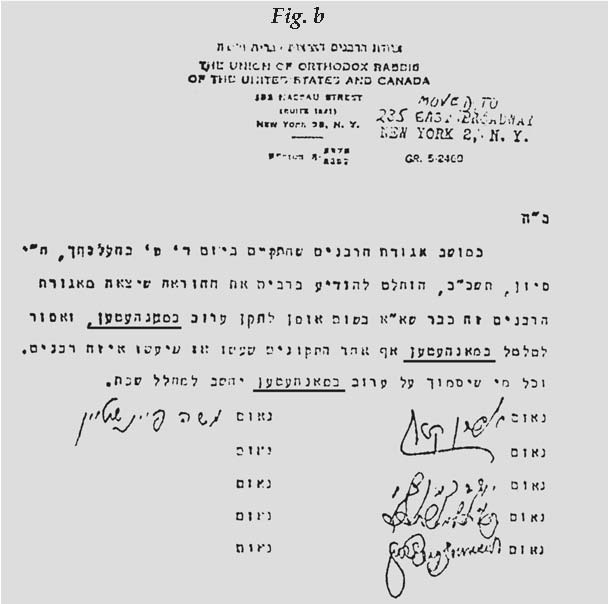
The text of the 1979 kol korei against a Flatbush eruv [Fig. a] refers back to the 1962 Manhattan kol korei [Fig. b], claiming that it includes Brooklyn in the Manhattan issur and listing among the signatories Hagaon Harav Eliyahu Henkin zt“l. However, as the original copy of the 1962 Manhattan kol korei demonstrates, the takanah then against erecting eruvin only applied to Manhattan and not to Brooklyn. This correlates with what Hagaon Harav Menashe Klein shlita wrote (Oim Ani Chomah, siman 7) that Hagaon Harav Moshe Feinstein zt”l told him in 1979 - in the presence of Rav Elimelech Bluth shlita, Rav Shalom Dresner shlita, and Rav Mordechai Tendler shlita - that contrary to what someone in the Agudas HaRabbonim was promoting, the 1962 issur from the Agudas HaRabbonim was only regarding Manhattan.
i

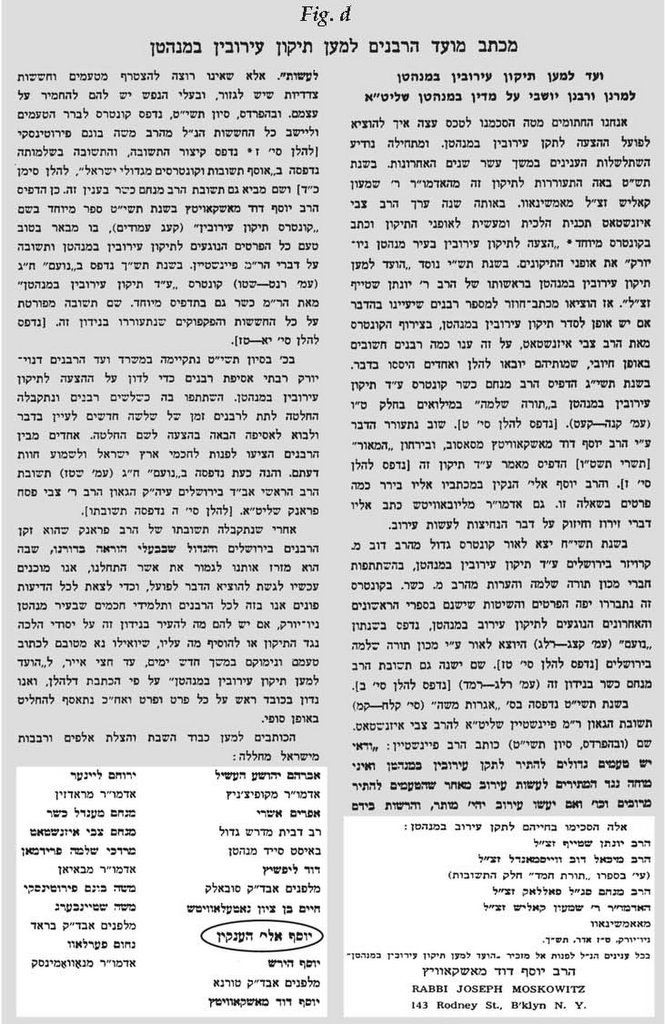
Additionally, it shows only five signatures. Nowhere is Rav Eliyahu Henkin’s signature to be found. For more proof that Rav Eliyahu Henkin never signed the 1962 kol korei, see the copy of the 1962 kol korei that the Agudas HaRabbonim advertised in the HaPardes in 1966 (40th year, vol. 8) [Fig. c]. Note that even at this later date there was still no signature from Rav Eliyahu Henkin to be found. Even more so, from Rav Henkin’s letters (Kisvei Hagriah Henkin, p. 33) and from the 1960 kol korei on behalf of the Manhattan eruv (Divrei Menachem, O.C. vol. 2, p. 10) [Fig. d], we see he was a proponent of the Manhattan [and Brooklyn] eruvin. Additionally, Hagaon Harav Moshe Feinstein zt”l never gave a p’sak l’maaseh against eruvin as the 1979 kol korei falsely claims. On the contrary, he declined to issue a p’sak since the Aruch HaShulchan and other Achronim disagreed with him (Igros Moshe, O.C. 4:87).i
i

i

Wednesday, November 30, 2005

Part 2: The Truth About Warsaw

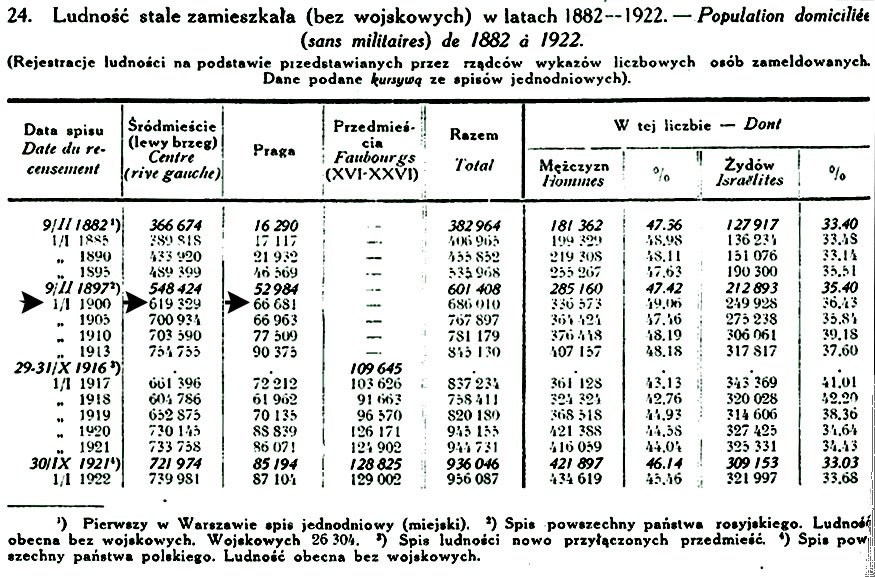
Many statements regarding the population of Warsaw have been tossed around e.g. that the Vistula River divided the population of Warsaw and therefore there was no shishim ribo on either side of the river. This is all fiction; the larger side, which was called Warsaw, contained a population greater than 600,000 by the year 1900. The smaller side, known as Praga, contained a population of approximately 66,000. This information was published in Rocznik Statystyczny Warszawy 1921 i 1922, 1924 p. 14, see copy below. For more about Warsaw see Part 1: The Truth About Warsaw.

[Even Rav Moshe zt"l acknowledged that Warsaw’s population was greater than 600,000. The reason Rav Moshe formulated his chiddush in shishim ribo (that there would need to be a population of 3,000,000 over twelve mil by twelve mil in order for that area to be classified as a reshus harabbim) was because he realized that there were European cities (Igros Moshe, O.C. 4:87), such as Warsaw (ibid., 5:28:5), whose populations were greater than 600,000 and nevertheless eruvin had been established there. Therefore, to say that the criterion of shishim ribo (600,000) is dependent on a city goes against the established minhag.]
i

Mefulash According to the Shulchan Aruch

The text of the Shulchan Aruch reads:
“What is a reshus harabbim? A street or marketplace that … is not walled and even if they are walled but they [the street or marketplace] are open from city gate to city gate, they [the street or marketplace] would be considered a reshus harabbim ….”

Even though the Shulchan Aruch cites the criterion of mefulash m’shaar l’shaar in conjunction with a walled city, the Tur does not differentiate between a walled city and an open city and the Bais Yosef (siman 345) does not disagree with the Tur. Therefore, mefulash would be considered a criterion of a reshus harabbim even in a city that is not walled (see Bais Av, 2:9:1 for a detailed explanation). The Gra offers a different perspective (Bi’ur HaGra, O.C. 345:7) and explains that the words of the Shulchan Aruch, “is not walled,” refers to a street [sratya]. The Dmesek Eliezer clarifies the Gra that a sratya is a road which does not have a wall around it. The Gra explains further that, “even if they are walled,” refers to a marketplace [platya]. The Dmesek Eliezer explains that a platya is a city street that is walled on two sides and the remaining two sides are open straight from city gate to city gate. What we see from this Dmesek Eliezer is that what the Shulchan Aruch refers to as, “walled,” pertains to the streets of the city and not the city walls. Therefore, it is understandable why the Gra (Sh’nos Eliyahu, introduction to Meseches Shabbos and Chidushi HaGra, Shabbos 6a) when discussing the criterion of mefulash m’shaar l’shaar does not attribute it to a walled city. It follows that our streets which are lined with houses would be classified as walled streets and would have to be mefulashim u’mechuvanim m’shaar l’shaar to be categorized as a reshus harabbim. Note that since the term city gate [shaar] does not always pertain to the gate of a walled city (Rashi, Yoma 11a), mefulash m’shaar l’shaar can refer to a city that is not walled as well.

Tuesday, November 29, 2005

Part 2: A Critical Analysis of Rav Yisroel Hirsch’s Critique of Eruvin in Brooklyn

Continued from part I

Page 3 comment 2:
“Furthermore, there was no reason for the אר"י to question the eruv of צפת whereas great halachic authorities have publicly forbidden the construction of an(y) eruv in New York City. So there is every reason to question its construction. Also, the אר"י did not question the eruv in צפת after it had already been constructed; our present situation deals with – precisely – the halachic basis for such a construction.”

In fact there was reason to question the eruv of Tsfas. The, “lamdanim and some of the talmidi chachamim,” of Tsfas questioned the eruv since in the non Jewish section of the city there was a street more than sixteen amos wide and some of the streets in the Jewish section opened on to it. On this issue the Maharit Tzahalon (siman 251) commented that for a street to be classified as a reshus harabbim, we require shishim ribo to traverse it. Additionally, these, “lamdanim and some of the talmidi chachamim,” of Tsfas were questioning the existing eruv. (Ironically, the fact is Rav Hirsch’s comments on the Kensington eruv were written after the fact as well.)


Page 3 comment 4:
“But the logic that sees a contradiction because of the “collection of disparate sources” is untenable. Different aspects of any argument may be accepted or rejected, without having to accept the entire thesis. So long as one does not both partially accept and partially reject the same aspect, or selectively accept two aspects of the same argument that are contradictory, one may find one point valid and the other not.”

This is not the argument put forth by the kuntres at all. If the reason that we have to follow Rav Moshe’s zt"l p’sak is because he was the Gadol Hador then why would the anti-eruv group bring other shitos against eruvin (shitos that Rav Moshe never subscribed to) from others whom they do not consider the Gadolei Hador? It must be that the goal is to asser eruvin hence the need to collect shitos yachidos from disparate sources.

To quote The Community Eruv kuntres, “Of course, it is always possible to cite shitos yachidos to invalidate an eruv; however, ruling according to shitos yachidos is not the correct approach in halachah. [The Chasam Sofer writes (Y.D. 37) that if we were to collect all the shitos ha’ossrim we would not be able to eat bread or drink water.] Even more so, in hilchos eruvin, since all criteria have to be met for the area to be classified as a reshus harabbim, even if we were to employ a shitas yachid regarding reshus harabbim that would then disqualify the eruv based on only one criterion, the other conditions would not be met and an eruv would be permissible l’chatchilah. Consequently, to invalidate an eruv, one would have to selectively choose from disparate shitos yachidos ― which in many cases are contradictory ― and that is an unjustifiable approach to halachah. The reality is that if someone learns hilchos eruvin with an open mind, he would realize that since it is almost impossible to meet all the criteria of a reshus harabbim, creating an eruv l’chatchilah is a real possibility.”


Page 3 comment 5:
“Granted, the halacha is not like ר' יהודה; rather, לא אתו רבים ומבטלי מחיצתא. But if the pirtzah is more than 10 amos (maybe 16) that is another matter. In such a case many rishonim would say the entire mechitzah is invalid. R’ Aharon Kotler spends much time in his קונטרס showing this to be the position of the רמב"ם.”

If it’s granted that the halachah is not like Rav Yehudah since most poskim pasken as such, then it’s established as well that the halachah of pirtzos esser is only a rabbinical proscription. As a matter of fact Rav Hirsch admits later (comment 32) that “many” poskim maintain pirtzos esser is d’rabbanan. However, the fact is it’s not just many poskim but the overwhelming majority of poskim who maintain as such (see Pirtzos, Biblical or Rabbinical proscription?). Actually Rav Moshe zt”l maintains that a pirtzos esser is d’rabbanan (Igros Moshe, O.C. 2:89). It is obvious that we don’t pasken like Rav Aharon zt”l (and the Mishkenos Yaakov). If we would pasken like Rav Aharon that pirtzos esser is d’Oraysa and asu rabbim u’mevatlei mechitzta and that a rabbim is less than shishim ribo we would not be able to establish eruvin in any town big or small. [It’s important to note that since Brooklyn’s mechitzos are at the waterfront there is no rabbim traversing them and Rav Aharon would admit that a tzuras hapesach at the pirtzos would be sufficient; see Mishkenos Yaakov, O.C. 122 p. 144.] There is no Rishon who states explicitly that a pirtzos esser is a d’Oraysa – Rav Aharon and others extrapolate from some Rishonim as such. However, the fact is there are three Rishonim who state unequivocally that pirtzos esser is only d’rabbanan (Hashlama, Eruvin 5a; Tosafos HaRosh, Eruvin 17b, and HaEshkol, p. 167). Regarding a pirtzah of sixteen amos even the Mishkenos Yaakov (O.C. 122 p. 144-45) admits to the Bais Ephraim that it is not a qualifier of a pirtzah in a mechitzah.

Part III

Pirtzos, Biblical or Rabbinical proscription?

Nearly all poskim maintain that pirtzos esser is me’d’rabbanan (Mabit in Kiryat Sefer, Shabbos Perek 16; Bais Meir, siman 364; Pri Megadim, Mishbetzes Zahav, 363:1; Shulchan Aruch HaRav, O.C. 345:11; Zera Emes, Eruvin 17; Bais Ephraim, O.C. 26-27; Tikkun Eruvin Krakow, teshuvah 1; Melamud Leho’il, siman 68; Avnei Nezer, O.C. 265:13, 265:25, 276:1, 279:3; Aruch HaShulchan, O.C. 362:26; Mahari Slutsk, O.C. 11; Achiezer, 4:8; Chazon Ish, O.C. 107:5-8, 112:5; Chavatzelet HaSharon, O.C. 19; Kol Mevaser, 1:20:2, and Igros Moshe, O.C. 2:89).

None of the Rishonim state explicitly that a pirtzos esser is a d’Oraysa – Rav Aharon Kotler zt"l and others extrapolate from some Rishonim as such. However, the fact is three Rishonim state unequivocally that pirtzos esser is only d’rabbanan (Hashlama, Eruvin 5a; Tosafos HaRosh, Eruvin 17b, and HaEshkol, p. 167). Furthermore, even those few Achronim who state that a pirtzos esser is d’Oraysa would admit that when utilizing a tzuras hapesach to close the pirtzah it is as though the pirtzah itself ceases to exist (Mishkenos Yaakov, O.C. 122 p. 144). Additionally, it’s difficult to understand Rav Aharon’s (Mishnas Rav Aharon, 6:2) statement that Rabeinu Chananel (101a) maintains pirtzos esser is d'Oraysa. Since Rabeinu Chananel is referring to Yerushalayim and Rav Aharon adds there was shem daled mechitzos there, consequently, according to R’ Yehudah, the pirtzah would have to be at the minimum 13 1/3 amos. Why would Rabeinu Chananel only go according to R’ Meir (even more so, the Yerushalmi states this part of the Mishna is according to R’ Yehudah). Moreover, according to the way the Meiri (11b) explains the Rabeinu Chananel we see that he maintains pirtzos esser is d’rabbanan. (See Divrei Yechezkel, siman 5:13 for a different explanation of Rabeinu Chananel, 101a.)

When clarifying that a pirtzah of ten amos is a rabbinical proscription, almost all poskim do not differentiate between a pirtzah of ten amos and one of thirteen amos which is proof that they maintain there is no difference halachically between them. Additionally, there are poskim who clearly state that a pirtzah of thirteen amos is me’d’rabbanan as well (Zera Emes, Eruvin 17; Bais Ephraim, O.C. 26; Avnei Nezer, O.C. 265:25, 276:1; Aruch HaShulchan, O.C. 362:26, and Chazon Ish, O.C. 107:5-8). Furthermore, even those few poskim who state a pirtzah of thirteen amos is me’d’Oraysa would admit that when utilizing a tzuras hapesach to close the pirtzah it is as though the pirtzah itself ceases to exist (Mishkenos Yaakov, O.C. 122 p. 144).

Regarding a pirtzah of sixteen amos even the Mishkenos Yaakov (O.C. 122 p. 144-45) admits to the Bais Ephraim that it is not a qualifier of a pirtzah in a mechitzah.

Monday, November 28, 2005

Part 1: Halachah K’Divrei Hameikil B'Eruvin

Most poskim maintain that we pasken halachah k’divrei hameikil even in issues regarding mechitzos: Mordechai, Eruvin 1:482; Rosh, Eruvin 2:4 see the Gra, O.C. 358:5 and the Bais Shlomo, siman 42; Maharash Elgazi, Halichos Eli, Klali 5 Ois 251 cites the Rabbeinu Chananel, Rambam and Tosfos; Mayim Rabbim, siman 36, 38; Chacham Tzvi, siman 59; Bach HaChadash, Kuntrus Achron siman 3; Yeshuas Yaakov, 363:5; Chasam Sofer, 6:82, and Maharsham, 4:105, 8:58:5, 9:18.

Sunday, November 27, 2005

Part 1: A Critical Analysis of Rav Yisroel Hirsch’s Critique of Eruvin in Brooklyn

Part of an ongoing commentary on the bias against city eruvin.

We have been told that after Rav Hirsch published his Critique of Eruvin in Brooklyn, a member of his congregation pressed him to answer what Rav Moshe Feinstein zt"l's shita was regarding mechitzos. After analyzing the way it was elucidated in Eruvin in Brooklyn, he admitted that what was stated therein was accurate. Additionally, the later edition of Eruvin in Brooklyn, The Community Eruv kuntres covered many of Rav Hirsch’s comments and there really is no need to reply to his criticism per se. However, since his analysis is still posted on his shul’s website, we will analyze his words in a linear fashion.


Rav Hirsch writes in his introduction (page 1-2):
“In the spring of 1962, a group of the most preeminent halachic authorities in the United States gathered to discuss the plausibility of an eruv in Manhattan. The meeting was chaired by HaGaon R’ Aharon Kotler zt”l, in the presence of HaGaon R’ Moshe Feinstein, HaGaon R’ Yaakov Kamenetsky, and HaGaon R’ Eliyahu Henkin zt”l among others. While there was (probably) no unanimity of opinion concerning the issue from an academic standpoint, an absolute consensus was reached toward an halachic prescription. They publicly declared that “it is impossible under any circumstances to erect an eruv in Manhattan and that it is forbidden to carry even after all the improvisations that have or will be implemented by any rabbi(s).”

If Rav Eliyahu Henkin zt”l was at the meeting as Rav Hirsch claims why then didn’t he sign this kol korei (see The 1979 Flatbush Kol Korei Exposed). Therefore, his statement that, “an absolute consensus was reached toward an halachic prescription,” is untrue since Rav Henkin abstained from partaking in this prescription against the establishment of the Manhattan eruv. In fact in 1960 Rav Henkin signed on to the committee to establish an eruv in Manhattan (Divrei Menachem, O.C. vol. 2, p. 10; see also Kisvei Hagriah Henkin, p. 33 where he urges the rabbanim of the Bronx and Brooklyn to erect eruvin). Additionally, most rabbanim at that time were in favor of the eruv in Manhattan such as: Rav Tzvi Eisenstadt, Amshinover Rebbe, Kapishnitzer Rebbe, Boyaner Rebbe, Noverminsker Rebbe, Radziner Rebbe, Rav Michol Dov Weissmandel, Rav Yonasan Steif, Rav Tzvi Pesach Frank, Rav Menachem Kasher, and the Shatzer Rebbe, zt”l. In Iyyar of 1962 an eruv was established under the supervision of the Shatzer Rebbe. Only after the Manhattan eruv was established did this aforementioned meeting of the, “preeminent halachic authorities [Agudas HaRabbonim],” take place and then they issued a kol korei against the Manhattan eruv.

It’s important to note, when Rav Moshe zt"l signed on the 1962 takanah with Rav Aharon Kotler zt"l, we see that he was not at ease with the language, since after he quoted this takanah in his teshuvah, he omitted the last line which stated that, “those who rely on the eruv in Manhattan are considered a mechalel Shabbos” (Igros Moshe, Addendum to O.C. 4:89).


“R’ Moshe, who was a member of that convocation, maintained that although that prohibition was issued only with regard to Manhattan, its relevance extended to the whole city of New York, minus the clearly defined exceptions, i.e. Queens (Kew Gardens Hill) etc.”

This is pure fiction since Rav Moshe zt"l never stated that the 1962 issur against establishing an eruv in Manhattan included all of New York City. This is a fabrication of the 1979 Flatbush kol korei (see The Community Eruv kuntres, Appendix 10). If Rav Hirsch is correct then when the rabbanim of Flatbush asked Rav Moshe for his p’sak about erecting an eruv (Igros Moshe, O.C. 4:87) Rav Moshe should have referred back to the 1962 kol korei and stated that the issur then included erecting an eruv in Brooklyn. Not only did Rav Moshe not declare that it was prohibited to construct an eruv, he was not mocheh and did not even recommend that they not erect an eruv (ibid.). What he did tell them was, “I do not want to join you in this matter, because there are many opinions on this topic, as we see in the Shulchan Aruch.” Only when some people misunderstood these words as somehow supporting the eruv did Rav Moshe feel there was a need to clarify his personal approach regarding the issue. Hence he wrote this teshuvah clarifying his opinion, explaining that he had a chiddush, which accordingly would prohibit the construction of an eruv. However, he declined to issue a p’sak, since, as he acknowledged, his chiddush was not mentioned in the Achronim, and moreover it was obvious that the Aruch HaShulchan would not agree with him.

Rav Menashe Klein shlita wrote (Oim Ani Chomah, siman 7) that Rav Moshe told him in 1979 ― in the presence of Rav Elimelech Bluth shlita, Rav Shalom Dresner shlita, and Rav Mordechai Tendler shlita ― that contrary to what someone in the Agudas HaRabbonim was promoting the 1962 issur from the Agudas HaRabbonim was only regarding Manhattan. More so, Rav Tuvia Goldstein zt”l, a Talmid/Chaver of Rav Moshe zt”l, said on numerous occasions that even after the 1979 kol korei against the Flatbush eruv was published, he spoke with Rav Moshe who agreed that if the rabbanim wanted to erect an eruv they could do as they saw fit. Moreover, he stated that even Rav Moshe himself would have allowed an eruv in its present construction. Therefore, we can’t extrapolate what these signatories of the 1962 kol korei would maintain regarding Brooklyn and definitely not their stance concerning the present eruv.


“The attempt to construct an eruv in Brooklyn flies in the face of rabbinic consensus.”

Again there was no consensus and where is it stated that there is a need for a rabbinic consensus when constructing an eruv? On the contrary, every rav has a responsibility to establish an eruv in his town (Teshuvos V’Hanhagos, 1:844; see also Chasam Sofer, O.C. 99).


“New York City already has its ruling. It must not be ignored!”

Even if there was a ruling, the Bach (Choshen Mishpat, siman 25) states that after the passing of a rav other rabbanim, even in his hometown, can make permissible that which he had forbidden. More so, since regarding Brooklyn Rav Moshe was misled (regarding the population size and mechitzos) the Mharsham (7:48) brings the Rivash and the Mharashdam that to begin with there is no din of chacham sh’osser.

Part II

Friday, November 25, 2005

A Rambam Eruv in Brooklyn?

The Rambam considers a tzuras hapesach a valid mechitzah only when utilizing at the minimum two mechitzos that are omed merubeh al haparutz (Shulchan Aruch, O.C. 362:10). Where this is not the case, each pole can be no more than ten amos apart from the other. The Kaf HaChaim (362:92) quotes the sefer Minchas Yehudah (siman 26) that states if a city has omed merubeh of its houses, they can be used to qualify the tzuras hapesachim as a Rambam eruv. Since the proximity of property lots in Brooklyn is such that they are omed merubeh al haparutz ― particularly the fences that surround the property lots ― any eruv in Brooklyn would be considered a Rambam eruv

Brooklyn and Queens: Same or Different?

As there are many similarities between Brooklyn and Queens, all the arguments why an eruv cannot be erected in Brooklyn can be said of Queens as well. [For example, the claim that there are many illegal immigrants who are not included in the Brooklyn census can be said of Queens as well and nevertheless we do not see that this issue concerned Rav Moshe Feinstein zt”l regarding Brooklyn or Queens.]

There are people who attempt to rationalize why Rav Moshe allowed an eruv to be erected in Queens. For example, some claim that Kew Gardens Hills is considered a suburb of Queens while others allege that Queens was not incorporated into the city as a whole unit, but rather as a set of disparate neighborhoods. Therefore, they argue, the population of Queens is considered divided and each neighborhood is independent of the other, which is why Rav Moshe allowed an eruv to be erected there. This assumption is incorrect; Rav Moshe never claimed that Kew Gardens was a separate entity, only that it was a small neighborhood in Queens (Igros Moshe, O.C. 4:86 and Addendum to O.C. 4:89). Additionally, Kew Gardens Hills is part of Queens just as Boro Park and Flatbush are part of Brooklyn, as can be seen on any map of the area. Every neighborhood in Queens is built up to the adjoining neighborhood and forms one contiguous borough just as all neighborhoods do in Brooklyn. Why then did Rav Moshe allow an eruv in Queens and oppose one in Brooklyn? Even more so, since both Brooklyn and Queens have similar populations of over 2,000,000, why did Rav Moshe not apply the same gezeirah that he implemented regarding Brooklyn and Detriot to negate an eruv in Kew Gardens Hills, Queens as well (see previous post Three Million: More or Less?)?

Additionally, in a speech given a while ago about the eruv in Flatbush, there was a claim made that the reason Rav Moshe allowed an eruv in Kew Gardens Hills, Queens was that the area is encircled with mechitzos. This is a fabrication, as Rav Moshe never refers to mechitzos in any teshuvah concerning Kew Gardens Hills (ibid., 4:86 and Addendum to O.C. 4:89). Nor does anyone else mention mechitzos regarding Kew Gardens Hills (See Minchas Chein, siman 24 and Minchas Asher, 1:51-52, 2:56-57, 2:59). More so, since Brooklyn is encircled with mechitzos as well, why should it be any different than Kew Gardens Hills? If Brooklyn would require dalsos at it’s pirtzos, Kew Gardens Hills would require dalsos as well (Igros Moshe, O.C. 1:139:3).

The underlying principle must be that Rav Moshe allowed an eruv in Kew Gardens Hills because the tzuras hapesach there separated the neighborhood just as he stated the eruvin in Europe demarcated the Jewish quarters from their cities (ibid., 5:28:5). Rav Moshe considered the eruv, in and of itself, a separation of the shishim ribo and allowed the eruv there. Consequentially, Rav Moshe was not concerned about the possibility that a twelve mil by twelve mil section of Queens which includes Kew Gardens Hills might be classified as a reshus harabbim, even though Queens ― like Brooklyn ― had a population well over 2,000,000. The important issue was that in Kew Gardens Hills, a neighborhood in Queens, they were dividing only a part of Queens, which contained less than shishim ribo with a tzuras hapesach in contrast to Brooklyn where Rav Moshe was under the impression that the tzuras hapesach encircled more than shishim ribo (Igros Moshe, O.C. 5:28:5 and Addendum to O.C. 4:89).

These are the facts:
Census figures reveal that in Boro Park the eruv includes a population of less than 100,000 people and in Flatbush a population under 200,000 people (NYC Department of City Planning, Community District Profiles, 2002). Had Rav Moshe known these figures, he certainly would have agreed to an eruv of tzuras hapesachim in these Brooklyn communities, which would set them off from their borough, just as he allowed that an eruv in Kew Gardens Hills, Queens and the eruvin in European communities set them off from their respective cities.

Three Million: More or Less?

In one of his teshuvos regarding eruvin in Brooklyn (Igros Moshe, O.C. 4:88), we see that Rav Moshe Feinstein zt”l realized that the total population of Brooklyn was perhaps less than 3,000,000. Nevertheless, he maintained that despite this an eruv should not be constructed since in a large city one may think that there is shishim ribo over a twelve mil by twelve mil area. [See also ibid., 5:29 regarding Detriot, a city with a population of approximately 1.2 million (in 1980, at the time this teshuvah was written). Despite the fact that the population was 1.2 million, Rav Moshe maintained that an eruv should not be established in the city of Detroit proper because of this gezeirah.] Since Brooklyn’s population is less than 3,000,000 an eruv according to Rav Moshe is not a matter of a d’Oraysa only a gezeirah.

This gezeirah does not pertain to us as well for the following reasons:
1. Rav Moshe only stated this gezeirah because he was led to believe that Brooklyn did not have mechitzos. Once we have established that Brooklyn is circumscribed by mechitzos, Rav Moshe would certainly not have objected because of a gezeirah since in any case with mechitzos Brooklyn is considered, me’d’Oraysa, a reshus hayachid.

2. Since we have erected a tzuras hapesach in each neighborhood, the area enclosed contains a population of much fewer than shishim ribo, which would definitely not be mistaken as a reshus harabbim. In fact, Rav Moshe allowed the separation of a neighborhood with a tzuras hapesach (see ibid., 5:28:5).

It is interesting to note the similarities between the Brooklyn and Chicago eruvin. Both Brooklyn and Chicago have a population of approximately 2,500,000 people over a twelve mil by twelve mil area. Despite this number of people Rav Dovid Feinstein shlita was cited in the Chicago eruv pamphlet (West Rogers Park Eruv, 1993 p. 23) as being in agreement that, according to his father, an eruv could be established in Chicago. This gezeirah was not considered a serious enough issue to impede the construction of eruvin in Chicago and should not interfere with an eruv in Brooklyn as well.

Monday, October 10, 2005

Rav Moshe zt"l and the Walking Stick

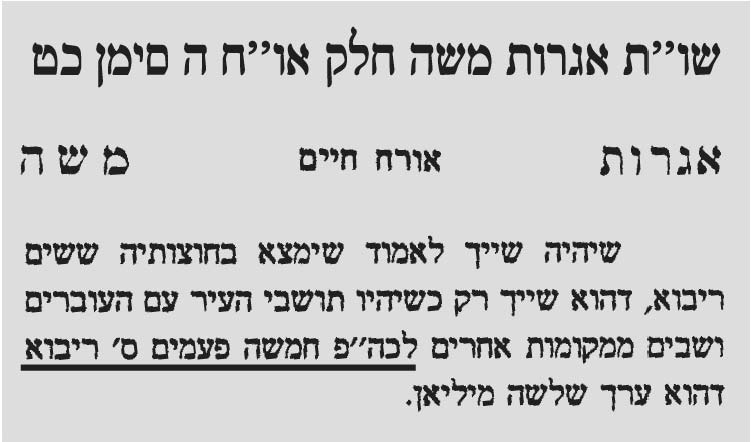
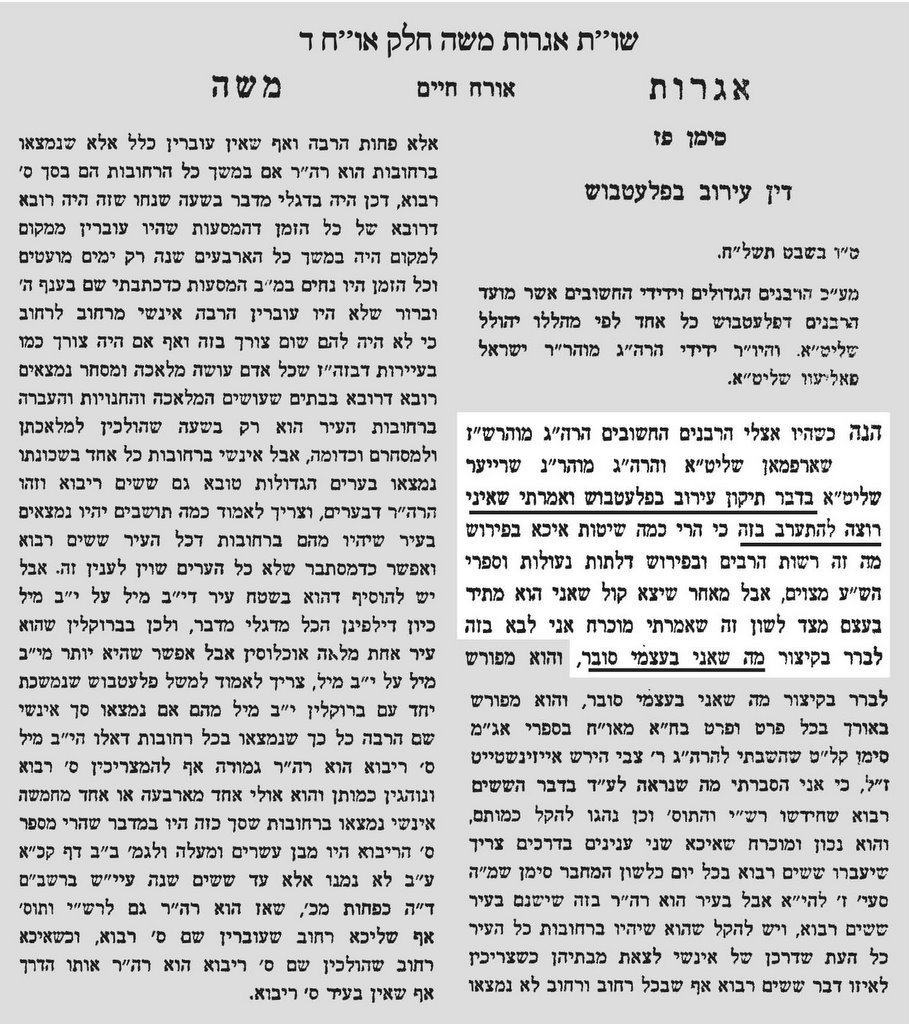
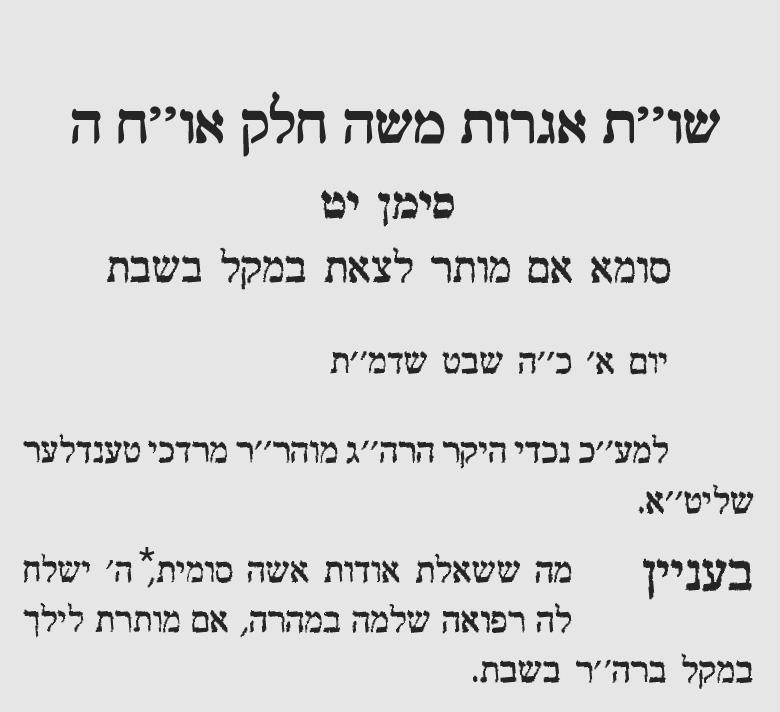
The detractors of eruvin have always claimed that when Hagaon Harav Moshe Feinstein zt”l stated that there is no reshus harabbim today because we rely on the heter of shishim ribo (Igros Moshe, O.C. 3:94, 5:24:10), he certainly did not mean Boro Park or Flatbush. The most illuminating of all his teshuvos is this final one on the issue, regarding a blind woman using a walking stick on Shabbos (ibid., vol. 8, O.C. 5:19). Rav Moshe ends this teshuvah by stating that today we rely on the fact that there is almost no true reshus harabbim. In Kovetz Am HaTorah (1986 no. 11), where this teshuvah was first printed, it clearly states that this woman lived in Boro Park. This very important fact was purposefully omitted from the teshuvah when Igros Moshe volume 8 was printed posthumously!


* Note the omission of the woman’s place of residence.

Saturday, October 08, 2005

The Overwhelming Majority of Rishonim Maintain Lo Asu Rabbim U’Mevatlei Mechitzta

Some think they understand the Rishonim better than the Bais Ephraim and the Gedolie H’Achronim, and that more Rishonim paskin asu rabbim. Therefore, to address this misconception we will list the overwhelming majority of Rishonim who pasken lo asu rabbim: 1. Tosfos (see Bais Ephraim, p. 39b and Avnei Nezer 276:2) 2. Rabeinu Chananel (see Ravyah p. 321) 3. Rambam (17:10, 17:33 and in Mishnayos, Eruvin 2:4) 4. Maggid Mishnah (ibid.) 5. Hagaos Maimones (ibid., basra 9) 6. Ravyah (p. 270) 7. HaEshkol (Eruvin siman 55) 8. Sefer HaBattim (perek 13) 9. Tosfas Ysheinim (Shabbos 6b) 10. Or Zarua (Eruvin 33b) 11. Piskei Mahrach Or Zarua (Eruvin Perek 2 ois 57) 12. Ramak (as cited in Hagaos Ashri, 20b) 13. Rabeinu Chananel Ben Shmuel (Eruvin 22a) 14. Rivevan (Eruvin 22a) 15. Tosfos Rid (Eruvin 22a, and in Piskei 20a) 16. Piskei Ri’az (2:1:6) 17. Sefer HaMeoros (Eruvin 17b).

More so, the Raved, Rabeinu Yonasan, Rashba (who quotes the Raved), Ran, Ramban (see Gaon Yaakov, Eruvin 6), and Meiri (Eruvin 20, 22a) maintain that if we have mechitzos that are omed merubeh al ha’parutz (as opposed to shem daled mechitzos), even Rav Yehudah would agree lo asu rabbim (this was only realized when the aforementioned Rishonim’s Chiddushim were published). [From this we see that the Bais Ephraim and the Chazon Ish were guided min hashomayim. They stated that only the Ritva explicitly states Yerushalyim was omed merubeh al ha’parutz and we pasken asu rabbim like Rav Yehudah which is not contradicted by any of the Rishonim discovered recently.]

The Overwhelming Majority of Achronim Maintain Lo Asu Rabbim U’Mevatlei Mechitzta

Once walls are omed merubeh al haparutz [that is, more than 50 percent of the length of each side must actually consist of a wall] on three sides, nearly all poskim maintain that the multitudes [rabbim] do not negate the enclosure, lo asu rabbim u’mevatlei mechitzta.

What follows is a list of the Achronim who paskin lo asu rabbim u’mevatlei mechitzta: Chacham Tzvi, siman 5, 37; Knesset Yechezkal, siman 2:3; Mayim Rabim, siman 34-36; Maharit Tzahalon, siman 251; Tosfos Shabbos, siman 363; Pri Megadim, Rosh Yoseph, Shabbos 6b; Even HaOzer, Eruvin 6b, 22a; Bais Ephraim, O.C. 26; Noda B’Yehudah, O.C. Mahadura Tinyana, 42 and Teshuvah M’Ahavah, siman 112; She’eilas Yaavetz, siman 7 and Mor U’Ketziyah, siman 363; Shulchan Aruch HaRav, O.C. 363:42, 364:4 and Kuntres Achron, O.C. 345:2; Keren Oreh, Eruvin 7a; Michtam L’David, siman 1; Tiferes Tzvi, siman 11; Chasam Sofer, O.C. 89; HaEleph Lecha Shlomo, siman 181; Aishel Avraham, siman 345; Chai Adam, klal 71:15; Gaon Yaakov, Eruvin 11a, 21a; Chesed L’Avraham, siman 39; Maharham Shick, O.C. 171, 181; Maharia HaLevi, siman 94; Bais Shlomo, siman 43, 51; Tzemach Tzedek, Shabbos 100a and Eruvin, the end of Perek 5; Nefesh Chayah, siman 25; Avnei Nezer, O.C. 273:16, 279:2, 289:2; Aruch HaShulchan, O.C. 364:1; Maharsham, 3:188, 9:18; Yeshuos Malko, siman 21; Harei B’samim, 5:73; Imrei Yosher, siman 102 and Minchas Pitim, siman 364; Kaf HaChaim, O.C. 364:12; Divrei Malkiel, 3:10, 14; Rav Chaim Berlin in Tikkun Shabbos Odessa, p. 28 and in Nishmas Chaim, siman 29; Achiezer, 4:8; Even Yikrah, siman 58, and Chazon Ish, O.C. 74:10, 107:4.

Thursday, October 06, 2005

Part 1: Shishim Ribo According to Hagaon Rav Moshe Feinstein zt”l

Like most poskim, Rav Moshe originally maintained (Igros Moshe, O.C. 1:109) that the criterion of shishim ribo was dependent on the street having shishim ribo traversing it. However, later (ibid., 1:139:5) he formulated his chiddush in which shishim ribo when applied to a city was not dependent on a street but over a twelve mil by twelve mil area. Rav Moshe added that the criterion of shishim ribo ovrim bo would require a sizable population living and commuting into the twelve mil by twelve mil area so that it could physically satisfy the condition of 600,000 people collectively traversing its streets. When these criteria are met, the area would be classified as a reshus harabbim and a tzuras hapesach would not be adequate; dalsos at the pirtzos would be needed. However, at this time Rav Moshe did not quantifying how many people would be required to live in this twelve mil by twelve mil area.

In the first teshuvah quantifying how many people would be required to live in this twelve mil by twelve mil area, Rav Moshe stated (ibid., 4:87) that since in the past eruvin had been erected in cities with populations exceeding shishim ribo, one could not classify a city as a reshus harabbim solely on the basis of the existence of a population of 600,000. He then added that although the actual number of inhabitants could possibly vary according to the city, in Brooklyn it would most likely require four to five times shishim ribo. In the final two teshuvos which followed regarding Brooklyn we see that Rav Moshe codified his chiddush that the requirement is, "just about 3,000,000 people," (ibid., 5:28:5) or, "at least five times shishim ribo," (ibid., 5:29) which could amount to even more than 3,000,000 people. Consequently, in the Chicago eruv pamphlet (West Rogers Park Eruv, 1993 p. 23) it is stated that Rav Dovid Feinstein shlita was in agreement that according to his father's shitah there must be a minimum of 3,000,000 people in order for the city to be defined as a reshus harabbim.

It’s important to note that Rav Moshe maintained the above only regarding shsihim ribo as it applied to a city. However, with regard to a sratya [intercity road] Rav Moshe stated (ibid., 1:139:5, 4:87, 5:28:16) that the shishim ribo would have to traverse the road itself every day.

Sunday, October 02, 2005

The Brilliant Chiddush of the Chazon Ish

Since many people are under the impression that the Chazon Ish’s chiddush ― that there are no cities today that would be classified as a reshus harabbim ― is based only on mechitzos habatim we would like to elaborate on his approach.

The Chazon Ish (O.C. 74:10, 107:4-7) states since, me’d’Oraysa, a break in an enclosure that is omed merubeh does not negate the enclosure, when a street which continues through a city ends, either with houses or a dead end, the whole length of that street with the mechitzos habatim on both sides and its dead end would be considered omed merubeh on three sides, and me’d’Oraysa, a reshus hayachid. As a result, the intersections of that street, which were pirtzos, would halachically be termed k’omed dami, closed. Consequently, all streets that run perpendicular through this street ― which now has three mechitzos and halachically closed intersections ― would in turn be surrounded with three mechitzos themselves, their own mechitzos habatim on both sides of the street and a third wall, the omed of the intersection. This creates a spiraling effect throughout the whole city. The Chazon Ish concludes that there never would be in large cities a reshus harabbim because we would always find one street that is enclosed by three walls. This Chazon Ish is one of the reasons why in Eretz Yisroel eruvin are maintained (Rav Yisroel Yaakov Fisher zt”l in Even Yisroel, 8:36; Kinyan Torah, 4:40, and Rav Chaim Kanievsky shlita in Shoneh Halachos, siman 363).

The Shulchan Aruch Explained

It seems from the Shulchan Aruch (364:2) that if an area encompassed by walls meets the criteria of a reshus harabbim, it would require, at the minimum delasos reuyos l'hinael and a tzuras hapesach would not be sufficient. However, it’s important to note that the Shulchan Aruch is discussing a situation where the area is enclosed by only two mechitzos (a mavoi, see 364:1) and not a walled city. The first opinion of the Shulchan Aruch, the Rif, maintains that to be considered shem daled mechitzos the delasos would need to be neulos ba’laila. According to the second opinion even delasos reuyos l'hinael would suffice to be considered shem daled mechitzos (Rosh Yosef, Shabbos 6b; Even HaOzer, Eruvin 6a, 22a; Shulchan Aruch HaRav, siman 363:42, 364:4; Bais Ephraim, O.C. 26; Avnei Nezer, O.C. 268:4, 276:1, and Chazon Ish, siman 107:4; see also Part 1: Delasos – Me’d’Oraysa or Me’d’rabbanan).

Therefore, if an area is circumscribed with either shem daled mechitzos or three mechitzos omed merubeh al haparutz the Bais Ephraim and all the poskim who paskin like the Chachamim only require a tzuras hapesach at the pirtzos and not delasos reuyos l'hinael.

Saturday, October 01, 2005

Part 1: The Truth About Warsaw

The fact that the city of Warsaw had an eruv is very important to the history of city eruvin since it’s population was greater than shishim ribo. Consequently, the heter to allow an eruv in Warsaw would allow us today to establish eruvin in all large cities. This explains the misinformation disseminated by the anti-eruv camp that the reason why an eruv was permitted in Warsaw was that the Wistula River split the cities population in two and that both sides had less than shishim ribo.

These are the facts:
Rav Shlomo Dovid Kahane zt”l (Divrei Menachem, O.C. vol. 2, pp. 42-43), one of the main rabbanim of Warsaw before World War II, posited that the heter to erect an eruv in a large city such as Warsaw, which was not walled from the year 1877 (Encyklopedia Warszawy, 1994 p. 187), was universally accepted as the streets were not mefulash u’mechuvanim m’shaar l’shaar. More so, he claimed, a small city would have a greater problem establishing an eruv since its streets would be mefulash. In a small city there is usually one main street running straight through the center of the town as opposed to a large city where the streets are generally not straight from city gate to city gate. From the year 1900 Warsaw had a population of more than shishim ribo on one side of the Vistula River which divided the city in two ― the larger side known as Warsaw and the significantly smaller side known as Praga (Rocznik Statystyczny Warszawy 1921 i 1922, 1924 p. 14).

Watch this Space for an Upcoming Exposé

Stay tuned for an exposé on an eruv builder based out of Chicago who travels across America, actively seeking flaws in community eruvin . ...